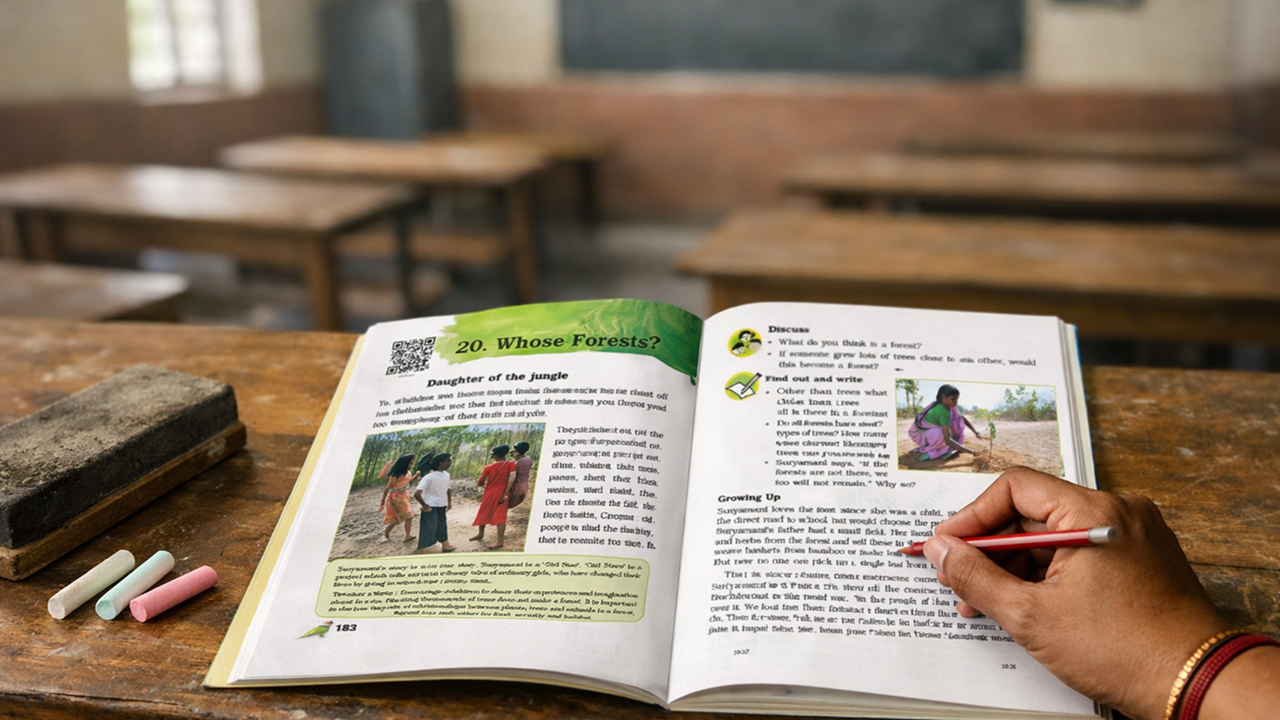



In Chapter 17 (‘Forests: Our Lifeline’) of the Grade VII science textbook (NCERT, Reprint 2024–2025), students read a fictionalised experience of a forest, described through the eyes of Boojho and Paheli, two children of their age.1 When seen from a height, this forest forms such a continuous green cover that the children “could not see any land.” When they enter the forest, they notice that it is cool, shaded, and moist. It is also multilayered as “giant and tall trees constituted the top layer followed by shrubs and tall grasses, and herbs formed the lowest layer.” The children identify a variety of trees, such as sal, teak, red silk-cotton tree (semal), Indian rosewood (sheesham), neem, flame of the forest (palash), fig, cutch tree (khair), Indian gooseberry (amla), bamboo, and orchid tree (kachnar). They hear that animals such as elephants, bison, wild boar, monkeys, and jackals can be spotted in denser parts of the forest. They notice that the floor is covered with a thick layer of dead and decaying plant matter (like leaves, fruits, seeds, twigs, and small herbs).1 Through this example, students learn how forests support biodiversity by providing a habitat for a wide range of plant and animal species, while also helping to regulate the water table, rainfall, and climate.1 In addition to these ecological functions, the chapter introduces the many ways humans benefit from these ecosystems. This is reinforced in Chapter 12 (‘How Nature Works in Harmony’) of the Grade VIII science textbook (NCERT, Reprint 2026-2027), where students read how forests “provide fresh air, fertile soil, food, fibres, timber, and medicines.” 2
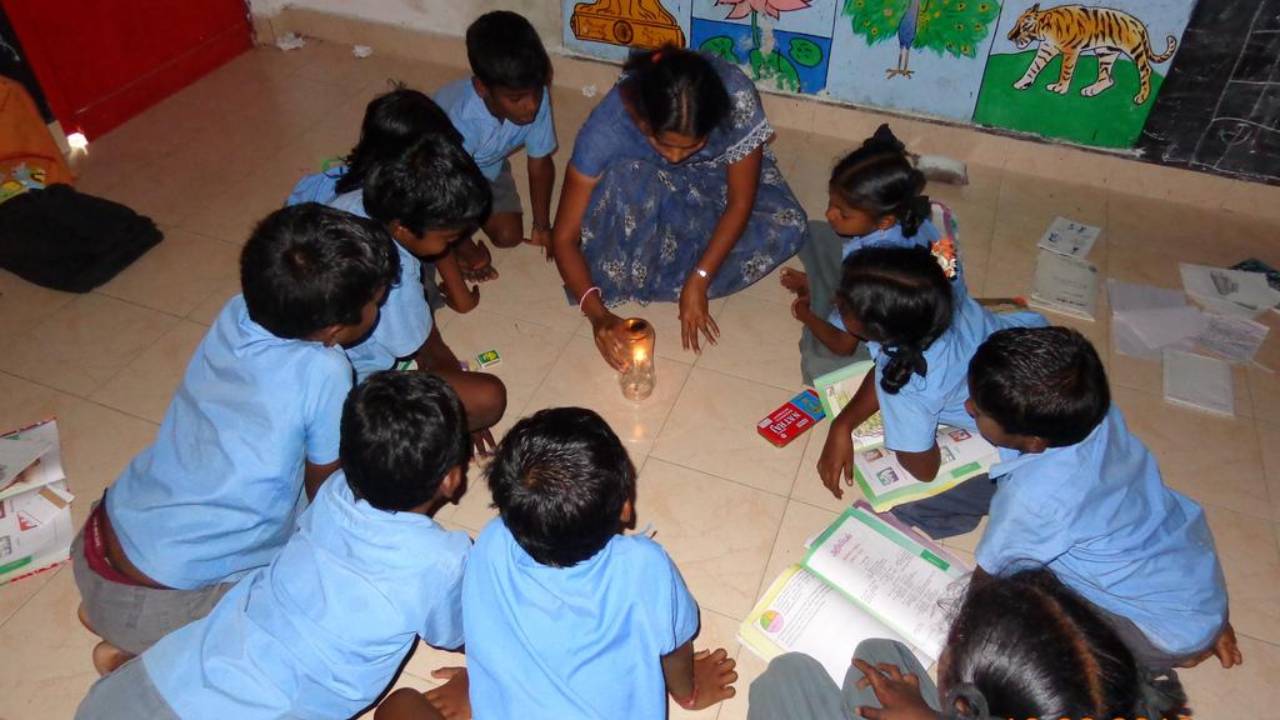
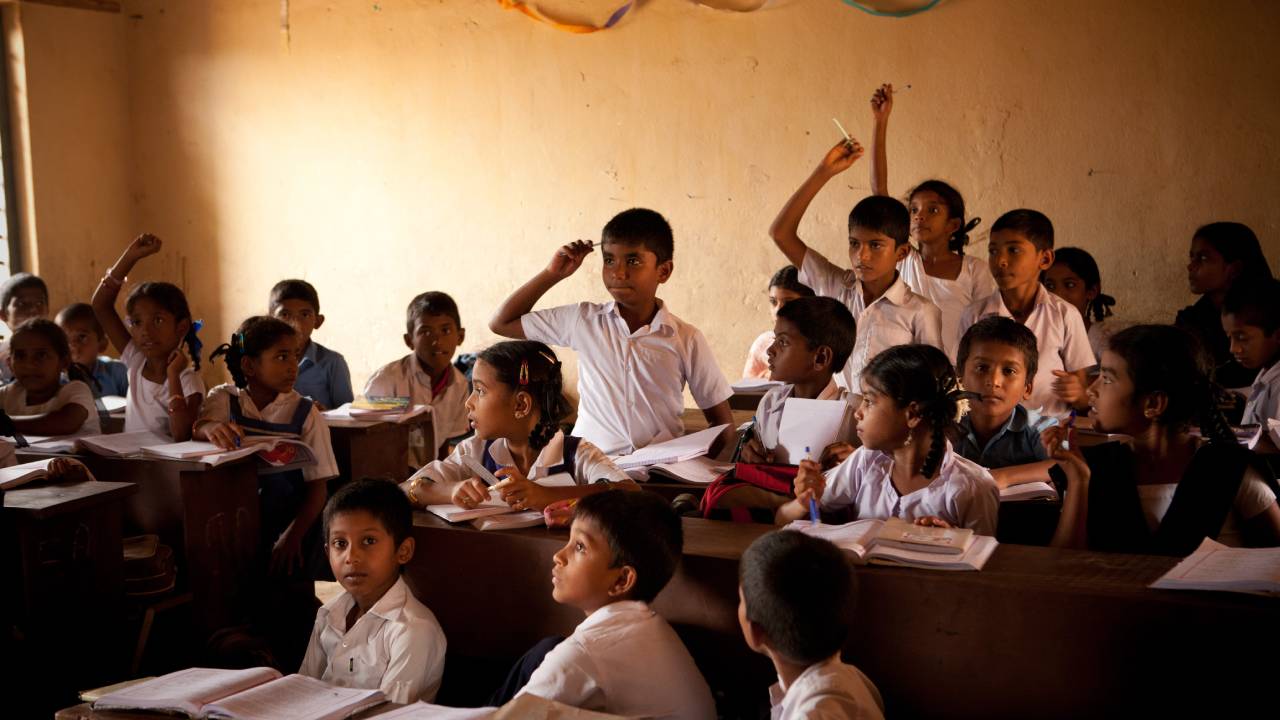
The National Curriculum Framework for School Education (NCF-SE) 2023 emphasises the importance of teachers in connecting classroom learning with the lived experiences of students.3 In practice, however, translating this principle into classroom instruction is not straightforward. Students in many landscapes may not be able to relate to the forest described in their textbook. For example, I was teaching this chapter to 16 students in a small government school in Barmer, Rajasthan. Located on the western edge of India, Barmer is part of the expansive Thar Desert. These children were born and raised in a landscape characterised by sand dunes, sparse vegetation, and hardy plants adapted to extremely arid conditions. How would they be able to connect the elephants and towering trees in the textbook with their lived experience?
The textbook recognises these challenges. Boojho asks: “Would we see similar kind of trees in every forest?” and is told, “No, due to different climatic conditions there are variations in the types of trees and other plants. The types of animals also differ from forest to forest.” It also encourages children to: “visit a forest or a park in your neighbourhood.”1 So this was the question I worked with: How do I design the field component suggested in the chapter? Which ecological spaces in Barmer might help students interpret the concept of forests in their own context?
Reading local landscapes
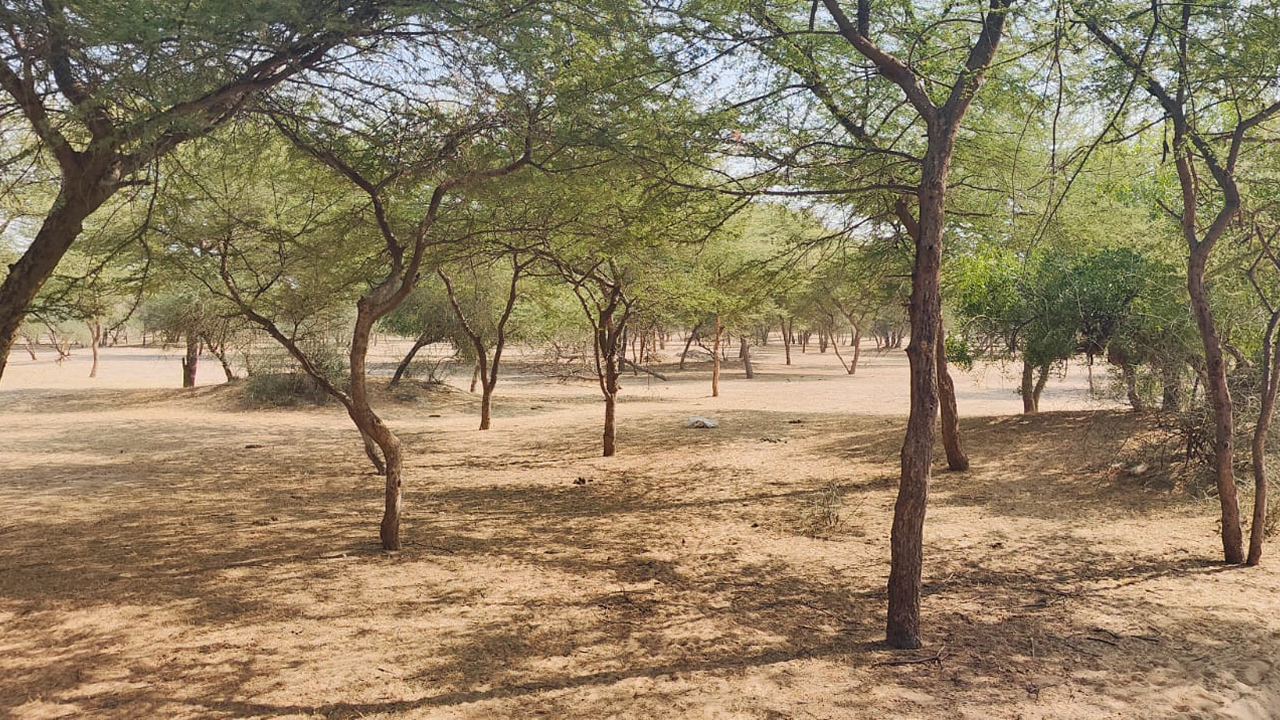
From my colleague Premaram, a naturalist familiar with local ecology, I learnt that Thar Desert’s vegetation is classified into tropical thorn forests, tropical dry deciduous forests, and desert scrublands. These ecosystems are uniquely adapted to very low rainfall, high temperatures, and sandy soils. Some patches are community-managed, including groves called orans and grazing lands called gauchars. Orans are considered sacred spaces, where cutting trees or disturbing the ecosystem is traditionally discouraged through social and cultural practices. This allows these patches to retain native vegetation and support local biodiversity.4 Gauchars, in contrast, are primarily intended for livestock grazing. Yet they, too, support a diversity of plant and animal life. From a documentary called ‘Wild India: Deserts’, I learnt how these ecosystems support conservation projects for endangered species such as the Great Indian Bustard (Rajasthan’s state bird) and Blackbuck.5 Soon after, during a visit to Chohtan, a neighbouring town, I was able to experience an oran firsthand.
With this background, I started the lesson by asking students, “What do you know about forests?” Most students mentioned that forests were places where tigers and lions live. I used a series of questions to broaden this understanding. For example, I asked, “Besides lions and tigers, what else does a forest contain?” The students replied that forests also have large trees and dense vegetation; some mentioned animals like deer, bears, and monkeys. I then asked, “What about humans? Do they have any relationship with forests?” Some students said that people go to forests to collect wood. Many of these responses reflected images that students had encountered in textbooks or media. My next question was, “So, would you think of a forest as a space where plants are in abundance and some wild animals are present?” The students agreed with this definition. Building on this understanding, I asked whether they had visited such spaces. A student immediately said, “Yes, sir, we have a forest in our village.” Another added, “Sir, we call it oran.” A third student mentioned that, in addition to the oran in his village, he had enjoyed a visit to one in Chohtan.
From this point, the classroom became a space of inquiry, moving beyond definitions into lived experiences, social practices, and cultural memories. I learnt that students regularly visit the oran in their village—to play, or to graze goats and cows. When I asked what made this oran a forest, they explained that they had seen many plants and wild animals there. Curious, I asked, “Does the oran really have wild animals in it?” A student replied, “Yes, we have deer there.” Others shared that they had seen peacocks and desert foxes in the oran. Some mentioned seeing dogs attack the deer. One girl told me how she and her friends go there to play every evening and throw stones to chase dogs attacking peacocks and deer. This discussion sparked further questions: What makes an animal wild or domestic? Why do we not keep deer at home? One student explained, “We keep cows because they give us milk.” This led to a discussion about how early humans had domesticated wild animals. Students were able to relate to this because humans and wild animals in this region continue to live in proximity. Since grazing land is limited in Rajasthan, students often take livestock to spaces shared with wildlife. Many described visiting orans during community festivals. I could see a shift in the discussion. While already familiar with orans, students now began to see them as part of a broader ecological idea of a forest ecosystem.
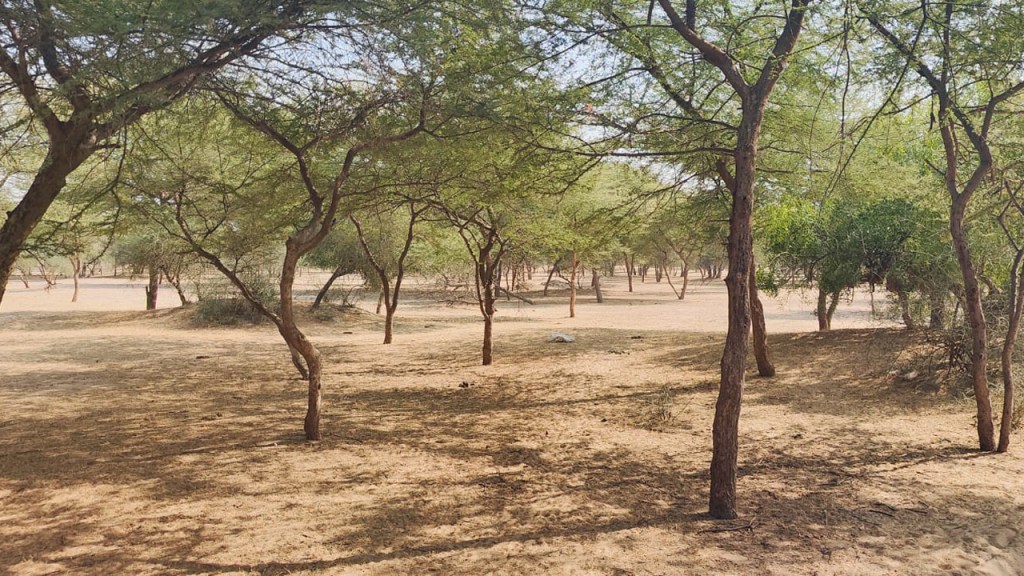
Next, I planned a visit to an oran, spanning nearly two square kilometres, located just 500 metres from the school. This oran is believed to be associated with a local deity, whose temple is situated within the grove. Every year, the deity is honoured through a religious ceremony, and people from different faiths actively participate in these rituals. I discussed the plan for the visit with the school’s science teacher and obtained permission from the principal. Since the visit involved taking students outside the school premises, we also discussed safety guidelines. Students were instructed to cross the road carefully, stay together as a group, and avoid disturbing plants or animals by throwing stones, plucking flowers, or damaging vegetation. These rules were strictly followed for most of the visit. However, when we reached a ber (Ziziphus mauritiana) tree toward the end of our visit, a few students plucked its fruit and shared it with us. Each student was also asked to bring a notebook to record their observations of: “features of stems, leaves, flowers and anything interesting in various plants.“6 This instruction helped ensure that students observed the oran with more careful attention.
Students could name many plants in the oran that were part of their daily lives. Building on this familiarity, we introduced students to the process of sorting plants into trees, shrubs, and herbs. These categories are introduced in Chapter 2 (‘Diversity in the Living World’) of the Grade VI science textbook (NCERT, Reprint 2026-27): “Plants can be grouped into herbs, shrubs, and trees based on their heights, types of stems, and branching patterns.“6 By handling examples of each category in the oran, students soon gained the confidence to engage in this exercise on their own. Their observations of the diversity in shape, size, and arrangement of spines on many local plants sparked one of our most interesting discussions. The science teacher asked students what role these features might play for the plants. The students admitted that they had not thought of this before. To them, spines were simply a common feature of all local plants. When prodded, they suggested that spines might deter animals from grazing on the plant and people from plucking flowers. Since the students had not yet studied transpiration, the teacher explained that plants lose water as vapour through their leaves. The heat and dry air in deserts can accelerate this loss. Leaves modified into spines expose significantly less surface area to the air, reducing water loss. This led students to recognise spines not just as protective structures, but as vital ‘adaptations’ for survival in a hot, dry environment. This concept is introduced in Chapter 2 (‘Diversity in the Living World’) of the Grade VI science textbook (NCERT, Reprint 2025-26): “Biodiversity of different regions varies because of distinct environmental conditions. The special features that enable plants and animals to survive in a particular region are called adaptations.“6 We asked students if they knew of any other such adaptations that allowed local plants to survive in an environment where water is scarce for most of the year (see Fig. 1). This led to a discussion on the deep tap roots and nitrogen-fixing capacity of khejri (Prosopis cineraria), the hardy structure and drought resistance of jaal (Salvadora oleoides), the role of the leafless herb kheenp (Leptadenia pyrotechnica) in stabilising dunes, and the fleshy leaves and thick cuticle of akada (Calotropis procera) and son makhai (Senna alexandrina).
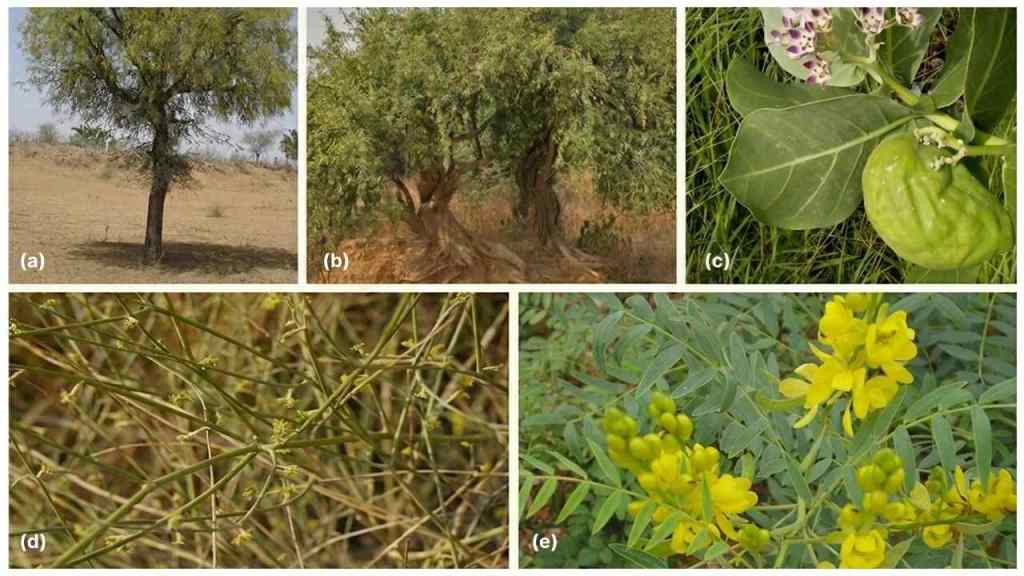
Image details: (a) LRBurdak, Wikimedia Commons. URL: https://commons.wikimedia.org/wiki/File:Khejri.jpg. License: CC BY-SA 4.0 International Deed. (b) J.M.Garg, Wikimedia Commons. URL: https://en.wikipedia.org/wiki/File:Khabbar_(Salvadora_oleoides),_ Hodal_(Faridabad,Haryana)I_IMG_1194.jpg. License: CC BY-SA 3.0 Unported Deed. (c) Wilfredo Rodríguez, Wikimedia Commons. URL: https://commons.wikimedia.org/wiki/File:Algodon_de_seda(Calotropis_procera)3.jpg. Licensea: CC0 1.0 Universal Deed. (d) Dinesh Valke, Wikimedia Commons. URL: https://commons.wikimedia.org/wiki/File:Leptadenia_pyrotechnica(Forssk.) Decne.(31787609488).jpg. License: CC BY-SA 2.0 Generic Deed. (e) Lalithamba, Wikimedia Commons. URL: https://commons. wikimedia.org/wiki/File:Senna_alexandrina_Mill.-Cassia_angustifolia_L.(Senna_Plant).jpg. License: CC BY 2.0 Generic Deed.
While exploring the oran, we observed some camels browsing on the leaves of local trees like desi babul (Acacia nilotica). Students pointed out that these animals moved freely across the landscape, illustrating the open nature of the ecosystem. Although we did not spot any insects, we observed various birds, including peacocks, crows, and eagles, as well as a small group of chinkara (Indian gazelle) in the distance. These sightings sparked a discussion on how orans serve as vital sanctuaries for wildlife in an otherwise sparse environment. Students added to this by describing animals they had encountered during evening visits to their own village orans, such as desert foxes, parakeets, and teetar (Grey francolin). In Chapter 2 of the Grade VI science textbook (NCERT, Reprint 2026-27), students learn that: “The variety of plants and animals found in a particular region contributes to the biodiversity of that region. Each member in the biodiversity of a region has a different role to play. For example, trees provide food and shelter to some birds and other animals, animals help in spreading seeds after eating fruits, and so on.“6 Back in the classroom, students recorded the diversity of plants and animals they had observed in the oran by preparing simple ecological maps. Some of them included notes on the local uses of these plants (see Fig. 2). They mentioned, for example, that ker (Capparis decidua) and ber (Ziziphus mauritiana) provide fruit, shade, and fodder; and akada (Calotropis procera) and son makhai are used for medicinal purposes. These notes led to discussions about how these plants support not only the ecosystem, but also the socioeconomic life of the village (see Box 1).
Box 1. Curricular connections:
Planning classroom instruction around such explorations and discussions can help meet the following:
- Curricular goal for middle-stage science: CG-3: [The student] explores the living world in scientific terms. Specifically, this lesson can help students develop the competency to:
- (C-3.1): “Describe the diversity of living things observed in the natural surroundings (insects, earthworms, snails, birds, mammals, reptiles, spiders, diverse plants, and fungi), including at a smaller scale (microscopic organisms).”
- (C-3.3): “Analyse patterns of relationships between living organisms and their environments in terms of dependence on and response to each other.“3
- Learning objectives for middle-stage students:
- Outline features of forests that are responsible for sustenance of life.
- Design a forest ecosystem by considering a few plants and animals and explaining how they support one another.10
As a follow-up activity, students were asked: How was your village 20–30 years ago? What animals and plants were common then? Can you find someone who has worked to protect trees or forests? This approach of drawing on community memory is touched upon in Chapter 4 (‘Growing up with Nature’) of the Grade IV EVS textbook (NCERT, Reprint 2026-2027), where students read how sacred groves are: “…important places for the community to gather, worship, and celebrate the beauty of nature.“7 They are then encouraged to: “Talk to your elders and find out the rituals in connection to animals and plants which are celebrated in your locality.“7 Although only a few students brought their responses to class, their stories sparked powerful discussions about change, memory, and local stewardship. Students shared stories of village deities, traditional taboos against tree-cutting, and the history of the Bishnoi community, who famously protected trees at the cost of their lives. These oral histories, passed down from elders, illustrated how cultural ethics are intertwined with environmental conservation. Using the example of the godawan (The Great Indian Bustard), we explored the broader issues of habitat loss and communal responsibility. The students observed that villagers do not perceive orans as merely ‘government’ or ‘forest’ land; instead, they regard them as a shared heritage. This collective sense of ownership ensures that people protect local flora and fauna—not because they are told to, but by an internal sense of duty to the land. Connecting these local values to the historic acts of protection by Amrita Devi and Sunderlal Bahuguna helped students see conservation as a living tradition within their own cultural and ecological heritage.8 , 9
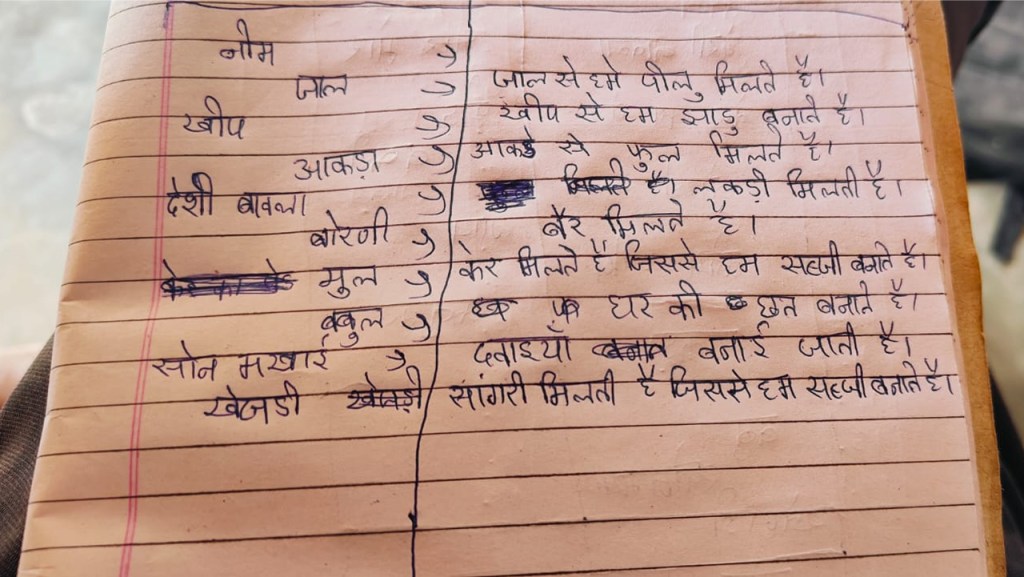
Credits: Nachiket Sandeep Shirude. License: CC BY-NC-ND 4.0 International Deed.
I concluded the lesson by showing a short video of a rainforest in Karnataka, where dense canopy cover and heavy rainfall support a vastly different ecosystem. Contrasting these lush forests with the arid landscapes of Barmer helped students return to the meaning of the term ‘forest’ and understand that it covers a wide variety of ecosystems that can look very different depending on where they are in the world. I also clarified that orans might not always be called ‘forests’ on official maps. But they function just like them by sustaining many different plants and animals in desert environments. Chapter 2 of the Grade VI science textbook (NCERT, Reprint 2026-2027) offers a window for this kind of local connection. In a section on traditionally protected forests, students read that: “Sacred groves are undisturbed patches of forests. Their sizes may vary from quite small to very large. Sacred groves are found all over India. They are home to different kinds of plants and animals, including numerous medicinal plants. These are protected by the local community and no one is allowed to harm any animals and cut trees in these groves, or disturb the area…“6 Students are then encouraged to: “Find out about the sacred groves in your region.“6 This comparison broadened the students’ perspective—instead of viewing forests as only distant habitats for large animals, they began to recognise that the key relationships defining these ecosystems also exist in the familiar landscape of their own community.
Parting thoughts
This experience reinforced the critical role teachers play in bridging the gap between textbook ideas and students’ lived environments. The specific examples of ecosystems that textbooks use to illustrate a concept may provide a useful foundation for discussion, but may be very different from the ecological realities of many regions. By drawing on local landscapes-such as orans, gauchars, wetlands, or grasslands-teachers can anchor scientific concepts in the world students see every day. In the arid landscape of Barmer, for example, the oran served as a powerful lens for exploring ecosystems, biodiversity, and adaptation. Here, the concept of a ‘forest’ did not need to be abandoned or simplified; it simply needed to be translated through the ecological features of the local landscape. When students begin to see their own surroundings as sites of ecological significance, science becomes both relevant and deeply engaging. It allows students to appreciate that even in a dry, thorny desert, vital ecological lifelines are present all around. Fostering this connection requires only the curiosity and care to help students see the landscapes they already know in a new light.
Key takeaways
- Textbook descriptions of forests often draw on the dense vegetation and wildlife typical of wetter regions. Teachers play an important role in helping students interpret this concept by instead connecting it to ecological spaces in their own surroundings, such as orans and gauchars in the Thar Desert.
- Local landscapes provide opportunities for students to observe ecological relationships directly. In arid environments, teachers can use features such as thorns and deep roots to discuss plant adaptations to heat, grazing pressure, and water scarcity.
- Community practices associated with spaces such as orans show how local beliefs and traditions contribute to protecting ecological habitats. Discussing the cultural significance of these spaces helps students see conservation not only as a formal policy goal, but also as a practice embedded in their everyday social life.
Acknowledgements
The i wonder… team thanks Amol Anandrao Kate from Azim Premji Foundation for sharing this draft with us and for his support in publishing it.
Notes
- Credits for the image (A view of the oran near school) used in the background of the article title: Nachiket Sandeep Shirude. License: CC BY- NC-ND 4.0 International Deed.
- This article includes one classroom resource: Activity Sheet: Reading a Local Landscape.
References
- National Council of Educational Research and Training (Reprint 2024–2025). ‘Chapter 17: Forests: Our Lifeline’. Science: Textbook for Grade VII: 207-219. URL: https://www.jsscacs.edu.in/sites/default/files/Files/7-Science-NCERT-Chapter-17.pdf.
- National Council of Educational Research and Training (Reprint 2026-27). ‘Chapter 12: How Nature Works in Harmony’. Curiosity— Textbook of Science for Grade VIII: 190-209. National Council of Educational Research and Training. URL: https://ncert.nic.in/textbook. php?hecu1=12-13.
- National Council of Educational Research and Training (2023). ‘National Curriculum Framework for School Education (NCF-SE)’. National Council of Educational Research and Training. URL: https://ncert.nic.in/pdf/NCFSE-2023-August_2023.pdf.
- Singh, A., & Sisodia, P. (n.d.). ‘Oran—A traditional biodiversity management system in Rajasthan’. LEISA India. URL: https://www.leisaindia.org/ oran-a-traditional-biodiversity-management-system-in-rajasthan/.
- BBC Earth (2012). ‘The Desert Kingdom’. Wild India. Documentary film episode. BBC Studios.
- National Council of Educational Research and Training (Reprint 2026-27). ‘Chapter 2: Diversity in the Living World’. Curiosity—Textbook of Science for Grade VI: 9-34. URL: https://ncert.nic.in/textbook.php?fecu1=2-12.
- National Council of Educational Research and Training (Reprint 2026–2027). ‘Chapter 4: Growing up with Nature’. Our Wondrous World, EVS Textbook for Grade IV: 57-68. URL: https://ncert.nic.in/textbook.php?deev1=4-10.
- Food and Agriculture Organization (FAO) of the United Nations (n.d.). ‘The cultural and symbolic importance of forest resources’. URL: https:// www.fao.org/4/t9450e/t9450e06.htm.
- Choudhary, D., & Choudhary, S. (2023). ‘An analytical review of ORANS: The traditional knowledge of conservation and management of natural environment’. Journal for ReAttach Therapy and Developmental Diversities, 6(1): 1240–1245. URL: https://doi.org/10.53555/jrtdd. v6i1.2615.
- Central Board of Secondary Education (2020). ‘Teachers’ Resource for Achieving Learning Outcomes, Classes 1 to 10’. URL: https:// cbseacademic.nic.in/web_material/Manuals/TeachersResource_LODoc.pdf.