


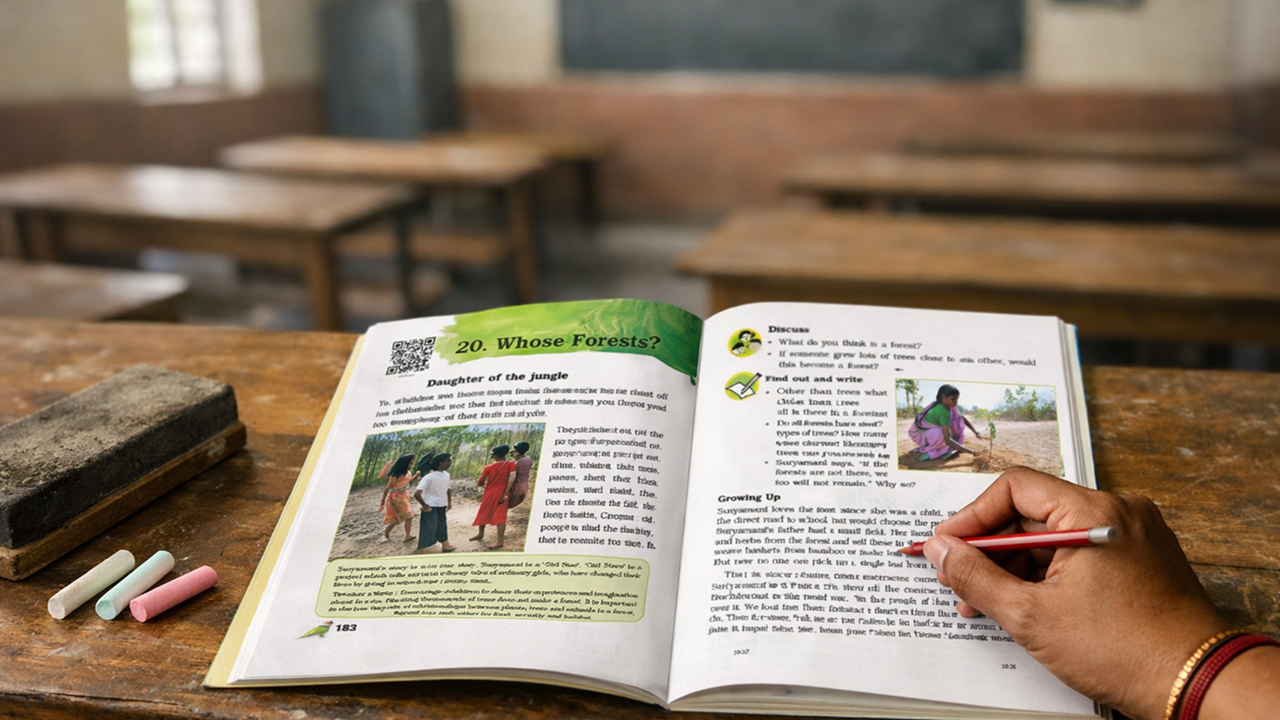
Textbooks play a central role in helping many practising school teachers across India meet the aims of the curriculum.1 However, textbooks are often designed for a broad readership (for example, NCERT textbooks are written for students across India). When children in geographically distinct areas, like Uttarakhand, study ecological themes from these books, the teacher’s role becomes critical. Rather than read from the textbook, teachers are required to interpret textbook content in classroom instruction in ways that both meet the broader aims of school education and connect learning to local contexts.2 This raises important questions for teachers: How do we identify where the textbook content might fall short of curricular aims? What direction do policy documents offer to teachers engaged in this work? In this article, I explore these questions through a specific example for government school teachers in Uttarakhand. This example is based on Chapter 20 (‘Whose Jungle?’) from the Grade V EVS textbook (NCERT, 2024–25), which introduces students to questions of nature, community life, and social responsibility.3
Where teacher work is needed
The National Curriculum Framework (NCF) 2005 defines six criteria that can be used to review how effectively EVS and science textbook chapters meet curricular aims. I used these criteria to review the chapter on forests:
- Content validity: This criterion “requires that the curriculum must convey significant and correct scientific information. Simplification of content, which is necessary for adapting the curriculum to the cognitive level of the learner, must not be so trivialised as to convey something basically flawed and/or meaningless.” 2 In the chapter, children are introduced to forests through the true story of Suryamani, a woman from the Kurukh tribal community in Jharkhand; a letter written to the Chief Minister of Odisha by Sikhya, a Class X student from the state; and the story of Saima Sir and jhum farming in Mizoram. These aspects address content validity because they draw attention to:
- Whose lives are represented in the textbook (introducing forests through the experiences of forest-dependent communities);
- What forms of knowledge are treated as important (including community knowledge, forest-based livelihoods, and cultural practices);
- How science is positioned in relation to society (by linking ecology with livelihood and identity).
Among these narratives, Suryamani’s story is likely to be most culturally relatable for students in Uttarakhand. She shares a close relationship with the forest and, through education, works to strengthen both her own identity and that of her community. Every Sunday, she takes children from her village into the forest to help them learn about wild plants and animals. This allows them to see the forest not only as a source of livelihood, but also as an integral part of everyday life: “Suryamani always says, “To learn to read the forest is as important as reading books.” She says, “We are forest people (Adivasis). Our lives are linked to the forests. If the forests are not there, we too will not remain.” 3 The chapter also refers to her setting up a community centre called ‘Torang’ (meaning ‘forest’ in the Kurukh language), where people are encouraged to value their songs, dances, dress, language, literature, and traditional musical instruments.3 From a curricular perspective, this content aligns with the emphasis in NCF 2005 on diversity, inclusion, and knowledge embedded in social life.
- Cognitive validity: This criterion “requires that the content, process, language, and pedagogical practices of the curriculum are age appropriate, and within the cognitive reach of the child.”2 Much of the information presented in the chapter appears appropriate for Grade V students. Because it draws closely on community life, children in many Uttarakhand classrooms are likely to find this content very relatable, easily connecting it to their own experiences.
However, the chapter also introduces some ideas that may be difficult given children’s prior knowledge and level of understanding. For example, questions under the heading “Think” are intended to encourage reflection and analysis. One such question asks: “Collect reports about forests from newspapers. Did you find any news about how the cutting down of forests affects the weather? How?” 3 While Grade V students can collect news reports and identify some visible effects of deforestation, the second part of the question assumes some prior understanding of climate change and long-term environmental processes. Without additional explanation, this expectation may be beyond the cognitive reach of many children at this level.
Apart from words that come directly from tribal vocabulary, the chapter’s language is largely simple and accessible. However, the Hindi version uses certain words—such as ‘halaat’ and ‘pansari’—that might be unfamiliar to students in Uttarakhand. The word ‘scholarship’ could be replaced with an appropriate Hindi term. Finally, while using ‘chawal’ to refer to the crop is acceptable, ‘dhan’ is more accurate in discussions on sowing.
- Process validity: This criterion “requires that the curriculum should engage the learner in acquiring the methods and processes that lead to the generation and validation of scientific knowledge and nurture the natural curiosity and creativity of the child in science. Process validity is an important criterion since it helps the student in ‘learning to learn’ science.” 2
The story of Suryamani’s struggle, the dialogue between her and Maniya Chacha, the words of Budhiyamai, and the letter written by Sikhya to the Chief Minister all provide opportunities for children to engage with how scientific knowledge is created and validated. Drawn from lived experience and traditional knowledge, these examples invite children to reflect, question, and make sense of ideas, rather than simply accept information. Through these narratives, the chapter supports the development of reasoning and encourages engagement with evidence, enquiry, and understanding.
- Historical validity: This criterion “requires that the science curriculum be informed by a historical perspective, enabling the learner to appreciate how the concepts of science evolve over time. It also helps the learner to view science as a social enterprise and to understand how social factors influence the development of science.” 2 This chapter includes a brief box on the Forest Rights Act, 2006: “People who have been living in the forests for at least 25 years, have a right over the forest land and what is grown on it. They should not be removed from the forest. The work of protecting the forest should be done by their Gram Sabha.” 3
Beyond this, however, historical context is largely absent. There is little indication that control over forests and the rights of forest-dependent communities have been contested for a long time. For example, it would have been relevant to mention that forest laws introduced during British rule placed forests under state control, restricted customary access, and altered long- standing relationships between forest-dependent communities and forest land. After independence, these struggles did not disappear; they continued through changing policies related to conservation, development projects, and displacement, leading to ongoing debates about forest rights.4 Since the chapter focuses on rights over forests, the absence of such context makes the discussion appear disconnected from the longer history through which these rights have emerged. Even brief references to a few key developments from the colonial period to the present could have helped students see forest rights as part of an ongoing social and historical struggle.
- Environmental validity: This criterion “requires that science be placed in the wider context of the learner’s environment, local and global, enabling him/her to appreciate the issues at the interface of science, technology and society, and equipping him/her with the requisite knowledge and skills to enter the world of work.” 2 The chapter describes the practice of jhum farming in North-East India: “After cutting one crop, the land is left as it is for some years. Nothing is grown there. The bamboo or weeds which grow on that land are not pulled out. They are cut and burnt. The ash makes the land fertile. While burning, care is taken so that the fire does not spread to the other parts of the forest. When the land is ready for farming it is lightly dug up, not ploughed. Seeds are dropped on it. In one farm different types of crops like maize, vegetables, chillies, rice can be grown. Weeds and other unwanted plants are also not pulled out; they are just cut. So that they get mixed with the soil. This also helps in making the soil fertile. If some family is not able to do farming on time, others help them and are given food.” 3 This description provides teachers with an opportunity to discuss how farming practices are shaped by environmental conditions and community needs. For example, jhum farming is used by communities living in tropical and subtropical forest regions, especially in Northeast India and neighbouring parts of South and Southeast Asia. It has evolved in response to specific ecological conditions and social arrangements. This discussion can also help children appreciate how people can work with their environment rather than against it. Teachers can strengthen this understanding by relating jhum farming to local agricultural or forest-based practices familiar to students, helping them notice similarities and differences across regions.
- Ethical validity: This criterion “requires that the curriculum promote the values of honesty, objectivity, cooperation, and freedom from fear and prejudice, and inculcate in the learner a concern for life and preservation of the environment.” 2 In this chapter, ethical validity is reflected in how the three narratives are presented. Suryamani’s life and cultural practices, for example, are shown in a positive and respectful manner. She is portrayed as someone who strongly advocates holding on to one’s culture while also working to connect her community with wider society.3 Through such portrayals, the chapter supports the development of values related to cooperation, dignity, and environmental responsibility.
Box 1. Curricular connections:
This assessment can support teachers in planning classroom instruction that meets the following curricular goals for preparatory-stage EVS:
- CG-1: [The student] explores and engages with the natural and socio-cultural environment in their surroundings. Specifically, this lesson can help students develop the competency (C-1.2) to: “Describe relationships (including between humans and animals/nature) and traditions (art forms, celebrations, festivals) in the family and community.”
- CG-2: [The student] understands the interdependence in their environment through observation and experiences, developing the basis for appreciation of the idea of ‘Vasudhaiva Kutumbakam’. Specifically, this lesson can help students develop the competency (C-2.2) to: “Describe the relationship between the natural environment and cultural practices in their immediate environment (nature of work, food, festivals, traditions).”
- CG-4: [The student] develops sensitivity towards social and natural environment. Specifically, this lesson can help students develop the competency to:
- (C-4.2): “Observe and describe cultural diversity in their immediate environment (food, clothing, games, different seasons, festivals related to harvest and sowing).”
- (C-4.3): “Describe usage of natural resources in their immediate environment.”
- (C-4.4): “Demonstrate how natural resources can be shared, maintained, and conserved (trees, use of rainwater, benefits of millets).”
- (C-4.6): “Identify the needs of people in different situations—in terms of access to resources, equal opportunities, work distribution, and shelter.‘ 2
Assessing a textbook chapter through these criteria can help teachers plan their role in classroom instruction more effectively. By seeing the kind of learning the chapter content makes possible in the classroom, this exercise allows teachers to identify where explanation, discussion, local examples, or additional context may need to be provided for students to fully engage with the curriculum (see Box 1). For example:
- Bridging Concepts: Concepts related to deforestation and environmental change may not be immediately clear to all children. Teachers can begin with examples from nearby forests, farms, or fields, encouraging children to share observations before introducing new terms or explanations.
- Adding Historical Context: Since the chapter provides limited historical information, teachers may need to briefly explain that forest use and forest laws have changed over time. Even simple references can help children understand that such issues did not arise suddenly, but have developed through social and political processes.
- Connecting Local Experiences: Although Suryamani’s story is set in Jharkhand, its themes of forest dependence and community knowledge are common to states where forests are a central aspect of life. For example, according to the India State of Forest Report 2023, Uttarakhand’s total forest and tree cover is around 43.7% of the state’s geographical area.5 Except for some urban areas, many children in the state are familiar with forests through family work, local travel, or community practices. In such states, therefore, teachers have many opportunities to connect Suryamani’s experiences with those of their own students. Her statement, “If the forests are not saved, we will not be saved either,” provides a useful starting point for class discussion.3 Children can be encouraged to talk about what forests provide, what recent changes have been noticed by their community, and what elders in their families say about these changes. Giving time for such discussions to develop will help make the lesson more meaningful.
- Contextualising Culture: The chapter also introduces ideas related to culture and community life. When children read about the Torang centre and the pride taken in traditional practices, teachers can help them think about what culture means in their own context (see Fig. 1). Teachers can also draw attention to how the festivals, food habits, and folksongs of agricultural communities are centred around crops and seasons, whereas those of fishing communities revolve around water bodies and aquatic life. Such discussions can help children see culture not as a fixed set of practices, but as a dynamic aspect of everyday life shaped by livelihood and environment. While helping students appreciate their own culture, teachers can also foster respect for different ways of living, taking care not to reduce other cultures to stereotypes.
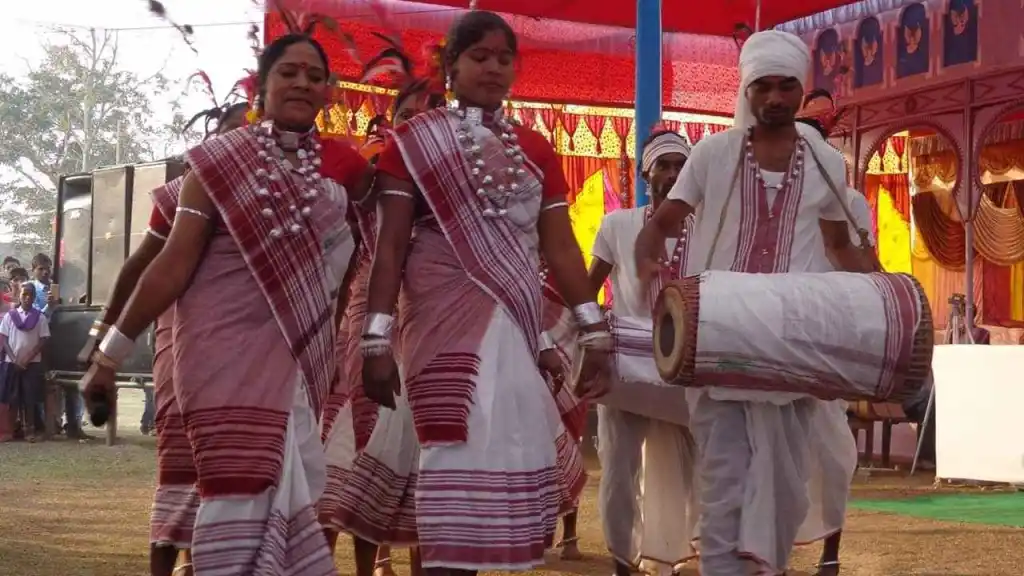
Credits: Rocky international,A Wikimedia ComAmons. URL: https://commons.wikimedia.org/wiki/File:Kurukh_dance_of_ Oraons_.jpg. License: CC BY-SA 4.0 International Deed
Parting thoughts
While NCERT textbooks are written for children across the country, this chapter leaves space for teachers to connect its main ideas with local realities. When classroom instruction draws on local forests, livelihoods, and experiences, teachers help children move from information in the textbook to lived understanding. This allows students and teachers to explore large issues, such as deforestation, in their everyday lives. This engagement with local experience can then be used to return to wider national questions-such as changes in forest use, development pressures, and policies that affect forest-dependent communities across India. To support such learning, teachers need to continue developing their own understanding, remain attentive to students’ experiences, and make space for discussion in the classroom. Through such an approach, students can begin to develop a broader sense of belonging that connects their local experiences with national concerns within a democratic framework.
Key takeaways
- Curricular documents view textbook chapters like ‘Whose Jungle?’ as a starting point for learning about forests. Teachers are expected to interpret such chapters with an approach that bridges the gap between broad national goals and the local realities of their classrooms.
- Teachers can identify the strengths and limitations of this textbook chapter by reviewing it against the curricular criteria described in NCF 2005. These criteria help teachers assess whether the content is accurate, age-appropriate, historically informed, and relevant to their students’ environment.
- Since this chapter is written for students across India, it highlights examples from diverse regions or communities. Teachers play a vital role in helping students connect distant textbook narratives to the landscapes and cultural practices in their own surroundings.
- Planning classroom instruction in this way opens opportunities for deeper learning. This helps students link what they read about forests in this textbook chapter with broader questions about the environment, livelihoods, and society.
Acknowledgements
The i wonder… team thanks Santosh Singh Mehta from Azim Premji Foundation for sharing this draft with us and for his support in publishing it. We also thank Rajesh Utsahi from Azim Premji University for his support in translating the original draft (in Hindi) into English.
Notes
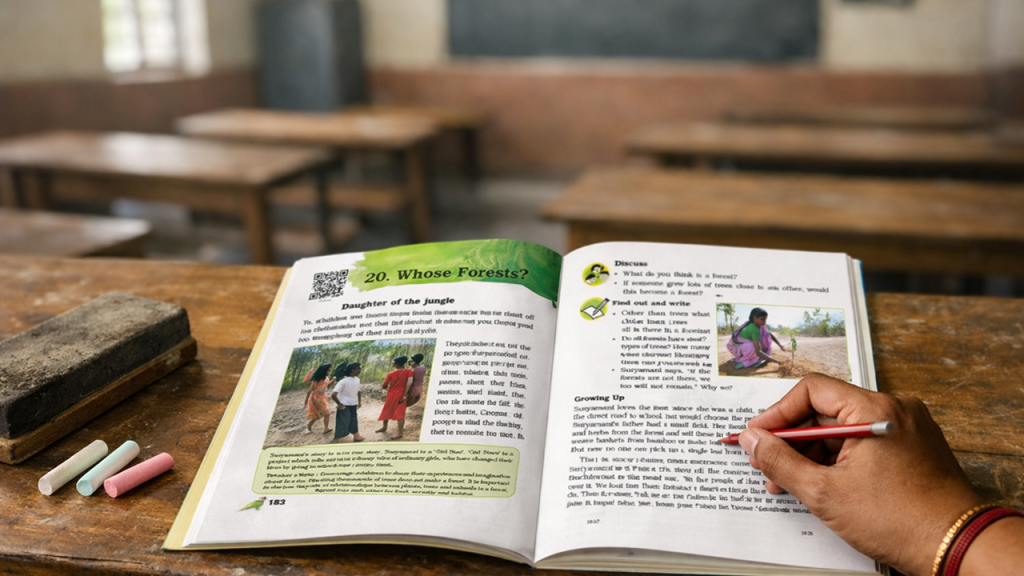
Credits for the image (Teacher reading the textbook) used in the background of the article title: Created for i wonder… using ChatGPT, under prompting by Chitra Ravi (Mar 2026). License: CC BY-NC-ND 4.0 International Deed.
References
- National Council of Educational Research and Training (2005). ‘National Curriculum Framework 2005’. National Council of Educational Research and Training. URL: https://ncert.nic.in/pdf/nc-framework/nf2005.pdf.
- National Council of Educational Research and Training (2023). ‘National Curriculum Framework for School Education (NCF-SE)’. National Council of Educational Research and Training. URL: https://ncert.nic.in/pdf/NCFSE-2023-August_2023.pdf.
- National Council of Educational Research and Training (Reprint 2024–2025). ‘Chapter 20: Whose Jungle?’. Looking Around: Environmental Studies, Textbook for Grade V: 182–191. URL: https://ncert.nic.in/textbook/pdf/eeap120.pdf.
- Guha, R. (1989). ‘The Unquiet Woods: Ecological Change and Peasant Resistance in the Himalaya’. Oxford University Press.
- Forest Survey of India (2023). India State of Forest Report 2023. Ministry of Environment, Forest and Climate Change, Government of India. URL: https://fsi.nic.in/isfr-2023.