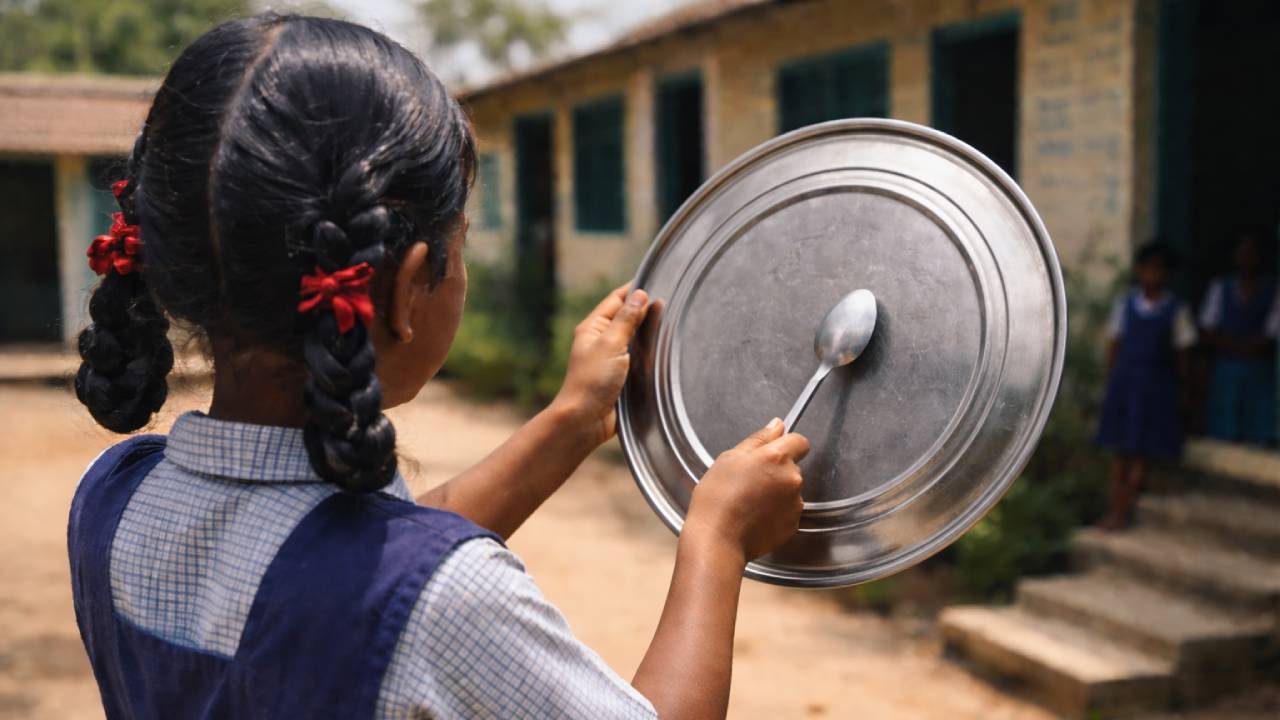




The middle-stage science curriculum introduces students to two important themes: light and heat. The connection between the two is explored in Chapter 7 (Heat Transfer in Nature’) of the Grade VII science textbook (NCERT, Reprint 2026-27) through this fictional, but relatable example, “Pema and her brother Palden reside in Gangtok. On a cold winter evening, they are sitting around a fireplace… They felt warm.“1 Pema asks: “I wonder how heat from the fire reaches us?“1 This example is used to introduce students to the process of radiation: “…heat transfer, in this case, takes place directly from the fire (hot object) to us.“1
To see if my students recognise this connection, I asked, “Can light heat things?” They respond confidently: “Yes!” I followed up with the question: “How do you know this?” The room becomes quieter. Then, students begin to share observations from their everyday world: “A metal bench left in the Sun becomes hot“, “dark-coloured clothes feel warmer than light-coloured ones“, and “on a sunny day, the ground can feel too hot to walk on barefoot.” Then, I ask: “How does sunlight heat things?” There is more hesitation before students respond: “Because the Sun is hot“, or “because sunlight is hot.” These responses are related to what students read about light in Chapter 12 (‘Beyond Earth’) of the Grade VI science textbook (NCERT, Reprint 2026-27): “The Sun is a star. It is the star closest to us. It is an extremely hot spherical ball of gases. The Sun gives out a huge amount of energy, and that is why it glows so brightly. The Sun produces heat and light, and is the main source of energy on the Earth.“2
This suggested that the students recognised familiar experiences—that the Sun gave both light and heat, and that some objects became warm in sunlight. However, they were less certain about how this heating happened. How could I help my students think more clearly about the connection between heat and light?
Creating a tangible experience
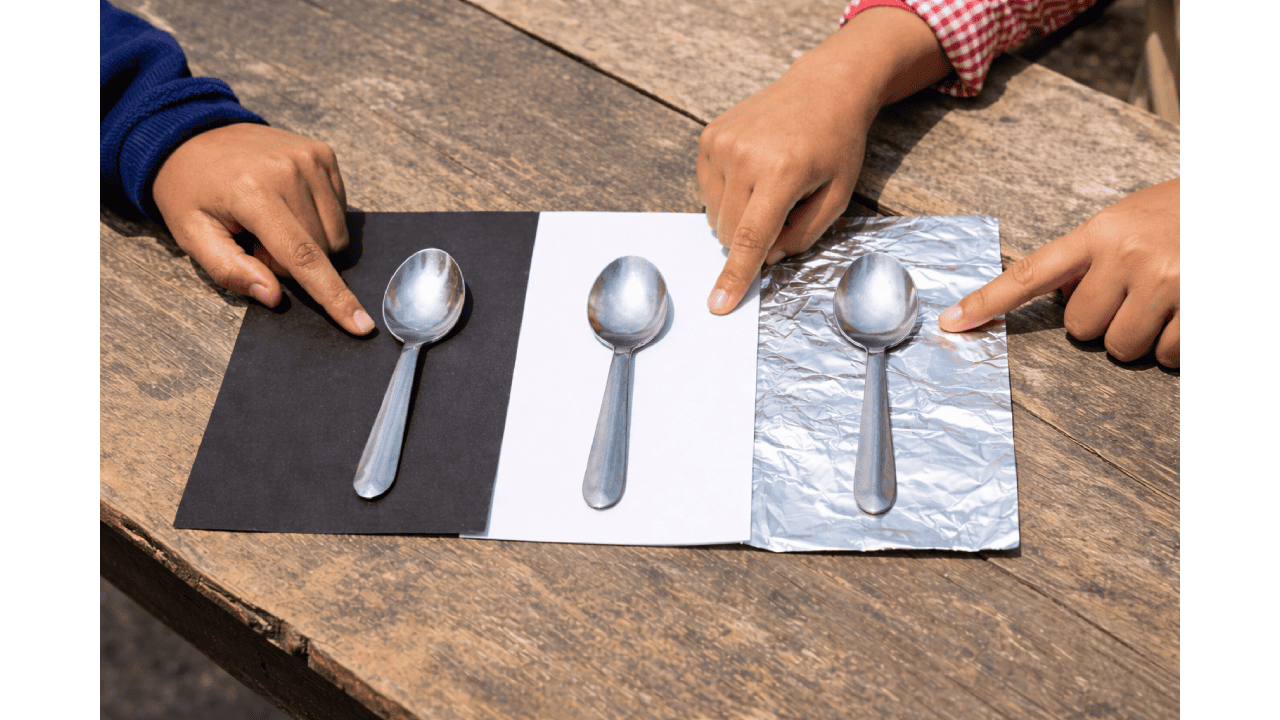
We designed a simple classroom activity using materials commonly available in government schools (see the Activity Sheet). In this activity, students place near-identical objects (like metal spoons) on different surfaces (black paper, white paper, and aluminium foil) and expose them to sunlight. After about 15-20 minutes, students are invited to touch the objects and compare their warmth.
I start the activity by placing the setup in the Sun. Then I ask students: “What do you think would happen to the metal spoons after 20 minutes?“
Students respond: “They will become warm.”
“Why? Where will the heat come from?“
Students respond confidently: “From the Sun.“
I ask a different question: “Is there some way I can show that the heat is coming from the Sun and not from any other part of the setup?“
Some students respond, “Keep it in the shade.“
“If we kept an identical setup in a cool, dark part of the school, can you predict what would happen to the three spoons?” Many students respond, “Nothing,” and “The spoons would not heat up.”
“So when the spoons are kept under the Sun, they will heat up. This does not happen when they are kept in the shade. Are you all sure that the heat comes from the Sun?“
“Yes,” the students respond.
I ask: “Is the Sun in contact with the spoons?“
“No.“
“Then how does heat from the Sun reach the spoons?“
There is silence as students think about this. Then one of them suggests, “Maybe it is carried by air.“
“What is the process of transfer of heat by air called?” I ask.
There is silence. At this point, I remind them that Chapter 7 of the Grade VII science textbook (NCERT, Reprint 2026-27) introduces them to three ways in which heat is transferred “from one place to another“: conduction, convection, and radiation.1 I also summarise the difference between the three ways on the board (see Table I).
| Conduction | Convection | Radiation | |
|---|---|---|---|
| Needs the two objects to be in physical contact with each other | Yes | No | No |
| Needs some material (like a liquid or a gas) to move between the two objects and carry heat with it | No | Yes | No |
Then I ask students the same question I had asked previously: “What is the process of transfer of heat by air called?” Now, some students respond, “Convection.”
“Is this what could be happening with the spoons kept in sunlight?” I ask.
Many students say, “Yes.“
I go back to an earlier part of the discussion. “On a sunny day, if you stand in the Sun and then step into the shade, what changes immediately?“
The students respond, “It feels cooler in the shade.“
I ask: “Has the air changed suddenly?“
I see students consider the question before saying, “No.“
“For heat from the Sun to be carried to our setup by air, the air would need to move between the two. When we step into the shade, we feel cooler even though the air is still there.“
I let students think about this for a few minutes before I draw their attention to this part of Chapter 7 of the Grade VII science textbook (NCERT, Reprint 2026-27): “Heat from the Sun reaches the Earth through radiation.“1 This process is described in a little more detail: “Do you remember when Pema and Palden were sitting around the fireplace? They felt warm. Their grandfather tells them that the heat transfer, in this case, takes place directly from the fire (hot object) to us by a process known as radiation. The heat of the Sun reaches us through this process. Heat transfer by radiation does not require any medium.“1
I invite students to test their prediction about the spoons. They touch the spoons and share their observations: “The spoon on the black paper is hotter,” and “the foil one is not very warm.”
“You predicted that spoons kept in the sunlight would become warm and ones kept in the shade would not. All three spoons are made of the same material and are nearly identical in shape and size. Shouldn’t all the spoons feel equally warm?“
Some students responded: “Yes.“
“Why does this not happen? Can you see any difference between them?” I ask.
A student replies, “Is it because of the paper beneath them?” I invite the student to elaborate. Other students join in, and we discuss different ideas. A student comments that the foil may be “sending light away.” Another student says, “Shiny objects send back light.” This revealed their prior understanding of an idea that is explored in an activity in Chapter 11 (‘Light: Shadows and Reflections’) of the Grade VII science textbook (NCERT, Reprint 2026-27), where students are invited to observe the effect of shining light on a shiny surface like a metal plate. This activity is used to introduce the idea that: “a shiny surface or a mirror changes the direction of light that falls upon it. This change in direction of light by a mirror is called the reflection of light.“3 I ask students if they can think of other shiny materials that would have the same effect as the foil. We discuss some examples (such as steel utensils, tin roofs, mirrors, and the shiny wrappers used in some potato chip packets) from their everyday experience.
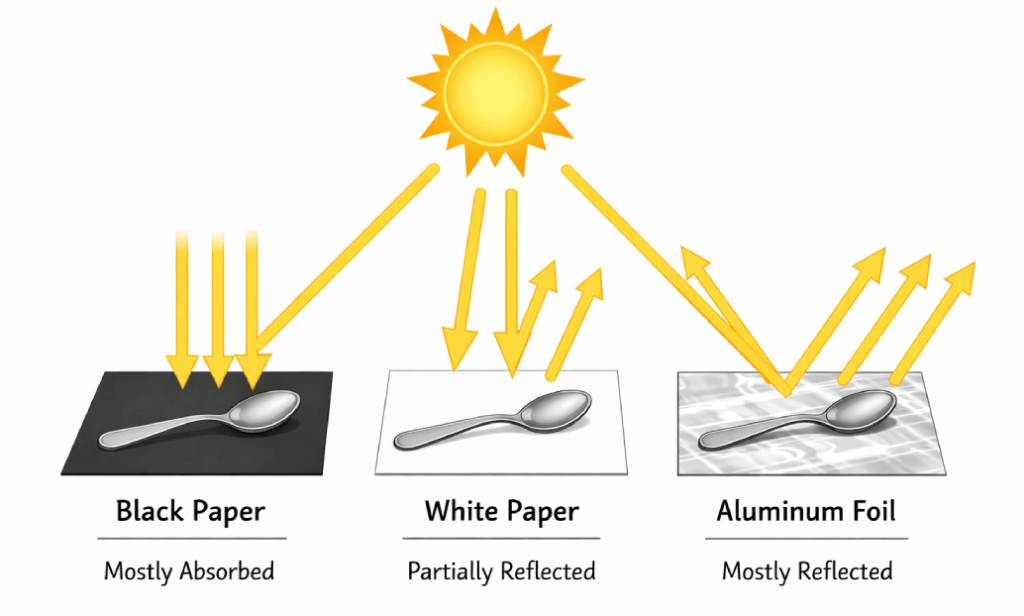
Then I ask, “What about the black and white paper?” Some students say that black paper “takes in” more light than white paper. I draw their attention to what they read in Chapter 7 of the Grade VII science textbook (NCERT, Reprint 2026- 27): “Light-coloured clothes reflect most of the heat that falls on them, and therefore, we feel more comfortable wearing them during summers. Dark surfaces, on the other hand, absorb more heat, and therefore, we feel more comfortable with dark-coloured clothes during winters.“1 This explanation uses the terms ‘heat’ and ‘light’ somewhat interchangeably. So I clarified that it is sunlight that is absorbed or reflected, and that heating follows from this. “The spoon on the black paper feels warmest because the black paper absorbs more sunlight than the other two surfaces and becomes hotter. This heat is then transferred to the spoon in contact with it. The white paper and foil reflect more sunlight than the black paper, so they remain cooler and transfer less heat to the spoons in contact with them.“
Box 1. Curricular connections:
This activity and related discussions can help teachers meet the following curricular goal for middle-stage science (CG-6): [The student] explores the nature and processes of science through engaging with the evolution of scientific knowledge and conducting scientific inquiry. Specifically, this lesson can help students develop the competency (C-6.2) to: “Formulate questions using scientific terminology (to identify possible causes for an event, patterns, or behaviour of objects) and collect data as evidence (through observation of the natural environment, design of simple experiments, or use of simple scientific instruments).”4
Through this discussion, students begin to understand the idea that something happens to sunlight when it reaches different materials. One student captured this insight in an interesting way: “So sunlight does not just come and go—it actually leaves something behind.“
Parting thoughts
Students are formally introduced to the topic of light in Chapter 11 of the Grade VII science textbook (NCERT, Reprint 2026-27). Here, they learn that light is reflected from shiny surfaces, forms shadows, and allows us to see objects.3 They are formally introduced to the topic of heat in Chapter 7 of the same textbook. Here, they learn that the Sun is a source of heat and light and that its heat is transferred to objects on Earth by radiation.1 While students may recognise from everyday experience that sunlight warms objects, the middle-stage science curriculum does not explore this connection adequately.
Credits: Created for i wonder… using ChatGPT, under prompting by Vipin Varghese (Apr 2026). License: CC BY-NC- ND 4.0 International Deed.
My aim was to design a hands-on experience that brought students’ learning from these two chapters together in a concrete way (see Box 1). By comparing how similar objects warm up under the Sun, students notice that the effect of sunlight is not uniform. This comparison draws students’ attention to what happens when light falls on different surfaces (see Fig. 1). Students can see that the way a surface interacts with light—whether it reflects more or absorbs more— has a direct connection to how warm it becomes in sunlight. This allows students to develop a deeper understanding of ideas they are already familiar with. For example, by directly observing the warming of surfaces kept in the Sun, students can begin to relate this to the idea that sunlight carries energy. Engaging with the question of how heat from the Sun reaches objects on Earth without any visible physical contact and without needing the movement of material like air opens a way for students to see that sunlight can travel through space. Comparing the warmth of spoons kept on different surfaces allows them to see that reflection does not just explain changes in the direction of light, but also why some objects and surfaces remain relatively cooler than others. This understanding of sunlight can be extended into a more coherent understanding of light itself: it carries energy, can travel through space, and interacts differently with different materials. In this way, students begin to connect interrelated ideas that are presented as separate facts in the curriculum. They can also begin to use this interconnected understanding to explain everyday observations more clearly.
Key takeaways
- The Grade VII science textbook introduces students to light and heat, but does not explore the connection between the two in sufficient detail.
- This connection can be explored by offering students the opportunity to investigate the heating effects of sunlight on surfaces with different reflective properties.
- What students learn from such an investigation can be used to build a more coherent understanding of light: that it carries energy, can travel through space, and interacts with materials in different ways.
- This understanding can help students explain everyday observations by bringing together their understanding of concepts from separate textbook chapters on light and heat.
Acknowledgements
This article draws inspiration from the Einstein-First project, a science education initiative focused on introducing modern physics ideas in school classrooms through activity-based learning. For background ideas and classroom resources, see: https://www. einsteinianphysics.com/. The authors also gratefully acknowledge Dr. Rahul Choudhary and Dr. Anastasia Popkova of the Einstein-First project for discussions that informed this article.
Notes
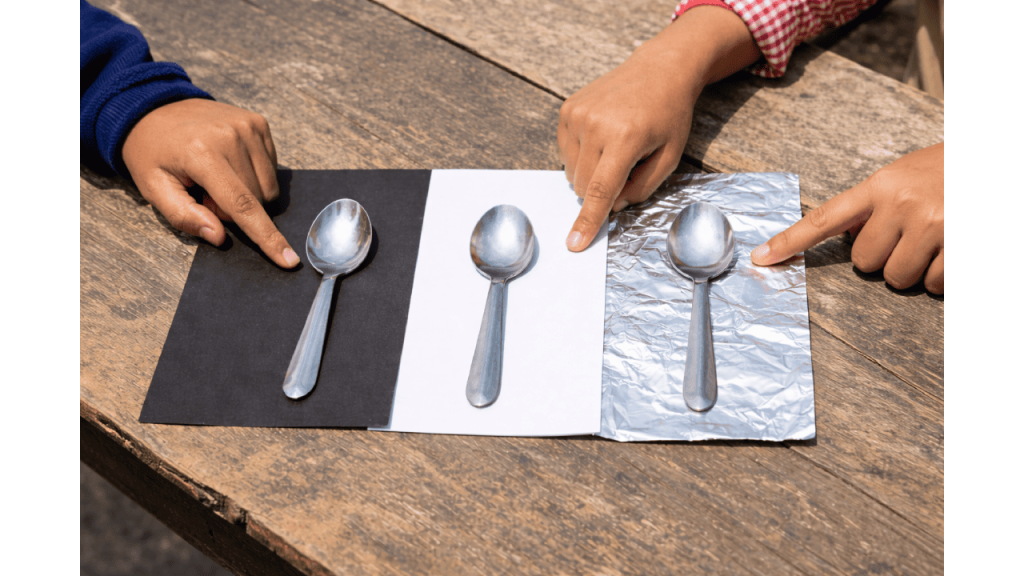
- Credits for the image (Comparing warmth of different spoons kept in the Sun) used in the background of the article title: Created for i wonder… using ChatGPT, under prompting by Chitra Ravi (Apr 2026). License: CC BY-NC-ND 4.0 International Deed.
- This article includes two classroom resources: Activity Sheet: How Are Light and Heat Related? and Teacher’s Guide: Thinking About Heat.
References
- National Council of Educational Research and Training (Reprint 2026-2027). ‘Chapter 7: Heat Transfer in Nature’. Curiosity—Textbook of Science for Grade VII: 89-104. URL: https://ncert.nic.in/textbook.php?gecu1=7-12.
- National Council of Educational Research and Training (Reprint 2026-27). ‘Chapter 12: Beyond Earth’. Curiosity—Textbook of Science for Grade VI: 231-252. URL: https://ncert.nic.in/textbook.php?fecu1=12-12.
- National Council of Educational Research and Training (Reprint 2026-2027). ‘Chapter 11: Light: Shadows and Reflections’. Curiosity—Textbook of Science for Grade VII: 153-168. URL: https://ncert.nic.in/textbook.php?gecu1=11-12.
- National Council of Educational Research and Training (2023). ‘National Curriculum Framework for School Education (NCF-SE)’. National Council of Educational Research and Training. URL: https://ncert.nic.in/pdf/NCF-SE-2023.pdf.