
Introducing the human heart: From diagram to experience


Students are introduced to the role of the heart in circulation in Chapter 9 (‘Life Processes in Animals’) of the Grade VII science textbook (NCERT, Reprint 2026-2027): “Our body has a unique system for the transport of nutrients, oxygen, and other substances. This system is called the circulatory system. It includes the heart, blood, and blood vessels. The heart pumps blood through blood vessels, ensuring the transport of nutrients, oxygen, and other substances to all parts of the body, while waste products are carried away.“1 Chapter 7 (‘Transportation in Animals and Plants’) of the Grade VII science textbook (NCERT, Reprint 2024- 2025) elaborates on this role through a labelled diagram of the human heart. Students are asked to trace the arrows showing the direction of blood flow—from the heart to the lungs and back, and then to the rest of the body.2
While students may engage in this exercise, the sequence of chambers and vessels can feel like names to remember rather than a process to understand. I remembered when I was a student in the seventh grade and my science teacher explained the working of the frog’s heart. That lesson has stayed with me even today. I wanted my lesson on the human heart to remain with my students just as strongly. I felt that if students learned through play, they would both enjoy it and remember it for longer. To structure this play, I decided to use the 5E method (see Box 1).
Box 1. What is the 5E method?
This is a teaching approach that is especially useful in science. It gives students opportunities to question, observe, discuss, and apply ideas—all of which are important for science learning. Instead of beginning with explanation, the lesson moves through five connected stages:
- Engage: Capture students’ interest and curiosity. Use these to draw out the ideas and prior knowledge they already have about the topic.
- Explore: Allow students to investigate, observe, or experience the concept in a concrete and hands-on way before formal explanations are introduced.
- Explain: Invite students to share what they noticed during exploration. The teacher then introduces scientific terms, concepts, and explanations to clarify and organise their understanding.
- Elaborate: Extend understanding by applying the concept in new situations, activities, or examples. This helps strengthen and deepen learning.
- Evaluate: Check students’ understanding through discussion, reflection, questioning, or simple assessments. Evaluation can happen throughout the lesson, not only at the end.
This approach helps students connect new ideas to what they already know and build concepts step by step. Because students actively participate in the learning process, their understanding is often clearer and more lasting.3,4
In the classroom
First, I engaged the students by asking them what they already knew about the heart and blood circulation (see Teacher’s Guide). Many of them said that the heart is related to feelings and emotions.
I then showed them a model of the human heart and explained its structure, pointing to the four chambers—right atrium, right ventricle, left atrium, and left ventricle. Some students tried to draw the structure of the heart by looking at the model. I also showed them an animated video of blood circulation. Many students looked fully engaged in the video, and I felt satisfied seeing their interest. But I wondered—are all the children equally involved? Watching and listening are not the same as participating. I realised that explanation alone was not enough. Students needed to experience circulation as a process. So I decided to turn the classroom into a giant heart.
With the help of chalk, I drew a large heart diagram on the classroom floor, clearly marking the four chambers and the major blood vessels (see Fig. 1). The students stood around it. I told them, “Now I will become blood and travel through the heart.“
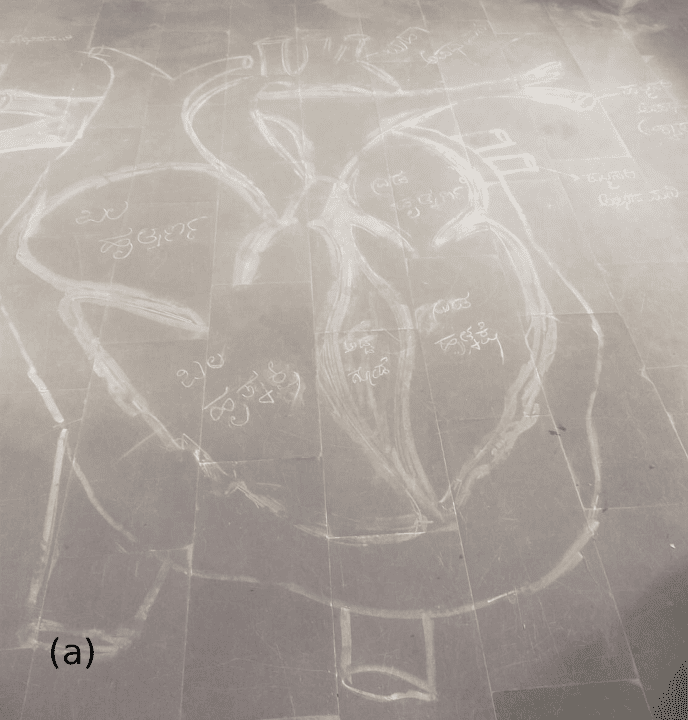
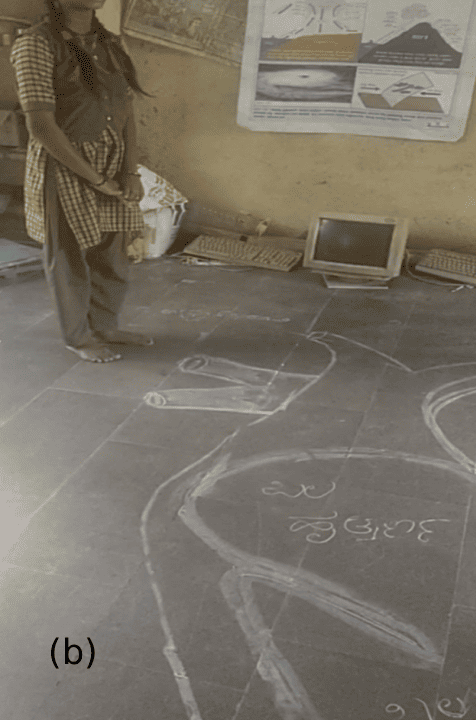
Credits: Vishwanath Gurubhim Kulkarni. License: CC BY-NC- ND 4.0 International Deed.
I entered the right atrium through the vena cava. From the right atrium, I moved into the right ventricle. From there, I went to the lungs through the pulmonary artery. I explained that the blood is deoxygenated at this stage. To make this visible, I hopped on one foot to represent deoxygenated blood. When I reached the lungs, I said, “Here, deoxygenated blood becomes oxygenated blood.” Then I switched to walking on both feet to represent oxygenated blood. From the lungs, I returned to the left atrium through the pulmonary vein. From the left atrium, I moved into the left ventricle. Finally, I travelled to all parts of the body through the aorta. Here is the sequence: Vena cava → Right atrium → Right ventricle → Pulmonary artery → Lungs → Pulmonary vein → Left atrium → Left ventricle → Aorta → Body.
The students watched carefully. Then I invited the students to play the role of blood, calling out the names of the chambers and blood vessels aloud as they moved. What made me especially happy was that every student wanted to participate. Through this activity, they began to speak more confidently about the process of blood circulation.
At one point, a student said, “Sir, we say that emotions are in the heart. But here there are no emotions—only blood!” This led to an important discussion. I explained that the heart is often represented as the source of feelings in poems and stories. But, scientifically, emotions are controlled by the brain. The heart’s main function is to pump blood throughout the body.
Next, students played in groups of five. A student stood inside each chamber of the heart drawn on the floor. The fifth student would say, “I am blood, I will come to your position,” and move into the chamber. The student standing there would guide the ‘blood’ to the next correct chamber or blood vessel, pushing it forward in the correct sequence. In their excitement of playing the game, the students did not realise that they were recapitulating what they had learnt. They repeated the names of the chambers, explained the direction of blood flow, and corrected one another when someone made a mistake.
As the game was ending, the bell rang. The mid- day meal was waiting for us. We walked out of the classroom together, still talking about the heart and laughing about who had been the best ‘blood’ in the game. I felt that perhaps this lesson would remain in my students’ memory—just as my teacher’s lesson has remained in mine (see Box 2).
Box 2. Curricular connections:
Discussions and activities around the structure of the heart and the movement of blood through it can help teachers meet the following:
- Curricular goal for middle-stage science:
- CG-7: [The student] communicates questions, observations, and conclusions related to science. Specifically, this lesson can help students develop the competency (C-7.1) to: “Use scientific vocabulary to communicate science accurately in oral and written form, and through visual representation.“5
- Learning objectives for middle-stage students:
- Describe the location and function of the heart in relation to blood circulation in the body.
- Analyse the implications of [the] intermixing of oxygenated and deoxygenated blood in order to explain the existence of four chambers in the heart.6
Parting thoughts
When I first planned this lesson on circulation, I wanted my students to remember it. While the textbook includes information on the circulatory system, this is not something students can see directly. The 5E strategy can help make abstract concepts more concrete by encouraging active learning. So I used this strategy to plan the lesson in a sequence that would make this invisible process clearer to students in small steps.
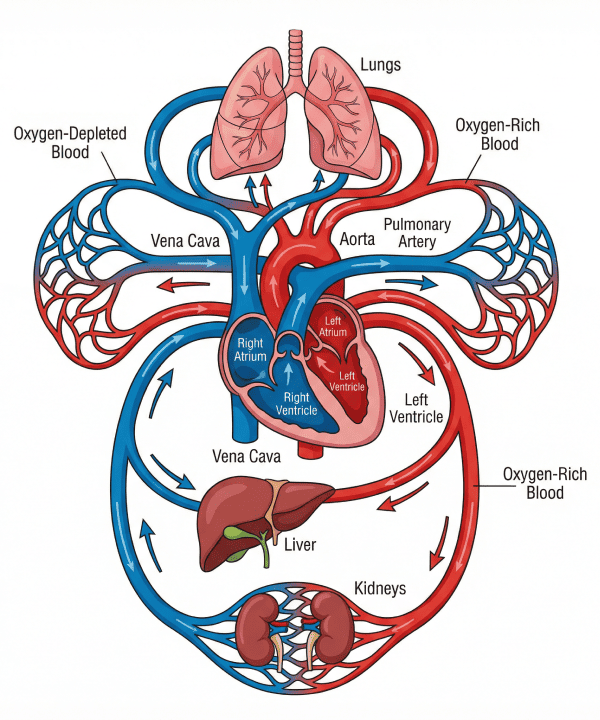
Credits: Easy-Peasy.AI. URL: https://easy-peasy.ai/ai-image- generator/images/human-circulatory-system-diagram. License: CC BY 4.0 International Deed.
In the first step, students were introduced to the diagram in the textbook. But when students look at a diagram alone, they can think of the heart only as arrows and labels (see Fig. 2). In the next step, I introduced them to a model of the heart. Before learning how blood moves, students need to see where it moves. The model helped them see that the heart is not flat like a picture in the book. They could observe its shape and structure more clearly. Not only could they identify the four chambers, but they were also able to notice how these were arranged in relation to one another. This helped move their understanding from a textbook image to something that feels like a real organ inside the body. Building on this, we watched an animated video on blood circulation. This allowed students to see the continuous movement of blood from one chamber to another, and from the heart to different parts of the body and back again. They could observe the direction of flow and notice how oxygenated and deoxygenated blood follow different pathways. This helped shift their understanding from the separate parts of the heart model to how these parts worked together.
After this, I drew a giant heart on the floor. This made the process of circulation more visible and active. When I demonstrated the flow of blood by moving through the chambers, students could observe the sequence step by step. Hopping on one foot to show deoxygenated blood and using both feet for oxygenated blood allowed students to more directly relate to the specific pathways followed by the different kinds of blood. When students themselves became ‘blood’ and moved through the heart, they did more than watch—they experienced the sequence. The classroom became the heart, and they stood inside its chambers. As they walked through the chambers and said the names aloud, the process became clearer. They began to relate to circulation as continuous movement and transport within their own bodies.7 The group activity further strengthened their understanding through discussion and peer learning. One student became blood, and others directed the flow. If someone made a mistake, others corrected it. Students had to think carefully about where the blood should go next. In addition to physical experience, they needed to apply reasoning. Students explained the pathway in their own words. This built their confidence, helped them check their understanding, and learn from one another. The activity on the floor did not remain a game; it became a way for students to apply, repeat, and check their understanding together. In this way, structure and play worked together.
This approach gave every student a chance to participate in the lesson, not only those who are confident in speaking or writing. It also reminded me that when students experience a scientific idea physically and socially, understanding becomes stronger. And when understanding becomes stronger, learning is more likely to stay with students over time.
Key takeaways

- Students are introduced to the structure of the heart and its role in circulation through a textbook diagram. While the diagram presents key labels and basic structure, it can make a complex system appear flat and static.
- Allowing students to handle a model of the heart helps them observe its shape and internal structure more closely. Seeing the four chambers and their arrangement supports understanding of the heart as a three- dimensional organ with organised parts.
- Showing an animated video of blood circulation helps students visualise movement within the heart. They can observe direction, sequence, and the difference between oxygenated and deoxygenated blood.
- Demonstrating blood flow through a large floor model makes the sequence of circulation visible. Using different movements to represent oxygenated and deoxygenated blood helps students distinguish between the two pathways.
- Inviting students to enact blood flow strengthens conceptual understanding. Moving through the chambers and saying the names aloud helps them internalise the sequence and connect structure with function.
- Organising group activities where students guide and correct one another promotes reasoning and peer learning. Explaining the pathway and identifying mistakes helps them see circulation as a connected system rather than separate parts.
- Designing activities in which all students participate builds engagement and confidence. Embodied and collaborative tasks allow every student to contribute.
- Observing students during enactment and discussion supports informal assessment. Their movements, explanations, and corrections reveal their level of understanding.
Notes
- Credits for the image (Blood flow) used in the background of the article title: qimono, Pixabay. URL: https://pixabay.com/illustrations/cells- red-medical-medicine-anatomy-1813410/. License: CC0 1. 0 Universal Deed.
- This article includes one classroom resource: Teacher’s Guide: Thinking About the Human Heart.
References
- National Council of Educational Research and Training (Reprint 2026-2027). ‘Chapter 9: Life Processes in Animals’. Curiosity, Textbook of Science for Grade VII: 121-136. URL: https://ncert.nic.in/textbook/pdf/gecu109.pdf.
- National Council of Educational Research and Training (Reprint 2024-2025). ‘Chapter 7: Transportation in Animals and Plants’. Textbook of Science for Grade VII: 70-81. URL: https://www.ncert.nic.in/textbook/pdf/gesc107.pdf.
- Hester, K (2022). ‘Understanding and Implementing the 5E Instructional Model.’ Little Smarticle Particles. Accessed on: Feb 15, 2026. URL: https://littlesmarticleparticles.com/2022/02/20/fear-not-the-5e-lesson-cycle/.
- K20 Center (2024). ‘What is the 5E Instructional Model?’ YouTube. Accessed on: Feb 15, 2026. URL: https://www.youtube.com/ watch?v=9l2MVsYVxlE.
- National Steering Committee for National Curriculum Frameworks (2023). ‘National Curriculum Framework for School Education 2023’. National Council of Educational Research and Training. URL: https://ncert.nic.in/pdf/NCFSE-2023-August_2023.pdf.
- Central Board of Secondary Education (2020). ‘Teachers’ Resource for Achieving Learning Outcomes, Classes 1 to 10’. URL: https:// cbseacademic.nic.in/web_material/Manuals/TeachersResource_LODoc.pdf
- Reimer, P, Mehta, R, and Mishra, P (2019). ‘Learning science with the body in mind’. i wonder…: 51-56. ISSN 2582-1636. URL: https:// publications.azimpremjiuniversity.edu.in/2102/.