
Exploring soil: The foundation of life

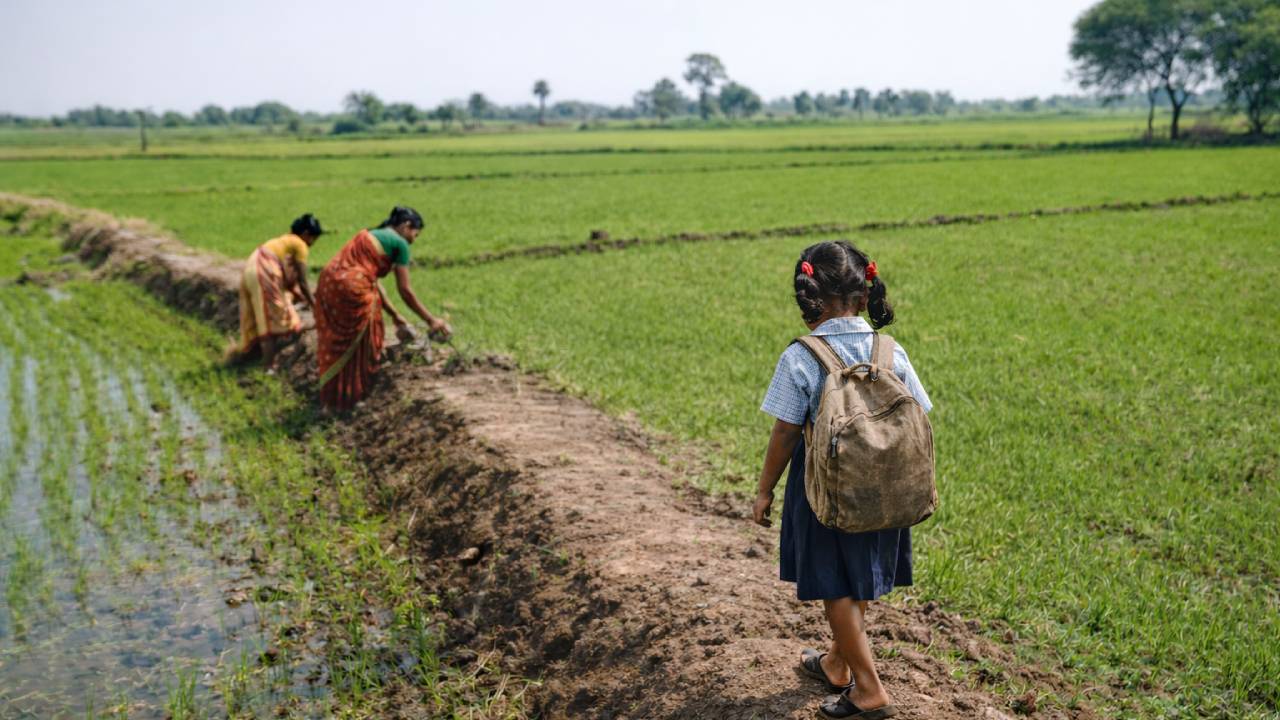
Chapter 12 (‘How Nature Works in Harmony’) of the Grade VIII science textbook (NCERT, 2025) shares how ecosystems are formed through “…interactions between the biotic components (plants, animals, and microorganisms) and the abiotic components (air, water, soil, sunlight, and temperature) in a habitat.“1 Drawing attention to how crucial ecosystems are for human survival and well-being, it shares how: “Human activities like pollution, deforestation, habitat loss, climate change, invasive species, and overexploitation of natural resources threaten ecosystems. Protecting them… is vital.“1
Many students in the government schools we work with in Kanakapura taluk, Ramanagara district, Karnataka, are from farming families. Farms are the immediate ecosystems they are part of and recognise as being important for their well-being. Fertile soil is the foundation of these ecosystems. What role can students play in protecting soil? We explored this question through hands-on activities supported by inquiry-based discussions.
What is soil?
Chapter 1 (‘Natural Resources and their Use’) of the Grade VIII social science textbook (NCERT, 2025) poses the following question to students: “In many indigenous traditions of the world, Nature is considered sacred… In such traditions, Nature is a nurturer and nourisher. Do you know of practices that reflect this?“2 Our experience suggests that beginning a lesson with an engaging puzzle, poem, short story, or an incident drawn from students’ immediate surroundings can be an effective way to capture their attention. So we began a discussion with our 24 Grade VIII students with a familiar Kannada verse:
ಬೆಳಗಾಗಿ ನಾನೆದ್ದು ಯಾರ್ಯಾರ ನೆನೆಯಾಲಿ ಎಳ್ಳು ಜೀರಿಗೆ ಬೆಳೆಯೋಳ | ಭೂಮ್ರಾಯ ಎದ್ದೊಂದು ಗಳಿಗೆ ನೆನೆದೇನ |3
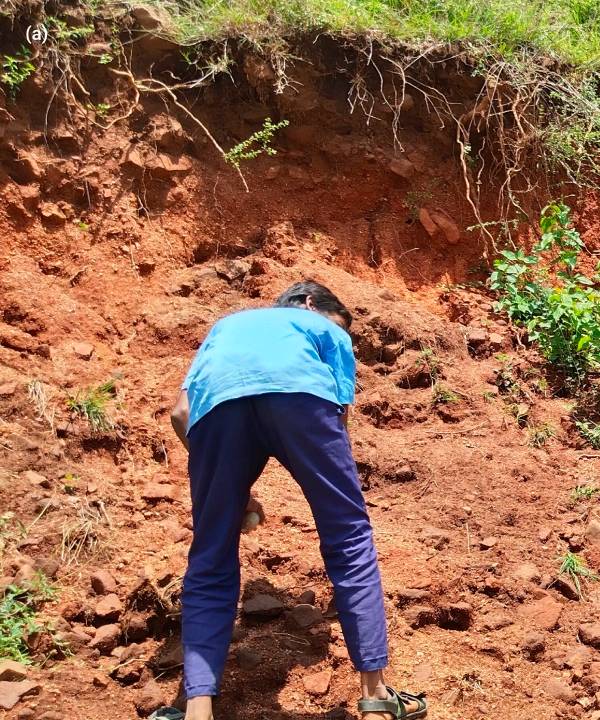
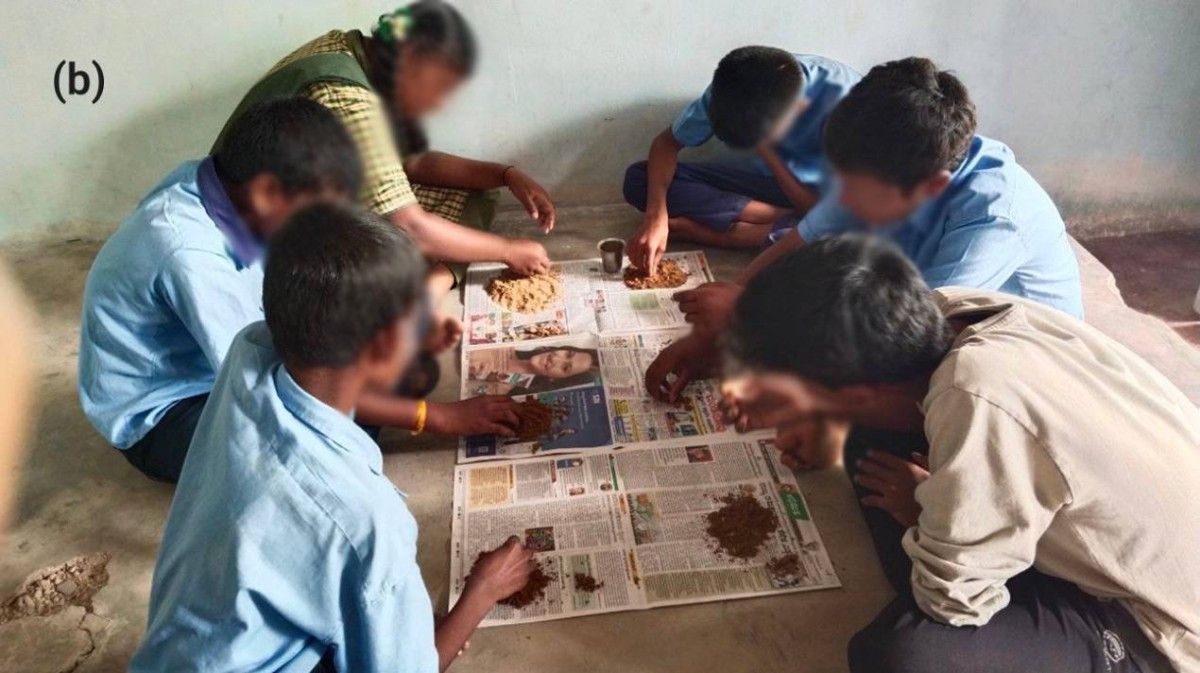
(At dawn, whom shall I remember? The one who nurtures sesame and cumin—Mother Earth herself; I remember her with each waking moment.) Some students were surprised to encounter a verse in a science class. One remarked, “ಈ ತರ ಬೆರೆ ಎಲ್ಲೋ ಕಲಿತ ವಿಷಯಗಳನ್ನು ಇನ್ಹೊಂದ ವಿಷಯದಲ್ಲಿ ಲಿಂಕ್ ಮಾಡಬಹುದು ಅಂತ ಅಂದುಕೊಂಡಿರ್ಲಿಲ್ಲ | (I never thought that things learned in one subject could be linked to another subject like this).” We asked our students: What is the meaning of this verse? What is its main point? Through discussion, students were able to appreciate how this simple verse reflects the deep bond between people and soil. They were also able to relate to how farmers see Mother Earth not only as the source of food, but also as the giver of life, and begin their day by remembering her with gratitude. In Chapter 1 (‘Crop Production and Management’) of the Grade VIII science textbook (NCERT, 2024-2025), students read that: “…soil contains minerals, water, air, and some living organisms.“4 To make this idea more concrete, we invited students to collect soil samples—no more than a handful from each location—from their immediate surroundings (see Fig. 1). Back in the classroom, students began by reporting what they could directly observe. They described the colour of the soil and identified the materials present in it, such as sand, stones, insects, paper, plastic, sticks, and leaves.
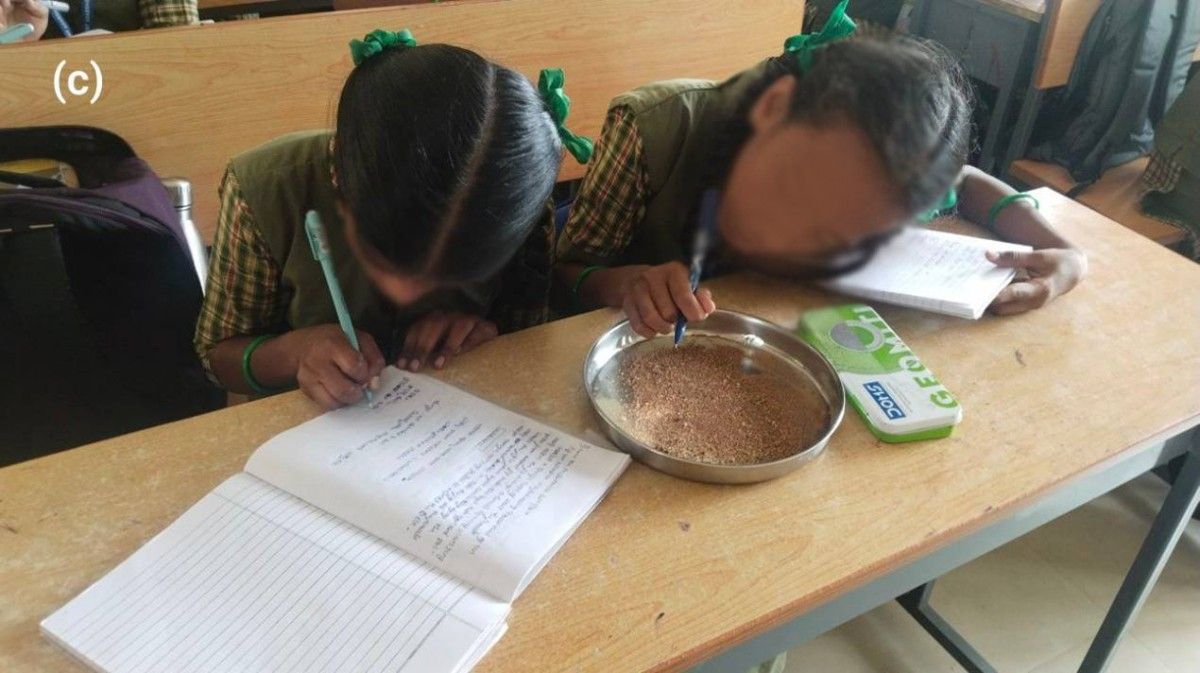
To encourage deeper exploration, students can be reminded that Chapter 13 (‘Our Home: Earth, a Unique Life-Sustaining Planet’) of the Grade VIII science textbook (NCERT, 2025) states: “Soil may look like simple dirt, but it is rich in nutrients like nitrogen and potassium that plants need to grow.“5 Gradually, students’ observations extended to soil characteristics that could be sensed through touch, including texture and water content. These were features students had seen their parents or elders traditionally use in the fields to decide which crops could be grown. If students are keen, they can be encouraged to compare soil samples for their ability to support plant growth (see Activity Sheet I).
We concluded the class by drawing students’ attention to Chapter 2 (‘Land, Soil, Water, Natural Vegetation, and Wildlife Resources’) of the Grade VIII social science textbook (NCERT, 2024–2025), where they read: “Soil is made up of organic matter, minerals and weathered rocks found on the earth.“6
Natural curiosity led some students to ask: How is soil formed? Others offered ideas—some suggested that running water brings soil, while others thought volcanic eruptions create it. Surprisingly, one student believed humans created soil and asked, “How could soil have formed before humans existed?” Most students recognised that soil formation is a slow, natural process.
Box 1. Curricular connections:
These activities and discussions can help meet the following:
- Curricular goals for middle-stage science:
- CG-3: [The student] explores the living world in scientific terms. Specifically, it can help students develop the competency (C-3.3) to: “Analyse patterns of relationships between living organisms and their environments in terms of dependence on and response to each other.“
- CG-6: [The student] explores the nature and processes of science through engaging with the evolution of scientific knowledge and conducting scientific inquiry. Specifically, it can help students develop the competency (C-6.2) to: “Formulate questions using scientific terminology (to identify possible causes for an event, patterns, or behaviour of objects) and collect data as evidence (through observation of the natural environment, design of simple experiments, or use of simple scientific instruments).“15
- Learning outcomes (LO) for:
- Middle-stage science: [The student] conducts simple investigations to seek answers to queries, relates processes and phenomena with causes, and applies learning of scientific concepts in day-to-day life.
- Grade VII science: [The student] makes efforts to protect the environment. For example, … by planting trees to avoid soil erosion; sensitising others with the consequences of excessive consumption of natural resources, etc.
- Grade VIII social science: [The student] justifies judicious use of natural resources such as water, soil, forest, etc. to maintain development in all areas.16
Instead of reiterating textbook explanations, we played a short animated video titled ‘How Was Soil Formed from Rocks’ and explained the visuals in Kannada to support understanding.7 To stimulate deeper thinking, we posed questions grounded in their own farming experiences: How deep is soil? Does it remain the same as we dig deeper? Have you noticed distinct layers while digging a pit or trench? Drawing on these experiences, students recognised that soil consists of multiple layers.
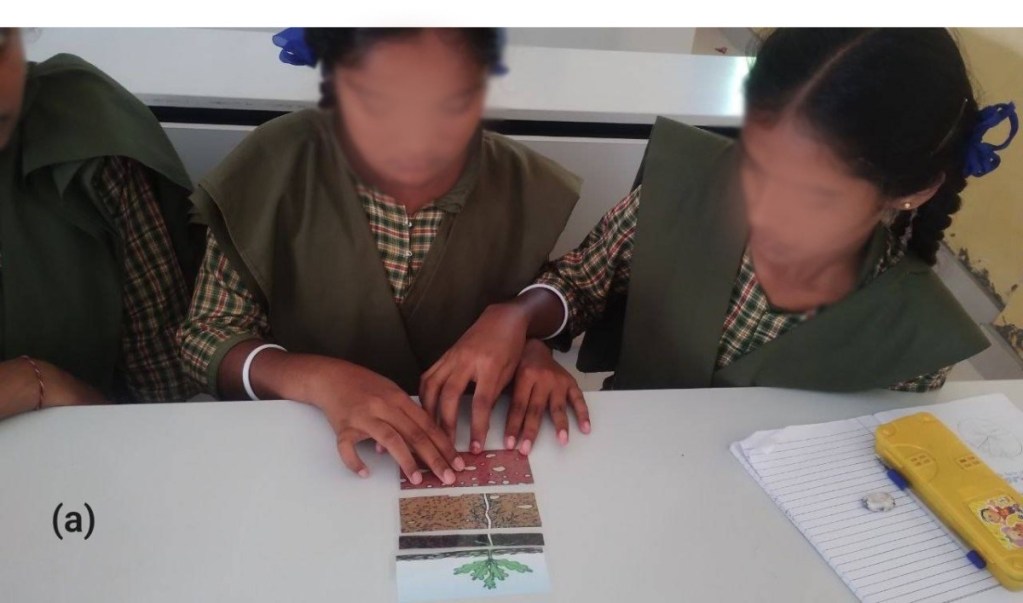
To make this concept more tangible, we divided the class into groups of five to seven. Each group received cardboard cut-outs representing different soil layers and was asked to arrange them based on their observations and prior knowledge (see Fig. 2a).8,9 After completing the task, groups presented their arrangements to the class and explained their reasoning. We then played a second video, ‘Soil Profile of Earth – Soil Layers and Horizons’, allowing students to compare their models with the video and identify which parts were accurate and which needed revision.10
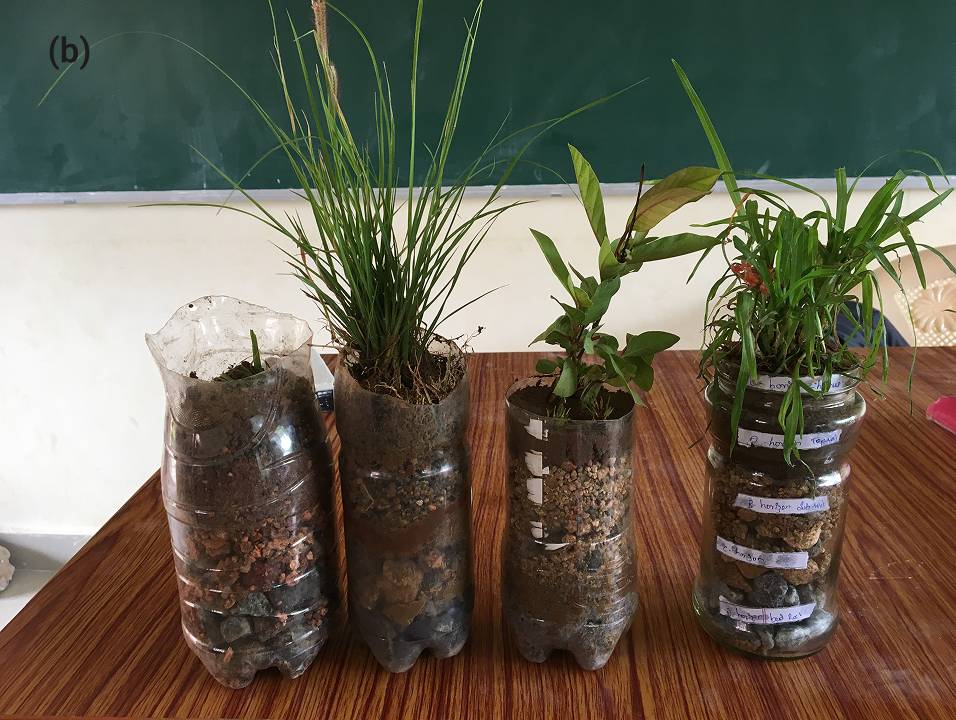
Finally, students were pointed to Chapter 2 of the Grade VIII social science textbook (NCERT, 2024–2025), which describes soil’s four layers: (a) topsoil, rich in humus and vegetation; (b) subsoil, containing sand, silt, and clay; (c) weathered rock material; and (d) parent rock.6 Students were encouraged to use materials from their surroundings to create visual displays of these layers (see Fig. 2b).
Why does soil matter?
In Chapter 13 of the Grade VIII science textbook (NCERT, 2025), students read: “Beneath our feet lies something remarkable—the Earth’s crust, made of rocks, soil, and minerals. It may seem hard and lifeless, but it provides almost everything life needs to grow and survive.“5 They also read: “There are various types of landforms, rocks, soils, etc., on Earth. This variety, along with the processes that shape and alter them, is called geodiversity… It helps create unique habitats where different types of life can thrive.“5 To help students grasp the scarcity of arable land, we used an onion to represent the Earth, removing portions corresponding to oceans, deserts, mountains, and settlements form it. Students could see that only a small fraction of land remained available for farming.11 This connects to Chapter 1 of the Grade VIII science textbook (NCERT, 2024–2025), where students learn that topsoil is the only layer that supports plant growth.4 We pointed out that the thin outer layer of the small fraction of arable land on the planet is all that humanity has to grow food. This visualisation helped students develop a more concrete appreciation for how limited and precious this thin layer of soil is.
This naturally led to the question: What holds topsoil in place? In Chapter 12 of the Grade VIII science textbook (NCERT, 2025), students read that “…soil provides medium and essential nutrients for plant growth” and plant “…roots hold soil in place and prevent erosion.“1 Rather than telling students this, we adapted a hands-on activity suggested in Chapter 2 of the Grade VIII social science textbook (NCERT, 2024–2025): “Take two trays, A and B, of the same size. Make six holes at one end of these trays and then fill them with the same amount of soil. Leave the soil in tray A bare while sow wheat or rice grains in tray B. When the grain in tray B has grown a few centimetres high, place both the trays in such a way that they are on a slope. Pour one mug of water from the same height into each tray. Collect the muddy water that trickles down the holes of both trays in two separate containers and compare how much soil is washed out of each tray.“6 Students were invited to work in groups to grow crops in shallow trays (see Activity Sheet II). Each tray was prepared with a mixture of soil and manure. We chose seeds such as finger millet, green gram, and jowar for the activity because they are commonly available in students’ homes and germinate quickly. Students were instructed to soak the seeds overnight before planting. Each group then sowed its assigned seeds and cared for the plants, ensuring adequate sunlight and regular watering.
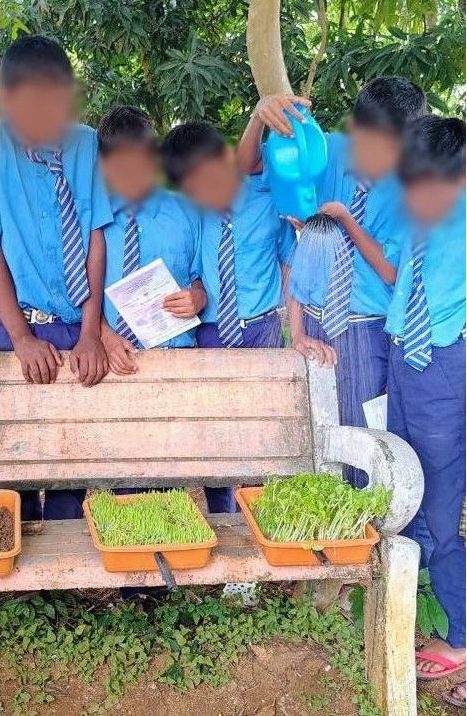
A week later, students brought their trays to class and shared their observations. Many had monitored their plants closely, noting when seeds germinated, how sprouts emerged through the soil, the shapes of the leaves, and changes in leaf number over time. Some trays showed healthy, lush growth, while others displayed sparse or uneven growth. This variation likely resulted from differences in seed type or the level of care the plants received. Rather than treating this as a failure, trays with limited growth became an important comparison for the next stage of the activity.
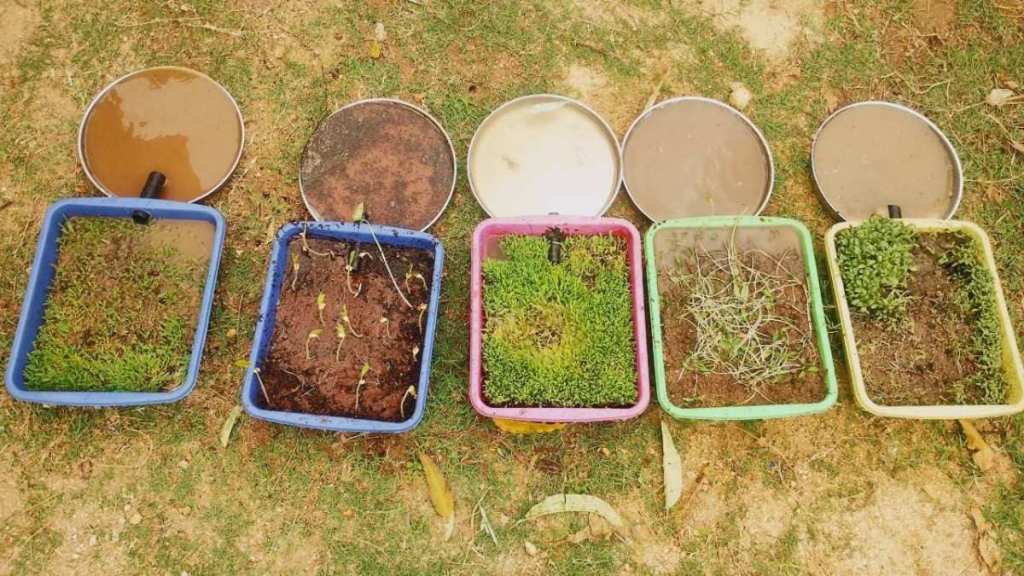
In the next step, a small hole was made at the bottom of each tray, and a plastic pipe approximately six inches long was attached to simulate drainage. Water was then poured into the trays to mimic rainfall (see Fig. 3). Transparent cups were placed beneath the pipes to collect the water that flowed out of the soil. The cups were labelled and arranged side by side, and students recorded differences in the appearance of the collected water and discussed possible reasons for these variations (see Fig. 4). Through this activity, students were able to identify some factors that contribute to soil erosion and appreciate the role of vegetation in preventing it (see Table I).
| Appearance of water in cup | Plant growth in tray | Inference |
|---|---|---|
| Clear, very little soil | Dense growth of the same kind of seedlings. | Very little soil loss |
| Clear, almost no soil | Dense and mixed growth of seedlings. | Almost no soil loss |
| Dark and muddy | Sparse or patchy growth | Significant soil loss |
Parting thoughts
Referring to the trays that had shown significant soil loss in the previous activity, we introduced the term ‘soil erosion’, defining it as the washing away of topsoil by rain or wind. We connected this to Chapter 2 of the Grade VIII social science textbook (NCERT, 2024–2025), where students read: “Soil erosion and depletion are the major threats to soil as a resource. Both human and natural factors can lead to degradation of soils.“6 In Karnataka alone, 7,522 hectares of cultivated land have been affected by soil erosion.12
We asked students: How can soil erosion be prevented? Drawing on their observations, many students suggested growing more plants. To inspire them, we shared the story of Jadav Payeng, who transformed degraded land on the Majuli islands in Assam by planting and nurturing saplings that eventually grew into a forest.13,14 This forest has helped reduce soil erosion and restore ecological balance. Students listened with great interest, and some even planted a few saplings in their backyards.
Returning to the earlier discussion, we asked students to think of practices that could reduce soil erosion on their farms. Observing that trays with mixed seeds showed very little soil loss, some students suggested growing different kinds of plants together. We explained that this practice is called ‘multi-cropping’ and is common on many small, traditional farms. This prompted students to share practices from their own communities. For example, some described how their parents and elders build bunds on sloped farmland to prevent rainwater runoff and loss of topsoil, and how these bunds are regularly checked and reinforced, especially after heavy rains.
We also discussed how soil erosion not only reduces soil fertility, but can contribute to floods, landslides, and other natural disasters. We then explained the preventive measures listed in Chapter 2 of the Grade VIII social science textbook (NCERT, 2024–2025): Mulching, building rock dams, contour ploughing, terrace farming, crop rotation, intercropping, and planting shelter belts.6 Some students spoke about the trees they had seen on their farms. Before this exploration, they had assumed that the trees were mainly used to provide fodder to sheep and goats. They now recognised that the trees also help bind farm soil and maintain its health.
While most of our students come from farming communities, this exploration helped them appreciate the importance of conserving the thin, fertile layer of topsoil on their field and beyond. It also enabled them to connect observations from their everyday lives with concepts in their science and social science textbooks (see Box 1).15,16 We concluded the discussion here, but plan to organise a class visit to nearby fields so students can observe and document soil conservation practices used by farmers in their own community.
Key takeaways
- The Grade VIII curriculum introduces students to the role of ecosystems and the importance of protecting them.
- Farms are the most immediate ecosystems that students from agricultural families can relate to, and healthy soil is the foundation of these ecosystems.
- By collecting and observing properties of soil samples from the vicinity, students can link scientific analysis with the ways their elders decide which crops to grow in different soils.
- Asking students to draw on their experience of digging soil to create displays of its layers enables them to identify and understand soil profiles through their own observations.
- A hands-on activity that lets students test how vegetation affects soil erosion helps them understand why protecting topsoil is important and recognise traditional farming practices that reduce soil loss.
Notes
- Credits for the image (Reinforcing bunds after the rains) used in the background of the article title: Created for i wonder… using ChatGPT, under prompting by Chitra Ravi (Dec 2025). License: CC BY-NC-ND 4.0.
- This article includes two detachable classroom resources: Activity Sheet I: What properties of soil help plants grow well? and Activity Sheet II: Do Plants Help Stop Soil from Washing Away?
References
- National Council of Educational Research and Training (2025). ‘Chapter 12: How Nature Works in Harmony’. Curiosity, Textbook of Science for Grade VIII: 190–209. URL: https://ncert.nic.in/textbook.php?hecu1=12-13.
- National Council of Educational Research and Training (2025). ‘Chapter 1: Natural Resources and their Use’. Social Science Textbook (Exploring Society: India and Beyond) for Grade VIII: 1–20. URL: https://ncert.nic.in/textbook.php?hees1=1-7.
- ಕನ್ನಡ ನುಡಿ (n.d.). ಗೀತವಿಹಾರ: ಜಾನಪದ ಗೀತೆಗಳು. ‘ಬೆಳಗಾಗಿ ನಾನೆದ್ದು ಯಾರ್ಯಾರ ನೆನೆಯಾಲಿ! URL: https://kannadanudi.com/geethavihaara/jaanapada/Belagagii%20Naneddu%20Yaryara%20Neneyali#google_vignette.
- National Council of Educational Research and Training (2024–2025). ‘Chapter 1: Crop Production and Management’. Curiosity, Textbook of Science for Grade VIII: 1–16. URL: https://ncert.nic.in/textbook/pdf/hesc101.pdf.
- National Council of Educational Research and Training (2025). ‘Chapter 13: Our Home: Earth, A Unique Life Sustaining Planet. Curiosity, Textbook of Science for Grade VIII: 210–228. URL: https://ncert.nic.in/textbook.php?hecu1=13-13.
- National Council of Educational Research and Training (2024–2025). ‘Chapter 2: Land, Soil, Water, Natural Vegetation and Wildlife Resources’. Social Science Textbook (Exploring Society: India and Beyond) for Grade VIII: 7–21. URL: https://ncert.nic.in/textbook/pdf/hess402.pdf.
- Bodhaguru (2014). ‘Science – How Was Soil Formed from Rocks (3D Animation)—English’. YouTube video. URL: https://www.youtube.com/watch?v=Fx8r3o2gsLk.
- Worksheets Library. ‘Layers of Soil: Worksheet 362005’. URL: https://worksheets.clipart-library.com/worksheet/soil-layer-worksheet-4.html.
- Worksheets Library. ‘Layers of Soil: Worksheet 362058’. URL: https://worksheets.clipart-library.com/worksheet/soil-layer-worksheet-19.html.
- MocomiKids (2022). ‘Soil Profile of Earth – Soil Layers and Horizons’. YouTube video. URL: https://www.youtube.com/watch?v=vqtdFaclWf0.
- Farm to Home Lesson Series (2018). ‘Earth: The Apple of Our Eye’. YouTube video. URL: https://www.youtube.com/watch?v=-vquGl0d3LQ.
- Ministry of Agriculture & Farmers Welfare (2022). ‘Survey on Soil Erosion’. Press Information Bureau, Government of India. URL: https://www.pib.gov.in/PressReleasePage.aspx?PRID=1810912.
- Sony BBC Earth (2023). ‘Meet Jadav Payeng: The Forest Man of India’. Earth Champion Series, YouTube video. URL: https://www.youtube.com/watch?v=w8OtZUcjKFU.
- McMaster, William D (2014). ‘Forest Man’. YouTube video. URL: https://www.youtube.com/watch?v=HkZDSqyE1do.
- National Steering Committee for National Curriculum Frameworks (2023). ‘National Curriculum Framework for School Education 2023’. National Council of Educational Research and Training. URL: https://ncert.nic.in/pdf/NCFSE-2023-August_2023.pdf.
- National Council of Educational Research and Training (2017). ‘Learning Outcomes at the Elementary Stage’. National Council of Educational Research and Training. URL: https://ncert.nic.in/pdf/publication/otherpublications/tilops101.pdf.