
Classifying everyday materials as metals and nonmetals



In Chapter 6 (‘Materials Around Us’) of the Grade VI science textbook (NCERT, Reprint 2025-2026), students read that all “objects are made up of various materials”, and that all materials “… possess different properties that determine their use.”1 They also learn that materials can be classified based on “… similarities and differences in their properties.”1 Students are encouraged to classify materials in their surroundings based on properties like lustre, hardness, and transparency. This is not the first time students read about metals. They are introduced to this class of materials in Chapter 10 (‘This World of Things’) of the Grade III Environmental Studies (EVS) textbook (NCERT, 2025-2026).2 An activity idea in this chapter encourages students to identify objects (like hinges, nails, and latches) in their classroom that are made of metals. Metals appear again in Chapter 3 (‘Electricity: Circuits and their Components’) of the Grade VII science textbook (NCERT, 2025-2026). Here, students read that, “…metals are conductors of electricity and, thus, are used for making wires.”3 But students are formally introduced to the properties of metals and nonmetals in Chapter 4 (‘The World of Metals and Nonmetals’) of the Grade VII science textbook (NCERT, 2025-2026). Through ideas for a series of hands-on activities, students learn that: “… metals are generally hard, lustrous, malleable, ductile, and good conductors of heat and electricity.”4 What do students learn from this introduction?
What do students learn?
I was in a Grade IX science class in a government school. Chapter 2 (‘Is Matter Around Us Pure?’) of the Grade IX science textbook (NCERT, Reprint 2025-2026) lists properties and examples of metals, nonmetals, and metalloids.5 Since students are expected to develop the competency to classify materials into these categories in the middle stage, I decided to start a discussion around this theme (see Box 1).
Box 1. Curricular connections:
Discussions and activities around the classification of materials into metals and nonmetals can help teachers meet the following:
- Curricular goals for middle-stage science:
- CG-1: Explore the world of matter and its constituents, properties, and behaviour. Specifically, it can help students develop the competency (C-1.1) to: “Classify matter based on observable physical (solid, liquid, gas… translucent… conducting, non-conducting) and chemical (pure, impure; acid, base; metal, non-metal; element, compound) characteristics.”
- CG-6: Explore the nature and processes of science through engaging with the evolution of scientific knowledge and conducting scientific inquiry. Specifically, it can help students develop the competency (C-6.2) to: “Formulate questions using scientific terminology… and collect data as evidence (through observation of the natural environment, design of simple experiments, or use of simple scientific instruments).”6
- Learning objectives for middle-stage students for the chapter on this theme:
- Differentiate between the commonly known materials based on their ability to be bent and formed into sheets, be drawn into wires, ability to produce ringing sound, ability to conduct electricity, and ability to conduct heat in order to define various properties of metals.
- Categorise the commonly known materials as metals and nonmetals in order to explain their physical properties.
- Predict the utility of a given material for a specific task to reinforce the physical and chemical properties of metals and nonmetals.7
I asked the students, “What are metals?” Almost all the students raised their hands. Some listed the properties of metals (“hard”, “malleable”, “ductile”, “good conductors of electricity”), while others shared examples (“like gold and silver”). I saw a piece of marble near the window of the classroom. Pointing to it, I asked: “Is marble a metal?” Many students said, “Yes.” Curious, I asked, “Why do you think marble is a metal?” The students shared this reasoning: “Marble is hard. Metals are hard. So marble must be a metal.” I replied, “Yes, one property of metals is that they are hard. But metals have other properties too. All of you listed these properties. Metals are shiny, malleable, ductile, and good conductors of heat and electricity. Does marble show any of these other properties?” The students took a few minutes to think about my question. One of them said, “It will not conduct electricity.” Another said: “It is not ductile.” A third student said: “It is shiny.” I asked the rest of the students if they agreed with the last statement. Many of them did. Another student said: “Marble is malleable.” Surprised, I asked, “Why do you say that?” They explained that they had seen houses with marble floors. The marble in these floors were in the form of sheets. The textbook defines malleable materials as materials that can be beaten into sheets. So marble was malleable.
Some of the other students shared that they too had seen sheets of marble being used for flooring. One of the students said: “Marble can conduct heat.” When I asked how they knew this, the student explained that they had observed that marble becomes warm to touch when it is exposed to direct sunlight or kept near a source of heat. Since the students had applied many of the properties of metals listed in their textbook to marble, I asked, “You have heard what your classmates think. What do you all think? Is marble a metal?” Most of the class replied that it was.
I posed similar questions to Grade IX students of the other government schools that I visited. They showed a similar understanding. To probe this more deeply, I compiled a list of 15 everyday objects that were made of materials listed as examples of metals or nonmetals in the Grade VI and Grade VII science textbooks. I shared this list with 56 Grade IX students from three government senior secondary schools. The students were asked to sort the materials into one of the following categories: Metal, nonmetal, or neither. To help the students with this exercise, I created a display of some of these objects on the teacher’s table (see Fig. 1).
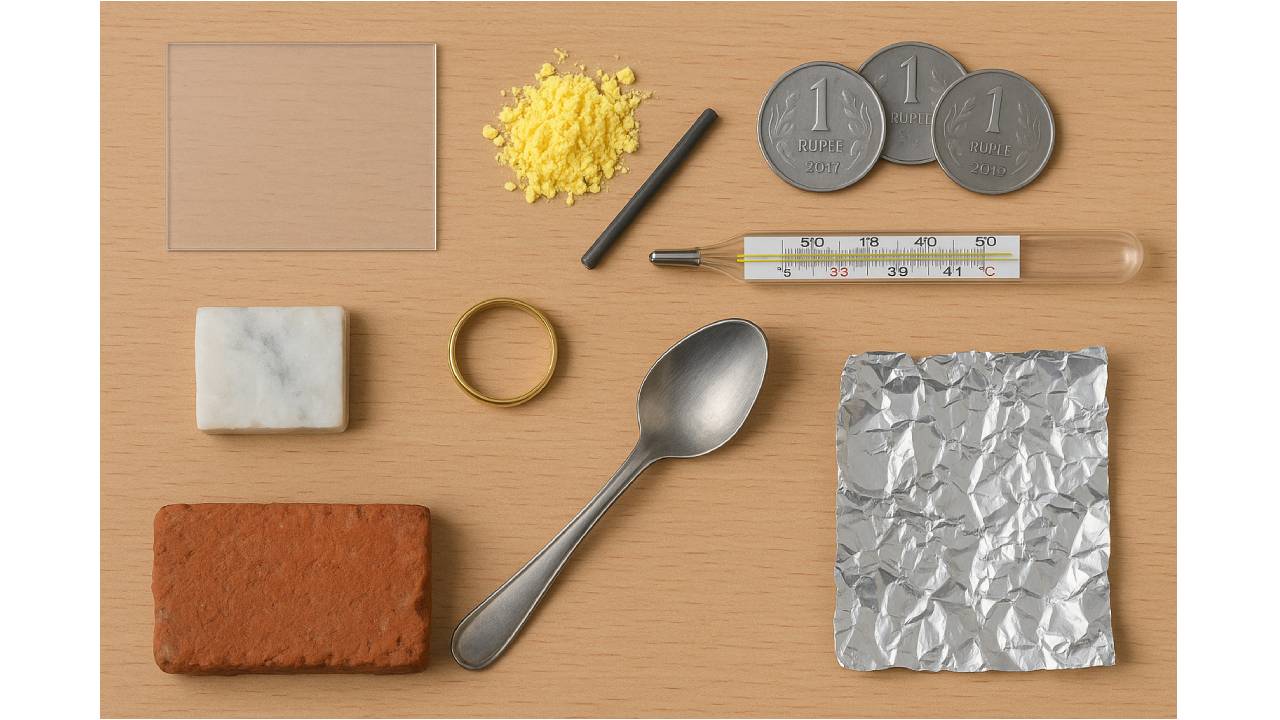
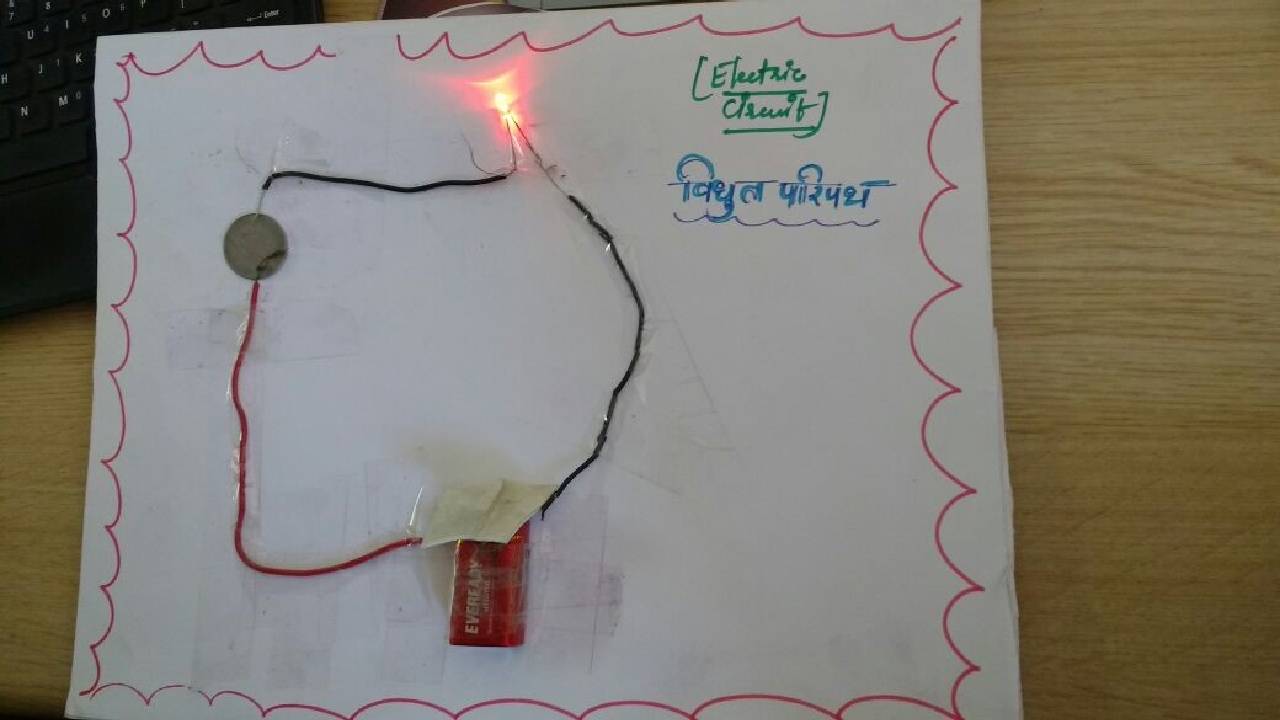
I also kept an electrical circuit on the table. The students were invited to examine any of the objects in the display or test their electrical conductivity before marking their choices in the sheets provided to them. Once the students had submitted their responses, I read out the name of each object in the list and invited the students to share and justify their answers (see Table I).
| Objects | Number of Student Responses | Main Reasons for the Most Common Answer | |||
|---|---|---|---|---|---|
| Metals | Nonmetals | Neither | Blank | ||
| Wooden chair and table | 33 | 23 | – | – | Classified as a metal for its hardness. Classified as a nonmetal because it was not shiny, malleable, or ductile. Some students shared that it was a poor conductor of heat and electricity. |
| Piece of hard plastic | 34 | 22 | – | – | Most students classified it as a metal for its hardness. Some of them had seen plastic sheets (malleable) and wires (ductile). Classified as a nonmetal because it was not shiny and was a poor conductor of electricity. |
| Iron rod | 55 | – | – | 1 | Students remembered it being listed as an example of a metal in one of their textbooks. |
| Sulphur | 29 | 24 | – | 3 | Classified as a metal because students examined crystals in the sample in the display and found them shiny and hard as stones. Classified as a nonmetal because it was not very hard, seemed like a poor conductor of heat, and did not look as if it could be made into sheets or wires. |
| Diamond | 45 | 6 | – | 1 | Classified as a metal because of its hardness and shine. Classified as a nonmetal because it could not be converted into a sheet or wire. Students did not know if it could conduct heat or electricity. |
| Graphite pencil | 43 | 12 | – | 1 | Classified as a metal because of its hardness and shine. When used in the electrical circuit, students found that it could conduct electricity. Classified as a nonmetal because it was not hard enough for a metal. Students could chew it. Also, it did not look like it could be used to make wires or sheets. |
| Coins | 55 | – | – | 1 | Classified as a metal because of its hardness and conductivity to heat and electricity. Students used the circuit to check the last of these properties. Also, students had seen wires or sheets prepared from the same/similar material. |
| Chalk | – | 35 | 11 | 10 | Classified as a nonmetal because it was neither hard nor shiny. |
| Piece of marble | 41 | – | – | 15 | Classified as a metal because of its hardness and shine. Some students thought it was malleable because they had seen (flat) marble floors. Some had observed that it became warmer on heating (conducts heat). Left blank mainly because students were not sure if they should place it under metals or nonmetals. |
| Gold | 55 | – | – | 1 | Students remembered it being mentioned as an example of a metal in one of their textbooks. |
| Steel | 55 | – | – | 1 | Classified as a metal because it was hard, shiny, and could conduct heat and electricity. |
| Brick | 4 | 22 | 10 | 20 | Students were not sure where to place it. |
| Mercury | 12 | 43 | – | 1 | Classified as a nonmetal by a majority because it was not hard and could not be used to make sheets or wires. Some students remembered that textbooks mentioned it as an example of a metal that was not hard. |
| Green board | 2 | 21 | 10 | 23 | Students were not sure where to place it. |
| Aluminium | 24 | 11 | – | 21 | Classified as a metal because of its shine. Some students remembered seeing it used as an example of a metal in one of their textbooks. Classified as a nonmetal or left blank when students were not sure which category it belonged to. |
Reflections from the exercise
I observed that the students were most confident about classifying materials that they could identify as examples of metals or nonmetals in one of their textbooks. For example, this was the only criterion used by those students who classified gold, iron, and mercury as metals. None of these students seemed to use what they could observe of the properties of these materials in their classification. In contrast, the students showed hesitation and reluctance to share their reasoning for classifying materials (like aluminium, mercury, and sulphur) that they could not identify in the real world and, therefore, could not connect to the examples listed in their textbooks. It was in classifying these materials that the students relied on an analysis of their observable properties.
My initial discussions showed that most students could recite all the properties of metals listed in their textbook. But rather than base their classification on an analysis of all of them, the students seemed to prioritize 1-2 of these properties over others. In many cases, the first property they looked for was hardness. Chapter 6 of the Grade VI science textbook (NCERT, Reprint 2025-2026) suggests that students: “Take a metal key and use it to scratch the surface of a piece of wood, aluminium, stone, iron, candle, chalk, and any other material or object. Can some materials be scratched more easily than others? Materials which can be compressed or scratched easily are soft, while other materials which are difficult to compress or scratch are hard.”1 While none of the students tried this exercise, many of them classified the material of the wooden chair, hard plastic, graphite rod, diamond, coins, steel spoon, iron rod, and marble as metals only because they were hard. The other property that students looked for was shine. In Chapter 6 of the Grade VI science textbook (NCERT, Reprint 2025-2026), students read that: “Materials that typically have shiny surfaces are said to have a lustrous appearance. Such materials with lustre are usually metals. Examples of metals include iron, copper, zinc, aluminium, gold, etc.”1 For the students, this property was an important criterion in classifying the material of the steel spoon and aluminium under metals and that of wood and plastic as nonmetals. They seemed to infer that if shiny materials were metals, materials that were not shiny were nonmetals. Similarly, the students who classified diamond as a metal based this mainly on the fact that it was shiny and hard. Overall, the properties that students seemed to give the least importance to in this classification were conductivity to electricity and heat. In Chapter 4 of the Grade VII science textbook (NCERT, 2025-2026), students read that: “Have you ever noticed the sound produced when a metal spoon, or a metal plate, or a metal coin is dropped on the floor? How is it different from the sound produced when a piece of coal or wood is dropped on the floor?”4 None of the students mentioned or used this property in their classification.
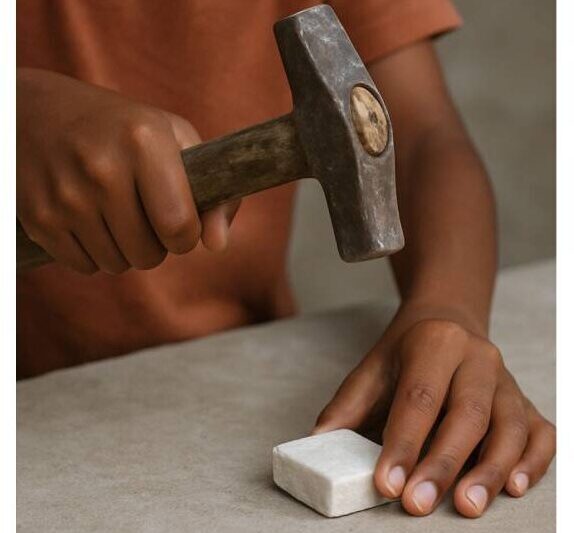
Most of the students were able to accurately define malleability and ductility. Students who classified mercury under nonmetals and the material of the coins under metals used these two properties as supporting reasons. But many of the students had also classified marble as a metal because of its ‘malleability’. This suggests that they may not have seen it break into pieces when beaten with a hammer. Chapter 4 of the Grade VII science textbook (NCERT, 2025- 2026) introduces students to this property with an idea for a simple hands-on activity (see Fig. 2). It also tells students how they can use this property to differentiate between metals and nonmetals: “You must have observed that objects such as a piece of copper, an iron nail, and a piece of aluminium become flat when beaten; whereas other objects or materials behave differently. This property by which materials can be beaten into thin sheets is called malleability. Most metals possess this property… A piece of coal or a lump of sulphur does not show this behaviour. They break into pieces and are said to be brittle. On the other hand, wood neither gets flattened into a sheet nor breaks into pieces. Therefore, wood is neither malleable nor brittle.”4 I described the activity in the textbook and asked the students if they had used this to test if marble was malleable. While the students remembered that the activity idea had been read aloud to them in class, they had not seen a demonstration or tried it for themselves.
The classification of the graphite rod led to the most debate. Most students had classified it under metals. When I asked why, these students pointed out that it was hard and shiny. The students who had classified it under nonmetals argued that it was not hard enough to be a metal. They recognized that this was the same material that was inside their pencils and knew from experience that it could be chewed. Some students responded by stating that it was a metal because it was shiny and a good conductor of electricity. They had experienced a mild shock when they had tried to insert their pencils into electrical sockets. A couple of other students decided to test its conductivity to electricity. They inserted the rod in the circuit I had kept on the table and found that the bulb glowed. In this case, the students had the opportunity to base their classification on an analysis of multiple properties. This was confusing to many students. Which of these properties must they prioritize? Were there any properties that all metals showed, but nonmetals never showed? On the other hand, carbon is listed as an example of a nonmetal in Chapter 4 of the Grade VII science textbook (NCERT, 2025-2026).4 Students read that: “Carbon is essential in everyday life because it is the building block of all life forms. It is a key component of proteins, fats, and carbohydrates, which are necessary for growth and energy.”4 But the students did not seem to know that something as common as the graphite rod in their pencils is also composed of carbon.
While the students recognized that the coins and spoon in the display were composed of steel, they placed these under the metal category because of their hardness and shine. Also, the students knew that steel became warm to touch when exposed to heat. They used the circuit to confirm that it could conduct electricity (see Fig. 3).
Since the coins were flat, the students reasoned that steel was malleable, too. What is interesting is that steel is mentioned in more than one chapter in middle-stage science textbooks and, in at least some of these cases, it is clearly referred to as an alloy of a metal and nonmetal. For example, Chapter 4 of the Grade VII science textbook (NCERT, 2025-2026) tells students that: “Do you know that ropes made of steel [a mixture of metal (iron) and nonmetal (carbon)] wires can support heavy loads? Therefore, they are used in suspension bridges and in cranes to lift heavy objects.”4 If this information on its composition was used to classify the material of the spoon, for example, it would be placed under both metals and nonmetals. Since this was not the case, it is most likely that the students did not remember the composition of steel. It is also possible that some mentions of steel may have been misleading to students. For example, Activity 3.7 in Chapter 3 (‘Heat’) of the Grade VII science textbook (NCERT, 2024-2025) invites students to: “Collect some articles such as a steel spoon, plastic scale, pencil, and divider. Dip one end of each of these articles in hot water. Wait for a few minutes. Touch the other end. Enter your observation in Table 3.3.”8
Looking at the second column of the table, students may assume that a steel spoon is made up of only ‘a’ metal (see Fig. 4). Similarly, Chapter 10 of the Grade III EVS textbook (NCERT, 2025-2026), includes this ‘Note to the Teacher’: “Show the children some common metals around you such as iron, copper, aluminium, gold, silver, mercury in a thermometer; or alloys such as steel, brass, and bronze. Alloys are mixtures of metals.”2 This, too, can be confusing to students because, for example, the gold that they commonly see in their everyday world is an alloy. Another possibility is that the students may not have understood the concept of a mixture. Or did not know what properties a mixture of a metal and nonmetal would show. At the time I tried this exercise, students were introduced to this concept in Chapter 2 of the Grade IX science textbook (NCERT, Reprint 2025-2026).5

This year, students are introduced to it in Chapter 8 (‘Nature of Matter: Elements, Compounds, and Mixtures’) of the Grade VIII science textbook (NCERT, 2025-2026).9 This chapter tells them that: “When two or more substances are mixed, where each substance retains its properties, it is called a mixture. The individual substances that make up a mixture are called its components. The components of a mixture do not react chemically with each other.”9
The material in six of the objects in the list I had shared with the students are neither metals nor nonmetals: Wood, plastic, chalk, marble, brick, and the green board. Yet, many students had not classified these materials under the ‘neither’ category. For example, plastic was classified either as a metal or a nonmetal. Some students decided that it was a metal mainly because, “It was hard.” Other students added that they had seen sheets and wires made of plastic. Therefore, they reasoned, plastic was malleable and ductile, too.
Parting thoughts
One of the goals of the middle-stage science curriculum is to help students develop the ability to classify materials as metals or nonmetals.6,7 From my discussions with Grade IX students, it was clear that they were able to answer direct and rote-based questions (like, what are the properties of metals, what is malleability, etc.) accurately. But they struggled to answer questions that were not from their textbooks. Giving them the opportunity to apply the properties they remembered to sort materials in everyday objects into metals and nonmetals revealed important gaps in their understanding of this and related concepts from the middle-stage science curriculum. These gaps may not be visible in formal assessments. Instead, using a simple classroom exercise, like the one I designed, with middle-stage science students may help teachers identify and address such gaps more effectively.
Key takeaways
- Multiple chapters of the preparatory-stage EVS and middle-stage science textbooks describe the properties of metals and nonmetals.
- Students are, often, able to accurately list and define these properties. They are also able to share accurate examples from their textbooks.
- But students may struggle to use memorized textbook facts to classify the material in objects from their everyday world as metals and nonmetals.
- Student responses to a practical classification exercise can help reveal important gaps in their understanding of this and related concepts.
Notes
- Credits for the image (Metal in a Forge) used in the background of the article title: U.S. Gov Works, Rawpixel. URL: https://www.rawpixel. com/image/5976798/photo-image-public-domain-fire. License: Public Domain.
- The author used her analysis from the exercise described in this article to design a teaching plan. The editors hope to publish this plan and the author’s experience of using it in class in the Dec 2025 issue of i wonder…
References
- National Council of Educational Research and Training (Reprint 2025-2026). ‘Chapter 6: Materials Around Us’. Curiosity, Textbook of Science for Grade VI: 101-122. URL: https://ncert.nic.in/textbook.php?fecu1=6-12.
- National Council of Educational Research and Training (2025-2026). ‘Chapter 10: This World of Things’. Our Wondrous World, EVS Textbook for Grade III: 123-134. URL: https://ncert.nic.in/textbook.php?ceev1=10-12.
- National Council of Educational Research and Training (2025-2026). ‘Chapter 3: Electricity: Circuits and their Components’. Curiosity, Textbook of Science for Grade VII: 23-40. URL: https://ncert.nic.in/textbook.php?gecu1=3-12.
- National Council of Educational Research and Training (2025-2026). ‘Chapter 4: The World of Metals and Nonmetals’. Curiosity, Textbook of Science for Grade VII: 41-56. URL: https://ncert.nic.in/textbook.php?gecu1=4-12.
- National Council of Educational Research and Training (Reprint 2025-2026). ‘Chapter 2: Is Matter Around Us Pure?’. Science Textbook for Grade IX: 14-25. URL: https://ncert.nic.in/textbook.php?iesc1=2-12.
- National Steering Committee for National Curriculum Frameworks (2023). ‘National Curriculum Framework for School Education 2023’. National Council of Educational Research and Training. URL: https://ncert.nic.in/pdf/NCFSE-2023-August_2023.pdf.
- Central Board of Secondary Education (2020). ‘Teachers’ Resource for Achieving Learning Outcomes, Classes 1 to 10’. URL: https:// cbseacademic.nic.in/web_material/Manuals/TeachersResource_LODoc.pdf.
- National Council of Educational Research and Training (2024-2025). ‘Chapter 3: Heat’. Science Textbook for Grade VII: 24-37. URL: https:// ncert.nic.in/textbook/pdf/gesc103.pdf.
- National Council of Educational Research and Training (2025-2026). ‘Chapter 8: Nature of Matter: Elements, Compounds, and Mixtures’. Curiosity, Textbook of Science for Grade VII: 116-133. URL: https://ncert.nic.in/textbook.php?hecu1=8-13.