
Experiencing how things work

A ‘Note to the Teacher’ in Unit 4 of the Grade IV Environmental Studies (EVS) textbook (NCERT, 2025-2026) shares that Chapter 7 (‘How Things Work‘) aims to nurture: ‘’… student’s natural curiosity to try out and observe common phenomena around them, including spinning, floating, and sinking. Through hands-on activities with toys, papers, and other materials used in day-to-day life, they will discover the patterns, and develop a sense of wonder about how things work.”1 It does this by suggesting a series of simple hands-on activities that are designed to: “…enable students to observe what happens and how things work in different situations. In this process, they will discover various common patterns, which gives them new learning about the materials. These new discoveries will raise their interest and curiosity in things further…”1 Despite the guidance that the textbook offers to teachers, this chapter, like the rest of the EVS curriculum, is frequently taught through rote learning and worksheets that assess textbook recall.
I designed a four-day summer camp around the experiential and child-centric approach recommended by the National Education Policy (NEP) 2020 and the National Curriculum Framework for Foundational Stage (NCF-FS) 2022.2,3 Thirty-four Grade III-V students from government schools in the Rahatgarh block of Sagar district in Madhya Pradesh participated in the camp. This offered the students a multigrade and multilevel learning environment. What did children learn from my approach?
Which objects spin?
Chapter 7 of the Grade IV EVS textbook (NCERT, 2025-2026) starts with ideas for an investigation into spinning.4 I started this investigation by asking the students: “Can you name some things that can be made to spin?” The students were initially quiet. But once I shared examples like that of a bangle, they began to respond with examples like chakri (wheel), ball, kada (bangle), lattu (top), and chakriwala jhula (Ferris wheel). I noticed that many students could not name more than one spinning object. Then, I invited the students to explore the classroom and its surroundings and collect objects that they thought could spin. The students brought items like erasers, bangles, tape, and bottle caps. And we spun them. I asked the students to observe the spinning objects. Connecting what they were doing in class with what they had observed outside it, one of the students exclaimed, “Ma’am, the tape is spinning like a matka (pot)!”
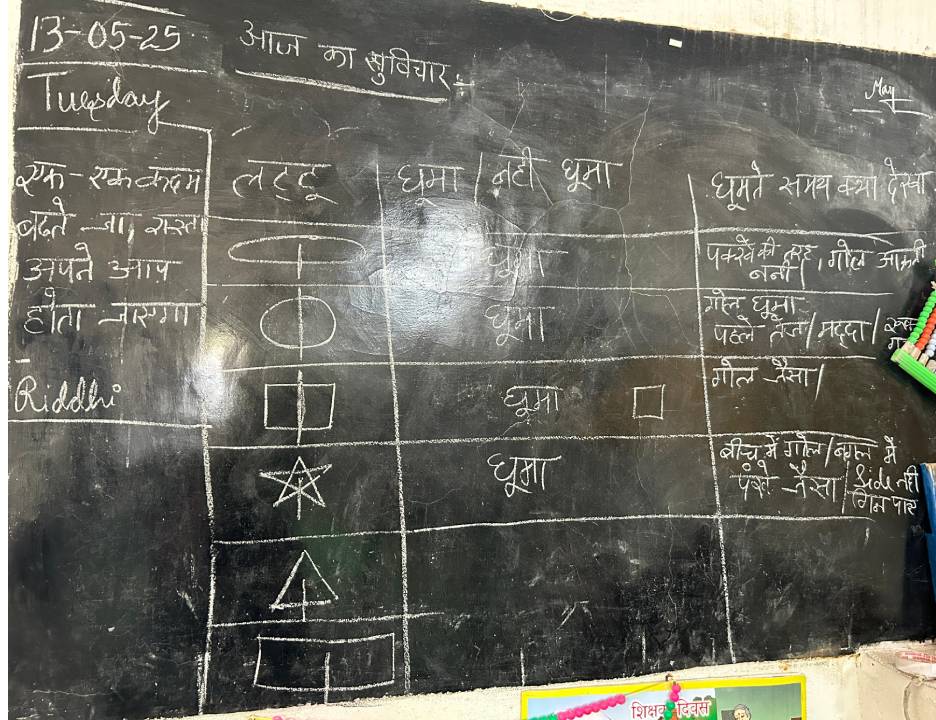
In the next part of the exercise, I invited the students to design their own spinners using cardboard and toothpicks (see Box 1). Once their spinners were ready, I encouraged them to observe what effect spinning had on the different shapes they had chosen for their models (see Fig. 1). When an oval-shaped spinner was spun, one student initially described its motion simply as “ghuma” (it spun). As they observed it more carefully, they noted that the spinner resembled a fan in motion and that it formed a circular shape while spinning. A circular spinner prompted comments like, “It is spinning like a ball” or “It’s like a lattu (top).’’ When a square-shaped spinner was spun, the students noted that even though its shape was angular, it still appeared circular while spinning. One of them remarked that they could no longer see the sides of the square, recognising how motion can change our perception of shape. A star-shaped spinner fascinated many students. One student noticed, “Its centre becomes round when it is spinning fast.” Another student pointed out that they could not count the number of sides this spinner had while it was spinning. A third student remarked that, “It looks like a fan.” When asked to elaborate, they shared that when it was spinning rapidly, the edges of the star-shaped spinner seemed to blur or disappear like the blades of a ceiling fan moving at high speed.
Box 1. Designing spinners:
While observing different objects spin, one student said, “Mere bhaiya ke paas lattu hai jo aise hi ghumta hai (My brother has a top that spins exactly like this).” I asked him, “What shape is your brother’s top?” He replied, ‘’Gol (Circular).’’ I took out a cardboard piece and a pencil. Together, we drew a circular spinner on a piece of cardboard. Then, I asked the class to suggest other possible shapes. One student said, ‘’Andakar (Like an egg).” So, I invited him to come forward and draw an oval shape on the cardboard. Inspired by this, another student added, “Ma’am, we can make a star-shaped spinner!” She too came forward and drew a star on the cardboard. In this way, the design process became a one-to-one interaction. My role was limited to offering a simple prompt: “Observe your surroundings. Think of a different shape. And come forward to draw it on the cardboard.” This open-ended prompt allowed the students to exercise their creativity and observational skills. Some looked around the classroom and drew inspiration from charts, posters, or objects they were familiar with. Others imagined shapes on their own and brought them into the activity. By the end of this exercise, there were many different shapes drawn on the piece of cardboard, including that of a circle, square, rectangle, half- moon, star, cloud, balloon, triangle, and water droplet. I divided the students into pairs in such a way that each Grade V student was paired with a student from Grade III or Grade IV. This pairing allowed the younger students to receive help from the older students. Each pair was assigned the task of cutting out the different shapes from the cardboard. Then, we inserted toothpicks into these shapes and our spinners were ready.
By refraining from giving step-by-step instructions for this activity, I allowed the students to take ownership of the learning process. The activity became not just about making spinners, but about visualizing, initiating, and expressing ideas freely. I made a conscious effort to ensure that every student had the opportunity to participate. Even if a student suggested a shape that had already been drawn, they were encouraged to come forward and draw it themselves. The emphasis was not on the uniqueness of the shapes they came up with, but on ensuring that each child had a hands-on experience and felt included in the design process. Some students chose to make spinners in multiple (2-3) shapes, while others made only one model. Regardless of how many shapes they attempted, every child had at least one opportunity to create a spinner and see their design come to life. This approach helped ensure that the classroom became a space of equal engagement and creative exploration, where every learner’s contribution was valued and visible.
These spontaneous and thoughtful observations showed that the students were actively processing the physical phenomena in front of them. Their ability to notice motion patterns, compare speeds, and connect classroom experiences with familiar real-world objects (like fans, balls, or tops) is a powerful example of learning driven by curiosity and guided observation.
The students also observed that the motion of their spinners was fast to start with, but gradually slowed down before coming to a stop. One student asked: “Ma’am why does it fall in the end?” A Grade IV student made a particularly thoughtful observation: “It falls in the end because the speed becomes slow. First, it spins very fast, then the speed reduces and, finally, when the speed is almost nothing, it falls.” Connecting this with the chakka (tyre) with which children play with in villages, he said, “As long as we push the tyre, it runs. When the speed of the tyre is almost zero, it falls.” What stood out was not just the accuracy of the observation, but the fact that the student was connecting a hands-on activity to the abstract concept of speed. While this concept is formally introduced to students at a later stage, this student was able to intuitively explain the slowing down of motion using real-world logic. For him to do this without knowing the technical vocabulary associated with speed reflects an emerging ability to reason beyond the surface level. It shows how students, when encouraged to observe closely and explain phenomena in their own words, naturally begin to engage with higher-order concepts—even those that have not yet been taught explicitly. In explaining what they see in ways that make sense to them, they begin to build the foundations for a more complex scientific understanding in the future.
The students also experimented with the position and size of the toothpick, which acted as the axis of rotation for their spinners. For example, a student who had created a star-shaped spinner inserted his toothpick at the edge of one of the star’s wings instead of at the centre. When he tried to spin it, the spinner did not rotate properly. It wobbled and fell quickly. He observed: “The weight of my spinner is not balanced; the toothpick is not in the centre.” On being questioned about his reasoning, the student connected the imbalance of his spinner to a real-life observation, saying: “It’s like when we wear a heel on one foot, but not on the other—we cannot walk properly because one side is higher than the other.” He related the side of the star with the toothpick to the heeled shoe in his example, “This side is heavier.” Like both feet need equal support to maintain balance, he reasoned, the toothpick needed to be inserted at the centre of his spinner. After adjusting the position of the toothpick, the student tried spinning his spinner three more times. Having failed at this, he observed, “The sides of the spinner are touching the ground, so it is not able to spin properly.” A little later, the same student wondered if the length of the toothpick might be disrupting the balance of the spinner. He asked, “Can we just reduce the size of the toothpick?” This showed that the student was beginning to think in a more open-ended, exploratory manner about the relationship between size, symmetry, and movement. This experience demonstrates the value of letting students explore, make mistakes, and reflect on their own experience. It also highlights the importance of inviting students to explain their understanding using language in their own way, as this often leads to richer and more relatable insights than technical terms alone can provide.
Some students tried this activity at home again, and shared their experience in class the next day. For example, a student had created a half-moon-shaped spinner and shared how it had moved when spun, “When it was spinning, it looked like a knife.” What made this moment especially significant was that the student documented this observation in writing on a piece of paper—an early and self-initiated form of scientific recording. This demonstrates that learning from the classroom need not be limited to a structured activity; it can spark curiosity that continues beyond school hours.
Why do some objects float?
The next part of Chapter 7 of the Grade IV EVS textbook (NCERT, 2025-2026) shares ideas for an investigation into floating and sinking.4 I started this exercise by asking the students: “Which objects have you seen float on water and which ones have you seen sink in water?” The students said that they had seen light objects, like leaves, float and heavy objects, like stones, sink. Then, I gave the students 8-10 minutes to explore the school surroundings and collect any things that they thought were likely to float or sink in water. These objects—leaves, rubber bands, stones, rope, rubber, stick, hairpins—were gathered in one pile. I invited the students to sit in a semicircle to increase visibility and interaction. I listed the objects in the pile on the board. The students were invited to come forward, one by one, choose an object and predict whether it would float or sink and why. As the students expressed their predictions, I recorded them on the board for the entire class to see (see Fig. 2).
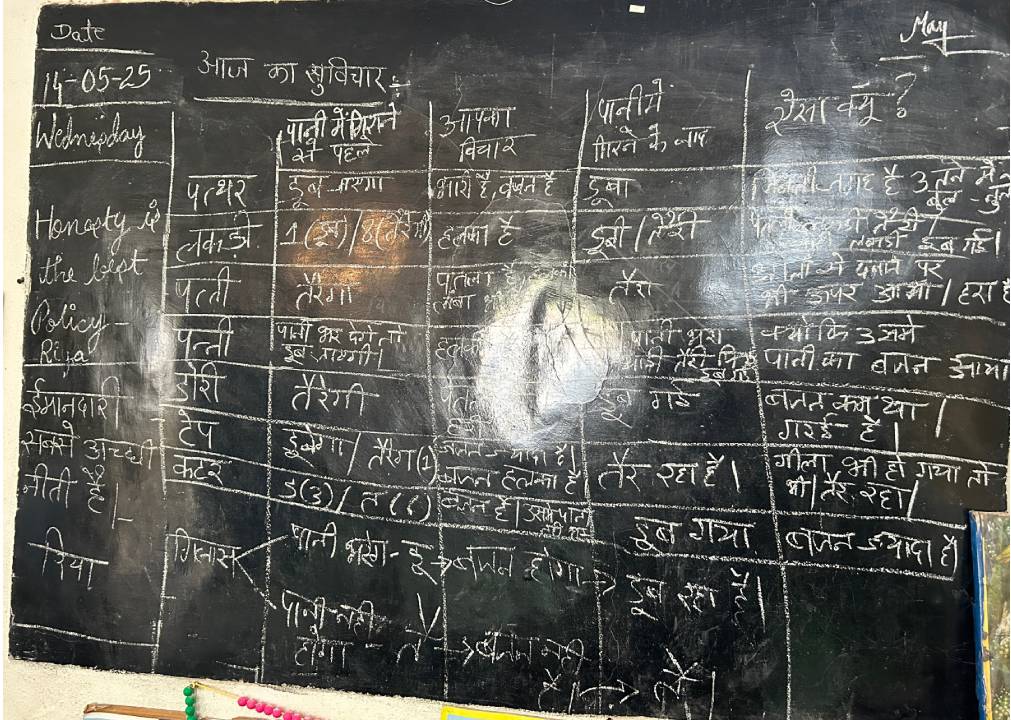
This allowed the class to collectively revisit, reflect on, and revise their thinking. I noticed that even the youngest learners demonstrated curiosity, initiative, and a willingness to participate in this exercise. For example, many Grade III students were actively listening to the logic shared by their older peers. When their turn came, they often tried to respond using similar reasoning. What stood out most was that students at this grade level were not hesitant to respond, even when asked higher-order thinking questions. Although their logic was not always accurate, they made genuine attempts to explain their thinking—an encouraging sign of growing confidence and conceptual engagement. This experience reaffirms that when students, regardless of grade level, are given voice, time, and support in a respectful and inclusive space, they can rise to a challenge.
The first predictions that students made were based on weight alone. For example, one of the students confidently predicted that a stone he had collected, “will sink.” When asked why, the response was, “Because it is heavy,” and “It is a big stone.” I then asked the student to bring a smaller and lighter stone for comparison. Once both stones were in hand, I asked: “Will both these stones sink?” The student examined them carefully and said, “Yes, both will sink. They are heavy.” We tested the prediction by dropping both stones into water. As expected, both sank, but not before leading to an interesting observation. As the stones entered the water, the students noticed that bubbles formed around them. These bubbles were visible only while the stones were still descending, and disappeared once the stones settled at the bottom of the container. I pointed to a tumbler and asked, “Will this tumbler float or sink?” Most of the students felt that it would sink. Their reason was again related to weight. Some of the students felt that it may float. One of the students said, “If there is water inside the glass, it will sink. If there is no water in the glass, it will float.”
Turning to the students who were confident that the tumbler would sink because of its heaviness, I asked, “If heavier objects sink, then why does a boat—which is heavy—float on water?” This sparked a deeper discussion (see Fig. 3). One student expressed the idea that a boat would float because: “It has wheels.” Since this did not seem directly relevant to floating, I waited for her to elaborate. The student added that she has seen a boat on television that had wheels on it, and the wheels were helping it cut through the water.
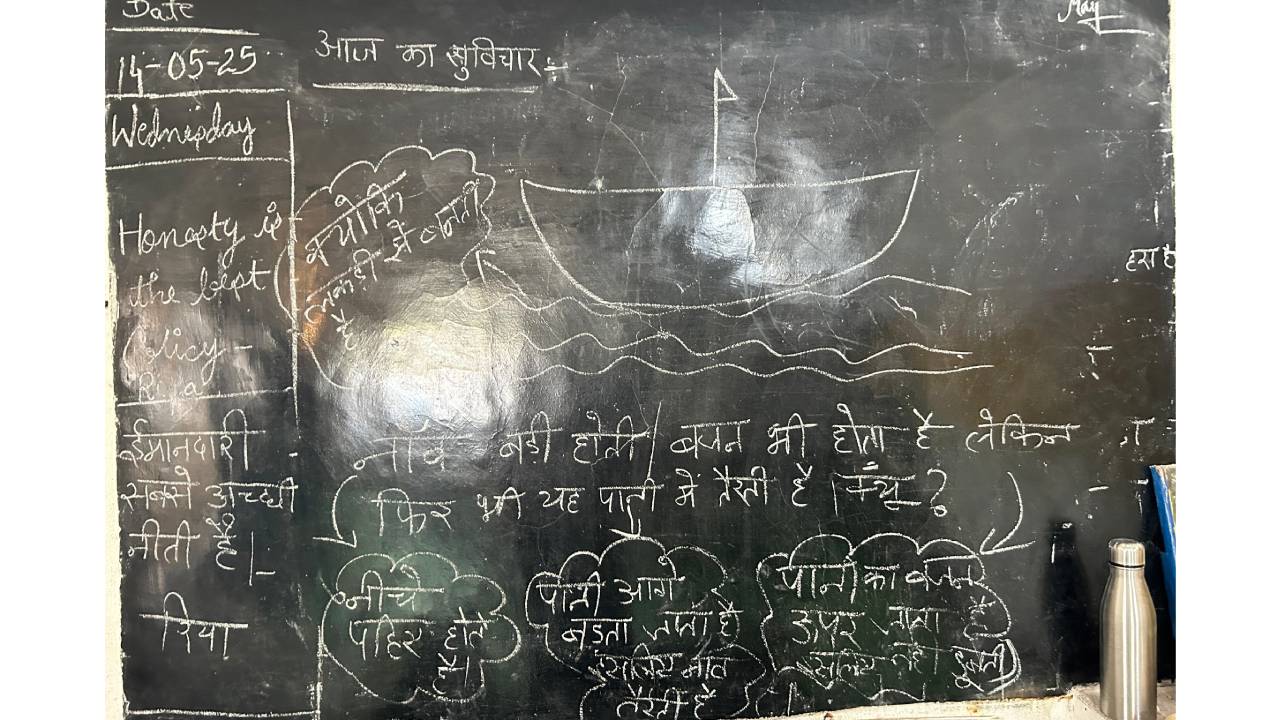
I wondered if the student was describing a turbine in action. A second student explained that: “Pani aage badhta jata hai, isliye nav tairti hai (The boat floats because the water keeps moving forward).” This explanation shows an attempt to relate the movement of water to the boat’s buoyancy. A Grade V student suggested this explanation: “Pani ka wajan uper le jata hai, isliye nav nahi doobhti (The weight of the water moves it up, that is why the boat does not sink).’’ Another student said, “Hum bhi toh tairte hain na pani mein (We also float on water).” This discussion allowed students to consider the role of the weight of the water displaced by an object on its tendency to float or sink in this medium. It also encouraged them to think more critically about the factors that influence the floating and sinking properties of objects and explore these concepts more deeply (see Box 2).
We tested the predictions the students had made by putting each of the objects in water and observing them. One particularly engaging moment involved a dori (a thin piece of rope) that the students had collected. Almost every student predicted that it would float in water. When asked why, they replied, “It is very light,” and “It doesn’t have any weight.” Some also added that it was “patli (thin)”, which reinforced their assumption. However, when the rope was placed in water, it unexpectedly sank. The students were surprised and said, “Ma’am, we predicted one thing, but something else happened!” I asked them to think about why this might have occurred. One student observed the rope closely and said, “It has a wire in it. That is why it sank.” Upon closer inspection, we found that the rope had been coated with a thick layer of black paint, giving it a stiff, wire-like appearance that added to its weight.
The student concluded that it was this heavy outer layer that caused it to sink; not the rope itself. To take their learning further, I gave the students an assignment: Search for any rope-like objects they could find in their homes and check if they floated or sank in water. The students came to class the next day excited to share their findings. Some said, “Ma’am, our rope floated,” while others said, “Ours sank.” When I asked about the material of their ropes, one student shared, “It was jute…bore wali (from a gunny bag),’’ while another said, “Hamare ghar mein patli si thi, wo dubi nahi (The one in my house was thin; it did not sink).” Through this discussion, the class collectively reached an important conclusion: Weight may not be the only factor that decides whether an object floats or sinks in water.
This exercise helped students make assumptions, build logical arguments to support them, test those assumptions, and revise their understanding when necessary. Their misconceptions were gently dismantled through engagement, not lectures.
Box 2. Designing boats that float:
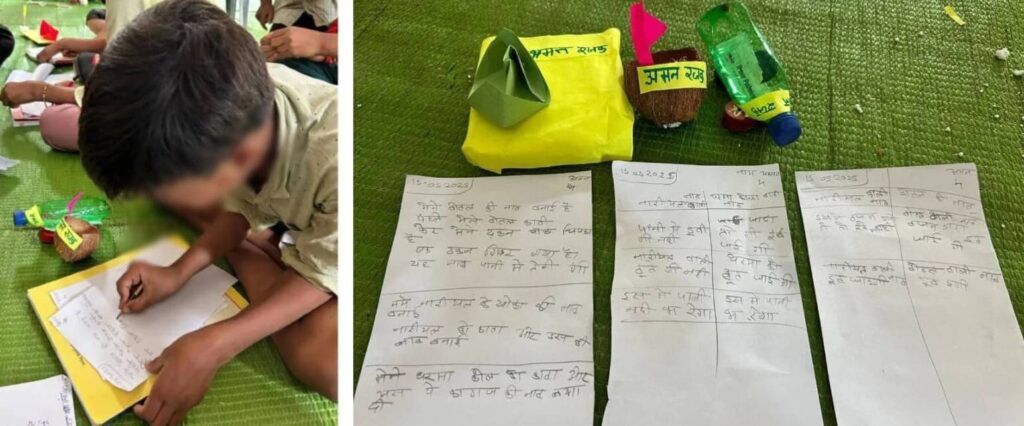
Chapter 7 of the Grade IV EVS textbook (NCERT, 2025-2026) ends with inviting students to design their own models of boats.4 I asked students to bring any inexpensive materials from home that they could use to design a working model of a boat in the classroom. I gave them some hints and prompts. For example, they were told that they could use items like coconut shells to make a boat. In addition to these, the students brought materials like thermocol, empty bottles, ice cream sticks, and cardboard. I provided basic supplies like Fevicol and scissors. Students were asked to work in groups to design and build floating boats. I grouped them in a way that not only ensured resource-sharing and collaboration, but also helped create an inclusive, cooperative learning environment. For instance, if two students brought similar materials, they were paired together. Older students (Grade V) were paired with younger ones (Grade IV). Students who brought ample materials were paired with those who had limited supplies. In total, there were 17 pairs of students. The students in each group worked together to build and test their models. They were asked to record the materials and process they used for construction and how they fixed challenges (see Fig. 4).
Please see Publication Terms here for details on the reuse of this image. Credits: Anshika Sharma. License: CC BY-NC-ND 4.0
One group, for example, documented how they had tried to build a model by sticking two pieces of thermocol together. At first, they tried using Fevicol to do this. But this did not work. So, the students looked around the classroom, searching for other material that they could use for this purpose. They found some toothpicks. But these, too, were not very effective in holding the two pieces together. Finally, they inserted some paper pins, obtained from the headmaster’s office, between the two pieces of thermocol. This approach worked, and their thermocol model was successfully completed. At the end of this exercise, we had 17 different designs. I asked each pair to compare their model with that of another group. They were asked to mention the strengths of both models, ways in which one model was better than the other, and predict if the two models would float or sink in water. One design in particular stood out for me. A student noticed some disposable cups in the classroom and ingeniously joined two of them. She then cut both from the middle to form a boat-like structure. I believe that such creativity might not have emerged if I had followed the more traditional approach of delivering a lecture on the content of the chapter. The learning environment, in this case, played a key role in bringing out this student’s ability to think innovatively.
Box 3. Curricular connections:
This pedagogical approach can help teachers meet the following:
- Curricular goals for the foundational stage:
- CG-7: Children make sense of the world around through observation and logical thinking. Specifically, it helps children develop the competency to:
- (C-7.1): “Observe and understand different categories of objects and relationships between them.”
- (C-7.2): “Observe and understand cause and effect relationships in nature by forming simple hypothesis and use observations to explain their hypothesis.”
- (C-7.3): “Use appropriate tools and technology in daily life situations and for learning.”
- CG-8: Children develop mathematical understanding and abilities to recognize the world through quantities, shapes, and measures. Specifically, it helps children develop the competency to:
- (C-8.1): “Sort objects into groups and sub-groups based on more than one property.”
- (C-8.2): “Identify and extend simple patterns in their surroundings, shapes, and numbers.”
- (C-8.8): “Recognise basic geometric shapes and their observable properties.”
- (C-8.12): “Develop adequate and appropriate vocabulary for comprehending and expressing concepts and procedures related to quantities, shapes, space, and measurements.”
- Curricular goals for preparatory-stage EVS:
- CG-1: [The student] explores and engages with the natural and socio-cultural environment in their surroundings. Specifically, it helps students develop the competency to:
- (C-1.3): “Ask questions and make predictions about simple patterns… observed in the immediate environment.”
- (C-1.5): “Use local materials to create simple objects… on their own for display or use in classroom processes.”
- CG-6: [The student] uses data and information from various sources to investigate questions related to their immediate environment. Specifically, it helps students develop the competency to:
- (C-6.1): “Perform simple inquiry related to specific questions independently or in groups.”
- CG-7: [The student] gains foundational familiarity with basic concepts and methods from the natural sciences (life sciences, physical sciences, and earth and space sciences) and engineering. Specifically, it helps students develop the competency to:
- (C-7.1): “Gain familiarity with using the scientific method in investigations, as well as familiarity with other crosscutting concepts such as energy, matter, and systems that apply across the domains of science and engineering.”
- (C-7.2): “Gain familiarity with disciplinary core ideas in the natural sciences, as well as in engineering, technology, and applications of science, which reflect the content that will be learned across subject areas in later grades.”5
Parting thoughts
The preparatory-stage EVS curriculum is designed less as a subject and more as a way to connect children to their surroundings. To help them observe, question, and understand their world. Recognising this, many EVS textbooks provide ideas for activities that are aimed at encouraging students to explore their surroundings. For example, Chapter 7 of the Grade IV EVS textbook (NCERT, 2025-2026) invites students to test if everyday objects (like erasers, bangles, and bottle caps) will float or sink in water, and share reasons to support their answers.4 Doing this activity in class will give students the opportunity to observe and reason for themselves. But many teachers approach EVS as another subject to be memorised and questions related to activities as assessments. So, they may tell their students the ‘correct answers’ to these questions. For example, a teacher may state, “The eraser will sink because it is heavy.” Students are then expected to memorise these answers, stripping their engagement with the activity of inquiry and reflection.
The camp that I organized was not a deviation from the curriculum. In fact, all the activities that students worked with were drawn from the Grade IV EVS textbook (NCERT, 2025-2026). What made it different from many EVS classrooms was my pedagogical approach. For example, none of the Grade V students could recall constructing boat models in a classroom setting. The camp offered them the opportunity to do this using household materials. According to the NCF-FS (2022), connecting classroom learning to the child’s real-world context enhances comprehension.3 We saw this in action. Hands-on experiences with everyday materials changed the camp to a living laboratory. Each of the models that the students had designed reflected their capacity for creativity, experimentation, and teamwork. These explorations showed how familiar tactile experiences can unlock students’ curiosity.
This experience demonstrates the kind of pedagogy needed in EVS classrooms. By shifting from rote to reflection, from memorisation to making, and from fear to freedom, the classroom can become a space where children’s natural curiosity is respected and nurtured. When children are given the freedom to experiment with materials from their surroundings, they began to think beyond the textbook. They build their own logic, test their assumptions, and deepen their understanding through direct experience (see Box 3). When teachers act as facilitators— encouraging observation, questioning, and hands-on work— students feel connected to the subject. It becomes their world, not just a chapter to memorise. So, let us move away from telling students, for example, what will float or sink. Instead, let us trust them to find out. Because when children explore, they do not just learn the answer; they learn how to think. Such an approach not only builds scientific thinking, it fosters curiosity, ownership, and joy in learning. Let EVS become a ‘subject’ that allows a child to learn to love learning.
Key takeaways
- The preparatory-stage EVS curriculum invites students to explore how things spin, float, or sink through ideas for many activities.
- Despite the guidance that the textbook offers to teachers, EVS continues to be taught in many schools through rote learning and worksheets that assess textbook recall.
- Using an experiential, child-led approach to teaching EVS helps students move beyond rote learning to curiosity, questioning, and real-world understanding.
- Allowing students to engage in hands-on activities on spinning, floating, and sinking can help them develop stronger observation and prediction skills.
- Involving students in the collaborative process of designing their own models of spinners and boats can help them build skills in communication, creativity, and teamwork.
- Observing how their models of spinners and boats work can help students develop and express an early understanding of scientific concepts that are formally introduced to them at later stages of schooling.
Notes
- Credits for the image (A Wooden Top Toy) used in the background of the article title: Tara Winstead, Pexels. URL: https://www.pexels.com/ photo/close-up-shot-of-a-wooden-top-toy-7123022/. License: Free to Use.
References
- National Council of Educational Research and Training (2025). ‘Unit 4: Things Around Us.’ Our Wondrous World, EVS Textbook for Grade IV: 102-103. URL: https://ncert.nic.in/textbook.php?deev1=7-10.
- Ministry of Human Resource and Development, Government of India (2020). ‘National Education Policy 2020’. Ministry of Education. URL: https://www.education.gov.in/sites/upload_files/mhrd/files/NEP_Final_English_0.pdf.
- National Steering Committee for National Curriculum Frameworks (2022). ‘National Curriculum Framework for Foundational Stage 2022’. National Council of Educational Research and Training. URL: https://ncert.nic.in/pdf/NCF_for_Foundational_Stage_20_October_2022.pdf.
- National Council of Educational Research and Training (2025). ‘Chapter 7: How Things Work’. Our Wondrous World, EVS Textbook for Grade IV: 104-116. URL: https://ncert.nic.in/textbook.php?deev1=7-10.
- National Steering Committee for National Curriculum Frameworks (2023). ‘National Curriculum Framework for School Education 2023’. National Council of Educational Research and Training. URL: https://ncert.nic.in/pdf/NCFSE-2023-August_2023.pdf.