
A project-centred approach to biographies of scientists
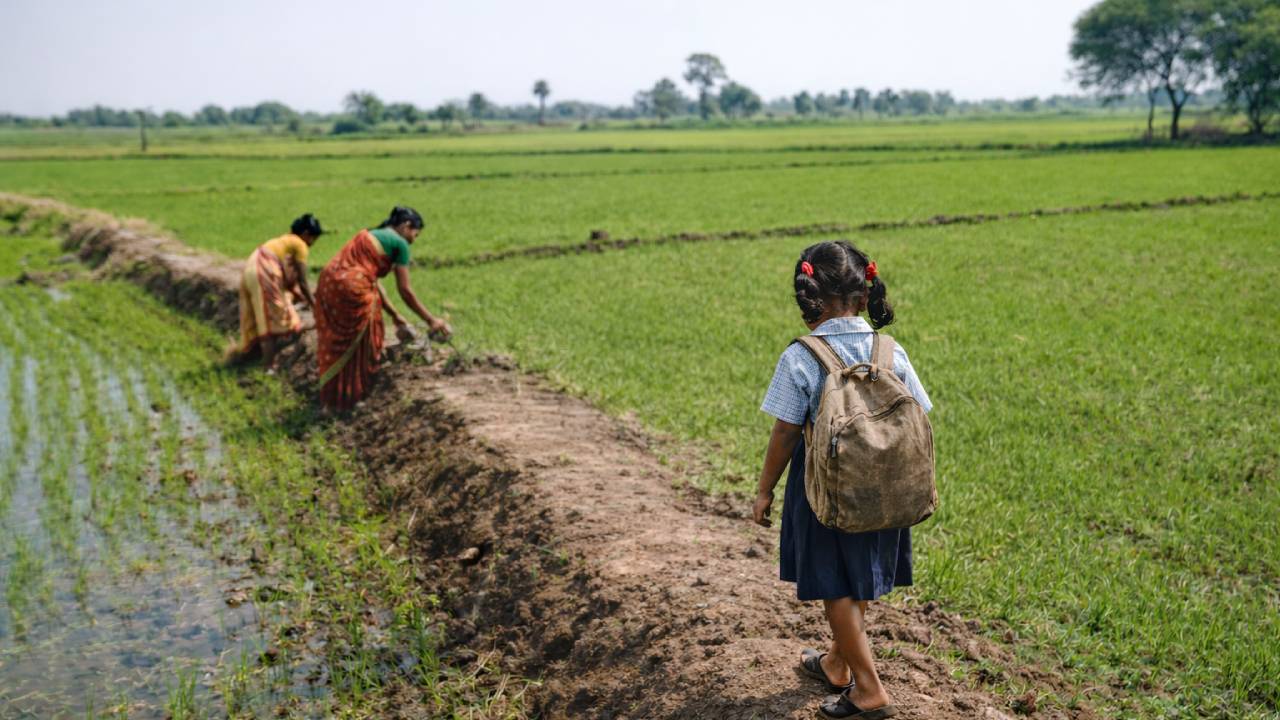
The National Curriculum Framework for School Education (NCF-SE) 2023 suggests that: “…examining the lives and works of scientists and the development of scientific knowledge is a way for students to engage with the nature and process of science and develop scientific values and dispositions”.1 It is for this reason that middle school science textbooks include biographies of scientists. An expected learning outcome for Grade VIII science is: “Children should discuss the stories of scientific discoveries and understand their importance”.2 But conversations with students and colleagues revealed that students are often asked to study these parts of the textbook by themselves. In some cases, teachers select details that are important from an examination point of view and write them down on the class board. Children are asked to copy these details in their notebooks and memorise them. In the rural environment that I teach in, I have seen many instances where children take the initiative to work together as a group towards a common goal. Their goal could be as simple as planning a trip to a nearby place or playing a team sport. In each such instance, children come up with a plan to meet this goal, decide each person’s role in the implementation of this plan, collect necessary information, and analyse it to make necessary decisions. These steps are part of the project-centred approach that the (NCF-SE) 2023 recommends for teaching school science: “This approach allows learning within the classroom to continue outside the classroom and extend over a period of time. For example, observing the changes in the moon over a month to understand the phases of the moon. In this process, connections to daily life are also made. The project-centred approach allows students to develop artefacts/products (charts, presentations, speeches) that reflect and communicate their emerging understanding. It also allows the integration of concepts across different curricular areas”.1 Since rural children use a project-centred approach so naturally and effectively in their everyday world, I decided to use it to introduce my Grade VIII students to the biographies of scientists.
My classroom process
Step 1: The Grade VIII textbook (NCERT, 2024-2025) includes biographies of eight scientists: Louis Pasteur, Alexander Fleming, Edward Jenner, Robert Koch, Ian Wilmut, Otto von Guericke, William Nicholson, and Benjamin Franklin. None of these scientists are from India. According to the NCF-SE 2023, one of the curricular goals of science education at the middle stage is to ensure that each student: “Understands and appreciates the contribution of India through history and the present times to the overall field of science, including the disciplines that constitute it”.1 With this aim in mind, I prepared a list of Indians who have made important contributions to science. This included people like Sushruta, Charaka, Kanada, Aryabhatta, Bhaskaracharya, Varahamihira, Brahmagupta, Nagarjuna, Birbal Sahni, Har Gobind Khorana, Meghnad Saha, MS Swaminathan, Homi Jehangir Bhabha, Vikram Sarabhai, APJ Abdul Kalam, CV Raman, Srinivasa Ramanujan, Jagadish Chandra Bose, and Satyendra Nath Bose. Two of these people are featured in the Grade VI textbook (NCERT, 2024-2025).
Step 2: I stuck photos of these scientists on a piece of thick cardboard and displayed this in class. I gave my students 10 minutes to look at these photos and asked if they recognised any of them. The only scientist my students knew of (and slightly) was Abdul Kalam. Apart from his name, they knew that Kalam was a scientist and had been one of the presidents of India. I named each of the scientists on the display.
Step 3: With their consent, I named each student after one of the scientists on my list. Their task was to investigate the scientist assigned to them. At the end of the two weeks, they were expected to submit a biography of this scientist. The biography could include details like: (a) What do we know about this scientist’s life and the challenges they faced, (b) What were their contributions to science, and (c) What have we learnt from their work or how have these contributions benefited us. I encouraged them to search for this information in books, newspapers, magazines, and on the Internet.
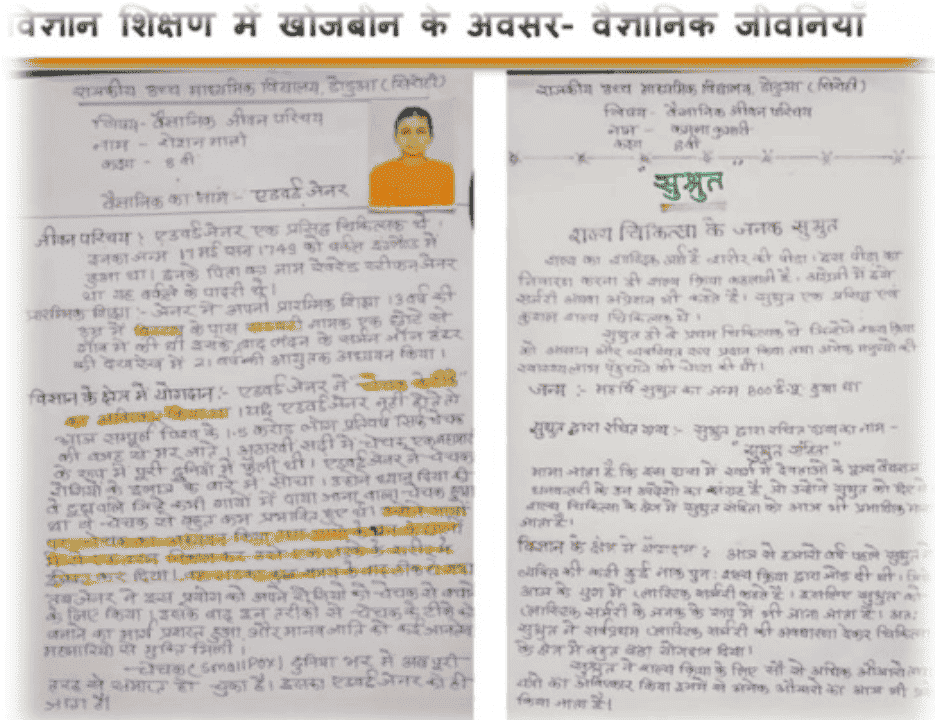
Step 4: I observed that my students applied themselves to this task with seriousness. In the days that followed, I heard them discuss their projects with each other, their siblings from higher grades, and the other teachers in school. Some of the students came up to me to share what they had learnt so far or to ask where they could get some more information. At the end of two weeks, each student submitted a piece of writing about the scientist assigned to them (see Fig. 1).
Step 5: To bring the students together as a group, I invited each of them to play the role of the scientist assigned to them and present what they had learnt about this scientist as a first-person account to the class. My students enjoyed this task. It allowed them to share their own work and hear about the scientists that their peers had researched.
Step 6: I wrapped up the project with a class discussion. I invited my students to share what they had learnt from their own work and that of their peers. This exercise gave them a chance to reflect upon and express their learning as a group.
Parting thoughts
Using a project-centred approach to introduce students to the lives and contributions of Indian scientists had many advantages. The individual tasks assigned to the students appealed to their inquisitive nature and interest in exploring new things by themselves. The process of writing biographies allowed them to develop skills like collecting information from different sources, analysing this information to understand it and reach valid conclusions, and communicating what they had learnt to their peers and teachers. The class presentations allowed my students to listen to and learn from their peers. These are important aspects of knowledge creation in science.
In the discussion that followed their presentations, the students shared how learning about the work of scientists like Sushruta, Louis Pasteur, Edward Jenner, Benjamin Franklin, and MS Swaminathan had shown them the usefulness of science in their real worlds. This observation extended into a discussion on the many ways in which the contributions of scientists from India and other parts of the world have not only helped save lives but also improved the quality of our lives. The students also shared how this project had challenged two of their most common beliefs: (a) Scientists are rarely Indian, and (b) Scientists had special abilities that made them very different from other people (in my students’ words, they were “smarter” or “more intelligent” than “ordinary” people).3 Through this project, my students learnt about some of the Indians who have made important contributions to science (see Activity Sheet: Who are these Scientists?). As they documented these lives in science and role-played them in class, they began to identify with the scientists assigned to them. For some time after the completion of this project, my students would call each other by the names of the scientists they had researched instead of their real names. Most importantly, they now looked at the biographies in their textbooks with spontaneous interest and curiosity rather than as material to be mechanically memorized for examinations.
Key takeaways
- Biographies of scientists can be an effective and engaging way of introducing students to the process of science.
- A project-centred approach that invites students to document and share key aspects of the life and work of scientists with their peers can help them develop skills like collecting, analysing, and communicating scientific knowledge.
- Focusing on scientists from other parts of the world as well as India allows students to examine some of their own beliefs about where scientists come from and who can be a scientist.
- The opportunity to relate to the people behind scientific discoveries and see how these discoveries have improved our lives can help students develop an interest in science and scientists that extends beyond examinations.
Acknowledgements
- Cooperation is key in the teaching and learning of science. The author thanks his institution head Sonu Mistry and his colleagues Tina Mistry and Saruparam for their constant support.
- The editors thank Gajendra Pal Chouhan and Amol Anandrao Kate from Azim Premji Foundation for sharing this draft with us. We acknowledge Gajendra Pal’s help in facilitating every stage of the review and design of this draft. We thank Rajesh Utsahi from Azim Premji University for sharing the English translation of the original draft (written in Hindi). We also thank Saurav Shome and Vinay Suram for their inputs on the project-centred approach described in this draft.
Notes
- Credits for the image used in the background of the article title: Constructing knowledge, Kathas_Fotos, Pixabay. URL: https://pixabay.com/photos/ jengawooden-blocks-game-strategy-6380189/. License: CC0.
- This article includes one detachable classroom resource: Activity Sheet: Who are these Scientists? The scientists in the sheet are: (a) Janaki Ammal, (b) Anna Mani, (c) Asima Chatterjee, (d) Indira Hinduja, (e) Paramjit Khurana, and (f) Kamala Sohonie. If you try this activity in your classroom, which scientists would you include and why? Write to tell us (at: iwonder@apu.edu.in).
References
- National Steering Committee for National Curriculum Frameworks. ‘National Curriculum Framework for School Education 2023’. National Council of Educational Research and Training. URL: https://ncert.nic.in/pdf/NCFSE-2023-August_2023.pdf.
- National Council of Educational Research and Training. ‘Learning Outcomes at the Elementary Stage’. First Edition. April 2017. National Council of Educational Research and Training, Sri Aurobindo Marg, New Delhi. ISBN 978-93-5007-785-6. URL: https://ncert.nic.in/pdf/publication/otherpublications/tilops101.pdf.
- The Nobel Prize Inspiration Initiative (NPII). ‘The five myths about scientists according to Nobel Laureate Martin Chalfie’. URL: https://www.youtube.com/ watch?v=0TBbK6cuuvs.