
Does an ’empty’ tumbler contain air?


Chapter 6 (‘Materials Around Us’) of the Grade VI science textbook (NCERT, 2025-2026) introduces students to matter and its fundamental properties: “Anything that occupies space and has mass is called matter… The space occupied by matter is its volume.”1 It then poses these questions: “Can all the materials around us be considered as different examples of matter?… For example, water is matter, sand and pebbles are matter and so is the cup… Is air matter?”1
Exploring the properties of air
I was in a Grade VI classroom in a government upper primary school in Sirohi, Rajasthan. I started a discussion on air with the question: “Does air exist?” To this, all the students replied, “Yes!” I asked, “I cannot see air. How do you know it exists?” Some of them agreed with me, “Yes, we cannot see air.” I repeated the question, but did not receive a response. So I gave the students a few minutes to discuss this with one of their classmates. In my experience, children feel more comfortable articulating their observations and reasoning with their peers. Often, this allows them to confirm the validity of their ideas and gives them the confidence to present these ideas to the rest of the class. When I asked the same question for the third time, I received a flurry of responses: “We cannot see air. But we can see trees move in the wind. Sand flies. Other things fly too. We can hear the wind when it blows with force.” Chapter 11 (‘Nature’s Treasures’) of the Grade VI science textbook (NCERT, Reprint 2025-2026) tells students that: “Moving air is called wind. Sometimes it blows fast, for example, during a storm, and sometimes it blows gently as a breeze.”2 I asked, “Do all things fly in the wind?” The students said that they had seen light things (like “empty polythene bags”, “grass straw”, and “feathers”) fly. I replied, “So wind can lift light things. What about heavy things?” Getting no response, I shared that when the wind speed is high, heavier things, like tin sheets used for roofing, can be blown away. This is explained in more detail in Chapter 6 (‘Pressure, Winds, Storms, and Cyclones’) of the Grade VIII science textbook (NCERT, 2025-2026): “When high- speed winds blow over houses, a low-pressure area is created over them, as high-speed winds are accompanied by a reduced pressure. Therefore, the air pressure above the roofs of the houses is lower than the pressure below them. If the pressure difference is large and the roofs are weak, they may be blown away.”3
I asked, “So we can ‘see’ that wind makes things fly. We can ‘hear’ the wind blow. Can we also ‘feel’ the wind?” To this, the answer was emphatic: “Yes!” Many students shared observations and experiences to support their response. A common one was of experiencing this force when their bicycle, bike, or bus was moving in a direction opposite to that of the wind, and “the wind hits us from the opposite direction.” After a pause, I asked, “So we know that air exists because we see, hear, and feel the wind. What if there is no wind? Does air still exist?” Many students were unsure. After some thought, some students said, “Yes.” I asked, “Where can we find it?” Many of them said that air is found everywhere “outside.” I asked, “And what do we breathe in and breathe out?’’ One of the students replied, “We breathe in oxygen.” I asked, “Do we breathe in air or oxygen?” Some of the students replied, ‘’The air we breathe in has other gases, too.” Other students started reciting the names of the gases they could remember, “Carbon dioxide”, “Nitrogen”, “Hydrogen”. In Chapter 10 (‘This World of Things’) of the Grade III Environmental Studies (EVS) textbook (NCERT, 2025-2026) students first learn that: “…objects can be classified as solids, liquids and gases.”4 Then, in Chapter 11 of the Grade VI science textbook (NCERT, Reprint 2025-2026), students learn that: “The air which surrounds the Earth is a mixture of gases… Air contains nitrogen, oxygen, argon, carbon dioxide, and other gases in small quantities.”2 I confirmed that all their responses were correct.
I also briefly explained what a mixture is. This concept is now introduced in Chapter 8 (‘Nature of Matter: Elements, Compounds, and Mixtures’) of the Grade VIII science textbook (NCERT, 2025-2026): “When two or more substances are mixed, where each substance retains its properties, it is called a mixture. The individual substances that make up a mixture are called its components. The components of a mixture do not react chemically with each other.”5 To help them relate to this, I pointed to a heap of sand in the school courtyard and asked, “Can that heap be called a mixture?’’ Many students said it was. When I asked why, they replied, “It has sand, small stones, and some pieces of iron.” Some of them told me how they used magnets to fish the iron pieces out of that heap. I had seen them doing this. This had prompted my question about the heap. I said, “The different components of air are mixed up like that, too. You named some of the gases in air. Do you know any other things that are part of this mixture?” When no answer came, I asked a question based on one of the observations they had shared before: “Can wind make sand fly?” The students said: “Yes, you can see it in the air. And dust, too.” Then, I asked, “What about water? If we throw some in the open courtyard, what will happen to it?” The students replied that it will disappear. We tried this out. Since it was summer in Rajasthan, it took only a few minutes for the water to disappear. I asked, “Where did the water go?”
The students answered that it went into the air. I explained that the water changes into a gas and mixes with the other gases in air. Students learn about ‘Water’s Disappearing Act’ in more detail in Chapter 8 (‘A Journey Through States of Water’) of the Grade VI science textbook (NCERT, Reprint 2025-2026): “The process of conversion of water into its vapour state is called evaporation.”6 To give students a quantitative understanding of the composition of air, I asked, “We know that air is a mixture of many gases. But in what quantities are these gases found?” When there was no response, I asked the students to look into their textbooks to see if they could find the answer. The students flipped through the pages of their textbook till they found this information and read it out aloud. I recorded their responses on the board: Nitrogen: 78%; Oxygen: 21%; Carbon dioxide: 0.03%; Other gases: 0.97%. Chapter 11 of the latest Grade VI science textbook (NCERT, Reprint 2025-2026) presents this information as fractions: “Out of 100 squares, 78 are occupied by nitrogen, 21 are occupied by oxygen, and 1 by argon, carbon dioxide, and other gases.”2
I held up a steel tumbler that I had brought into class. I turned it around so that students could see inside it. Then, I asked students, “Is this tumbler empty or does it contain something?” The students replied, “Empty.” I asked, “Does it contain air?” Many of the students quickly said, “No.” Some of them looked confused and did not respond. I gave the class some time to think before I repeated my question. This time, looking at each other, all the students said that there was no air in the tumbler. I filled a bucket with water and brought it into class. The students watched with curiosity. I turned the tumbler upside down and asked the students again, “Are you sure there is no air in this tumbler?” Again, the students said, “Yes.” Then, I asked, “What if I put this empty tumbler into this bucket of water upside down? What do you think will happen?” One of the students predicted that if I pushed the tumbler into the water and released it, it would bounce back to the surface of the water.
This suggests that the student had observed the effect of the buoyancy of water on objects submerged in it. Students are formally introduced to this concept in Chapter 5 (‘Exploring Forces’) of the Grade VIII science textbook (NCERT, 2025-2026) through a similar activity: “Take an empty plastic bottle (with its lid closed tightly) and a bucket full of water. Push the bottle in the water… Do you feel an upward push? Release the bottle. Does it bounce up? You would have felt an upward push and the bottle bounces back to the surface of the water. This indicates that water applies a force on the bottle in the upward direction. In fact, all liquids apply a similar force. The force applied by a liquid on an object in the upward direction is known as upthrust or buoyant force.”7 I asked the student, “Why? Will the tumbler come up because there is air in it?” He said he was sure there was no air in the tumbler. He did not know why the tumbler would come up, but he knew it would. I said: “Let us try putting this tumbler in.”
I asked all the students to move closer to me so that everyone could observe the activity properly. I held the tumbler up, and again asked, “Does anyone think there is air in this tumbler?” The students did not answer. My intention in asking the same question multiple times was to ensure that the students actively looked for any evidence for the presence of air in the empty tumbler. Then, I turned the empty tumbler upside down, closed its open mouth with the palm of my other hand, and gently immersed this set-up in the water. Holding the tumbler vertically, I asked the students to carefully observe the water in the bucket, “Can you see any evidence that the tumbler has air?” The students peered into the water, but remained silent. Then, very slowly, I started removing the palm of my hand from the mouth of the tumbler, while tilting the tumbler slightly (see Fig. 1).
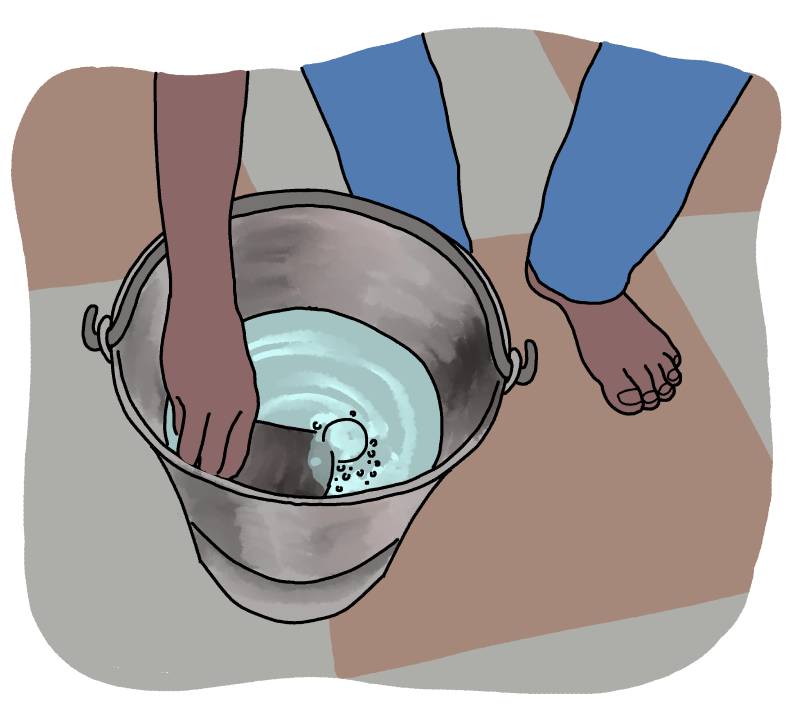
Immediately, we could all see bubbles coming out into the water and moving up towards its surface. I asked the students, “What do you think is happening here?” Their spontaneous response was, “Air is coming out.” They explained that they had seen other examples of this. Some of them mentioned that the bubbles in the bucket were like those that rise to the surface of water when it is heated to make tea. I said: “But where could air have come from? You said there was no air in the inverted tumbler before I put it into the water. I closed the mouth of the tumbler in front of you. When I moved my hand away, how did air come out from the empty tumbler?” Now, the students stated, with certainty, that the empty tumbler must have had air in it because they were able to see the bubbles that came out of it.
I repeated the activity once. Then, I invited the students to try it out by themselves. Some of them repeated what they had seen me doing. But others began to introduce variations. For example, one of the students copied me in tilting the tumbler slightly upward under water. But when bubbles started appearing from under the near-vertical tumbler, they increased its upward tilt. The students watching this remarked that the number of bubbles and the speed with which they came out had increased. The first student continued to move the mouth of the tumbler upward till it was filled to the brim with water. All of us observed that there were no more bubbles in the water. I asked, “Why are bubbles not coming out of the tumbler now?” The students guessed that all the air had already come out from the tumbler. They added: “No air is left in the tumbler now.” Another student, named Yogita, held the tumbler upside down in her hand in such a way that her index finger remained inside the tumbler. She held the inverted tumbler under the water in this position for some time. Then, she took the set-up out of water and looked at her index finger. Showing it to her classmates, she said, “Look, it’s still dry.” I asked Yogita: “Why do you think your index finger remained dry?” She replied: “There is air in the empty tumbler. There is no water. So my finger did not get wet.” While this activity may seem simple, it demonstrates Yogita’s use of the scientific process. She had seen bubbles coming out from under the tumbler when we moved our palm away from its mouth. Like the other students, she had inferred that this was air escaping from the tumbler.
But does the air from the tumbler need to come out for water to enter? She reasoned that if the tumbler remained filled with air as long as it remained vertical and its mouth was covered with the palm of her hand, any dry object that was kept in the tumbler would remain dry. This was her hypothesis. That her finger remained dry when she took the set-up out of water confirmed it. She now knew, from her own experience, that unless air escaped from the tumbler, water did not enter it. I shared her reasoning with the other students and invited them to test it for themselves.
After giving the students enough time to experiment with this activity, I asked, “Why does the tumbler not fill up with water as soon as we move our hand away from its mouth?” By this time, many of the students had tried Yogita’s version of the activity and seen the same result: The finger inserted into the upturned vertical tumbler remained dry. They replied, “There is air in the tumbler, how can it fill up with water?” I asked, “The tumbler is fully immersed in the water. But no water goes into it till it remains vertical. When does it start filling up with water? Let us try seeing this.” I held up a transparent plastic bottle and asked the students, “We are going to repeat the tumbler activity with this bottle. If some water does go into the bottle, will we be able to see it?” The students replied: “Yes.” After a brief pause, some of them asked, “But how will we make water go into the bottle?” I reminded them of the modification some of their classmates had made to the activity. They had continued to tilt the tumbler upward. The more they had tilted it, the more it had filled up with water. The students and I repeated this process with the bottle. We observed that the less the air bubbles that escaped from the bottle, the less the volume of water that filled into it. The more the air bubbles that came out of the bottle, the more the volume of water that filled into it. I asked, “Why do you think the amount of water that goes into the bottle depends on the amount of air that comes out of it?” The students replied, “The amount of water that goes into the bottle is equal to the amount of air that comes out of it.”
I now shared that air fills up all empty spaces on our planet. The tumbler appeared empty. But when we inverted it, immersed it in water, opened its mouth, and started tilting it upward, a certain volume of air came out of it as bubbles. The same volume of water moved into it. This shows that the ’empty’ tumbler was filled with air and that air also occupies space. When an apparently empty space gets filled with a certain volume of some other material, an equal volume of air moves out of that space. I emphasized this point with an example they could relate to: “There is air in this room. It occupies every space that looks empty. It is between the open pages of your book, in your bag, within your body. When you go out of this room, air equal to your body volume comes into the room. And when you come into the room, air equal to your body volume goes out of the room.” To test the students’ understanding, I filled half the tumbler with water. Showing this to them, I asked, “What is in this tumbler?” The students replied: “It has water.” I asked, “Is the entire tumbler filled with water?” The students replied: “There is some water and some air in it.” This demonstrated that the students were able to see that air was present in the space that appeared empty. To confirm this, I explained, “If I pour water from this tumbler into another tumbler, then some air from the other tumbler will come out to make space for the water. If I filled the other tumbler to the brim with water, all the air will come out of it. The tumbler will then be filled only with water. There will be no air in it.” The discussion ended with students sharing their experience of what they had done, seen, and learned in class.
Box 1. Curricular connections:
These activities and the supporting discussion can help meet the following:
- Curricular goals for middle-stage science:
- CG-1: [The student] explores the world of matter and its constituents, properties, and behaviour. Specifically, it can help students develop the competency (C-1.2) to: “Describe changes in matter (physical and chemical) and use particulate nature to represent the properties of matter and the changes.”
- CG-6: [The student] explores the nature and processes of science through engaging with the evolution of scientific knowledge and conducting scientific inquiry. Specifically, it can help students develop the competency (C-6.2) to: “Formulate questions using scientific terminology… and collect data as evidence (through observation of the natural environment, design of simple experiments, or use of simple scientific instruments).“8
- Curricular expectations for middle-stage science: Students are expected to develop process skills of science which includes observation(s), posing question(s), searching various resources of learning, planning investigations, hypothesis formulation and testing, using various tools for collecting, analysing, and interpreting data, supporting explanations with evidences, critically thinking to consider and evaluate alternative explanations, reflecting on their own thinking.9
- Learning outcomes (LO) for middle-stage science:
- Conduct simple investigations to seek answers to queries.
- Relate processes and phenomenon with causes.
- Explain processes and phenomenon.
- Apply learning of scientific concepts in day-to-day life.
- Exhibit creativity in designing, planning, making use of available resources, etc.9
Parting thoughts
Giving children the opportunity to learn through an inquiry-based approach allows them to become familiar with the scientific process (see the Activity Sheet and Teacher’s Guide). I have observed that children can get so involved in investigating a phenomenon we are exploring that they often modify an activity I have demonstrated or design new activities around it. When I shared Yogita’s modification with children from other schools, it inspired other variations. For example, in one school, a student did this activity with a pencil inserted into the inverted tumbler. In another school, students glued some paper to the bottom of the inner surface of the tumbler. Like Yogita, these students found that the pencil and paper remained dry when the inverted glass was dipped into water and kept vertical. This, for them, validated the presence of air in the empty tumbler. They were also more confident about this conclusion because it was drawn from their observations of a variation that they had come up with themselves (see Box 1).
If students are consistently allowed to apply this process in the science classroom, then they will develop the skill to test the validity of textbook facts for themselves, use their own observations to draw logical conclusions, and create their own knowledge of phenomena. Such experiences can also play an important role in helping them develop into citizens with qualities like “scientific temper, humanism, and the spirit of inquiry and reform” that are enshrined in Article 51A (h) of our Constitution.10
Key takeaways
- Students are introduced to the difference between solids, liquids, and gases in the preparatory-stage EVS curriculum and to the concept of matter and its properties in the middle-stage science curriculum. But students may not connect these concepts to air.
- Asking questions that encourage students to share and examine their everyday experiences of air can help them connect their sensory perception of its properties with textbook concepts on matter.
- Involving students in a hands-on investigation to check for the presence of air in an empty tumbler can allow them to validate this fact for themselves.
Notes
- Credits for the image (Metal tumblers) used in the background of the article title: FullyFunctnlPhil. URL: https://www.flickr.com/ photos/83626281@N00/5085420947/. License: CC BY-NC-SA 2.0 Generic Deed.
- The editors thank Amol Anandrao Kate and Shiv Pandey from Azim Premji Foundation for sharing this draft with us. We also thank Rajesh Utsahi from Azim Premji University for sharing the English translation of the original draft (written in Hindi).
- This article includes two detachable classroom resources: Activity Sheet: Test the Presence of Air in the Tumbler and Teacher’s Guide: Designing an Inquiry-Based Approach.
References
- National Council of Educational Research and Training (Reprint 2025-2026). ‘Chapter 6: Materials Around Us’. Curiosity, Textbook of Science for Grade VI: 101-121. URL: https://ncert.nic.in/textbook.php?fecu1=6-12.
- National Council of Educational Research and Training (Reprint 2025-2026). ‘Chapter 11: Nature’s Treasures’. Curiosity, Textbook of Science for Grade VI: 209. URL: https://ncert.nic.in/textbook.php?fecu1=11-12.
- National Council of Educational Research and Training (2025). ‘Chapter 6: Pressure, Winds, Storms, and Cyclones’. Curiosity, Textbook of Science for Grade VIII: 80-97. URL: https://ncert.nic.in/textbook.php?hecu1=6-12.
- National Council of Educational Research and Training (2025). ‘Chapter 10: This World of Things’. Our Wondrous World, EVS Textbook for Grade III: 121-134. URL: https://ncert.nic.in/textbook/pdf/ceev110.pdf.
- National Council of Educational Research and Training (2025-2026). ‘Chapter 8: Nature of Matter: Elements, Compounds, and Mixtures’. Curiosity, Textbook of Science for Grade VIII: 117. URL: https://ncert.nic.in/textbook.php?hecu1=8-13.
- National Council of Educational Research and Training (Reprint 2025-2026). ‘Chapter 8: A Journey Through States of Water’. Curiosity, Textbook of Science for Grade VI: 144-145. URL: https://ncert.nic.in/textbook.php?fecu1=8-12.
- National Council of Educational Research and Training (2025-2026). ‘Chapter 5: Exploring Forces’. Curiosity, Textbook of Science for Grade VIII: 76. URL: https://ncert.nic.in/textbook.php?hecu1=5-13.
- National Steering Committee for National Curriculum Frameworks (2023). ‘National Curriculum Framework for School Education 2023’. National Council of Educational Research and Training. URL: https://ncert.nic.in/pdf/NCFSE-2023-August_2023.pdf.
- National Council of Educational Research and Training (2017). ‘Learning Outcomes at the Elementary Stage’. National Council of Educational Research and Training. URL: https://ncert.nic.in/pdf/publication/otherpublications/tilops101.pdf.
- Government of India. ‘The Constitution (42nd Amendment) Act, 1976. Part IV A. Fundamental Duties, 51A (h)’. india.gov.in. URL: https://www. india.gov.in/my-government/constitution-india/amendments/constitution-india-forty-second-amendment-act-1976.