
Exploring acids and bases with natural indicators


Chapter 4 (‘Acids, Bases, and Salts’) of the Grade VII science textbook (NCERT, 2024-2025) introduces students to acids and bases through their sense of taste. It then cautions them against tasting unknown substances and poses the question: “If we cannot taste every substance, how do we find its nature?”1 This is how students are introduced to indicators, which are defined as: “… special type of substances used to test whether a substance is acidic or basic… indicators change their colour when added to a solution containing an acidic or a basic substance”.1 Some of the most common acid-base indicators used in labs include methyl orange, bromothymol blue, methyl red, bromocresol green, litmus, and universal indicator paper. These may not be available in many schools. When available, they may be too expensive to use for anything other than teacher demonstrations with a limited range of materials. In some cases, teachers with no formal training in science (but teaching it because teachers trained in science are unavailable) may not be confident about handling such chemicals. In such cases, students may only read ‘facts’ about indicators.
To address such challenges, Chapter 4 of the Grade VII textbook shares examples of two naturally occurring indicators: the powder of Turmeric rhizomes (haldi) and the extract of China rose (hibiscus) flowers. It also shares two simple activities (Activities 4.2 and 4.3) that invite students to prepare and use these indicators to test the acidity or alkalinity of many materials from their everyday world.1 I share my experience of using these activities to start a wider exploration into other materials from the natural world that can act as acid-base indicators.
Properties of natural indicators
Once students have tried Activities 4.2 and 4.3 from their textbook, teachers can point out that both indicators are extracted from plants. In fact, all natural indicators known to us today come from plants. They can ask students if they have observed any other properties that are common to these indicators. This discussion can lead students to recognise that:
- Contact with an acid or base causes a rapid and sharp change in colour in both indicators. Teachers can share that some indicators show a change in odour. While such ‘olfactory’ acid-base indicators are formally introduced in Chapter 2 (‘Acids, Bases, and Salts’) of the Grade X science textbook (2024-2025), you could invite students to try observing how contact with lemon juice and chuna water change the odour of onions and cloves.2
- For both indicators, the change in colour produced by contact with an acid is different from that produced by contact with a base. Teachers can ask students to predict if this change is reversible and how they would test their response.
Sources of natural indicators
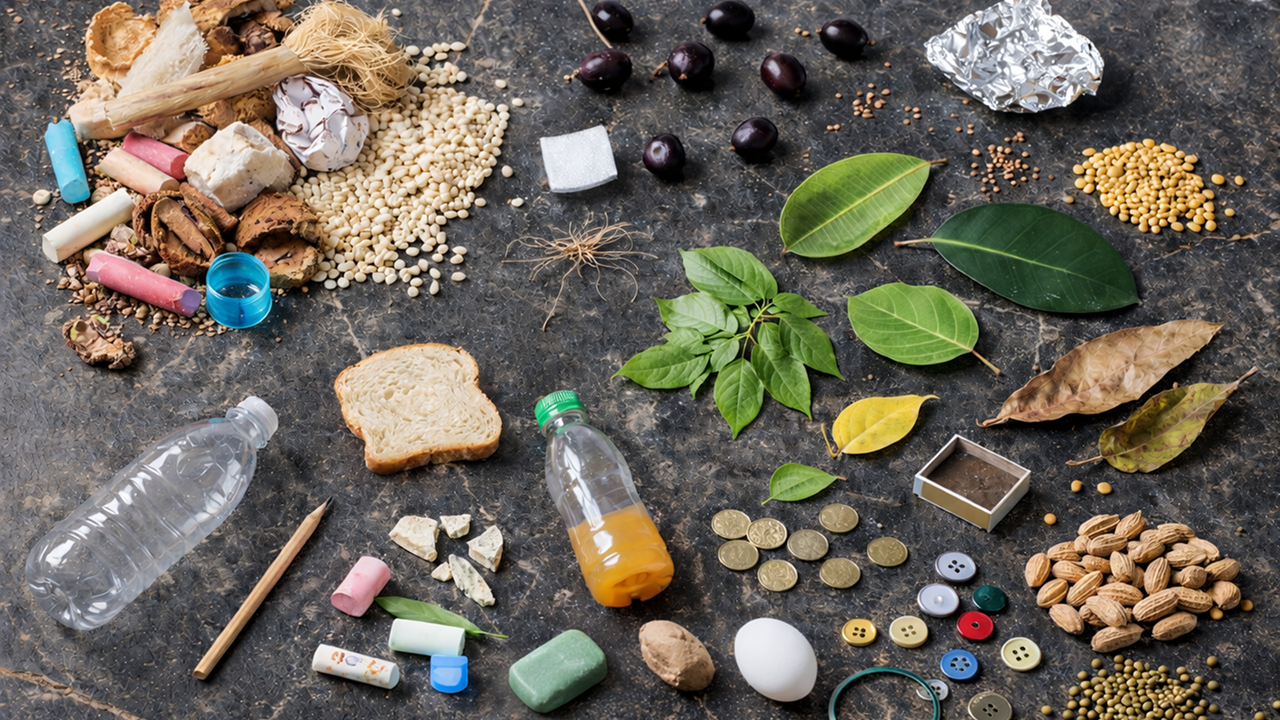
Teachers can ask students if they can think of other plant extracts that can act as natural indicators. Students can be invited to bring at least one potential source (stems, leaves, flowers, fruits, and/or seeds) from their immediate environment to class.
Students will likely bring many different colourful plant parts for this inquiry. Each plant part can be listed on the board. The student who has brought it can be asked to share more details about it, like which plant it comes from (they could share local or common names), where they found this plant, and which part they have chosen to bring to class. They can also be asked why they think the part could be a good acid-base indicator. This question may draw students to share any colour change they may have observed in the plant part in response to a household substance that is acidic or basic. For example, they may have observed how the juice from purple cabbage changes to pink when lemon juice is added to it.
Once the list of potential sources of natural indicators is prepared, students can be introduced to methods of preparing their extracts.
Extracting potential indicators
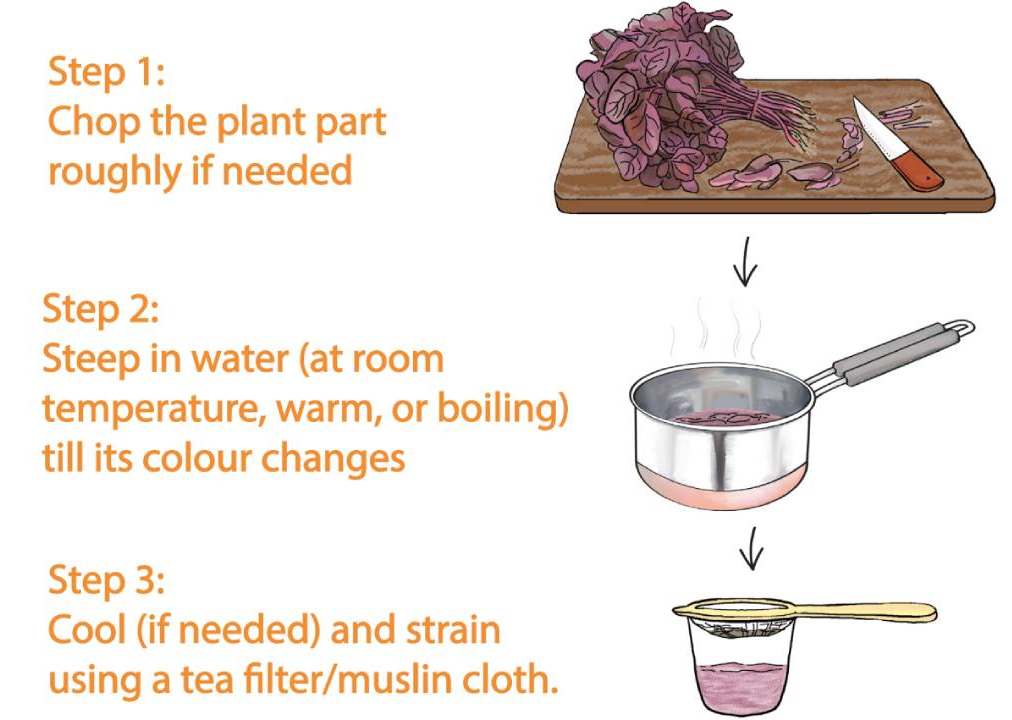
Natural indicators are prepared by extracting their pigments (like lawsone in henna and the anthocyanins in many red-, blue-, and purple-coloured fruits, vegetables, flowers, and leaves). The process of extracting these pigments is similar to making tea. The plant part is ‘steeped’ in a solvent. The most commonly used solvent is alcohol. But water (cold, warm, or boiling) can be used instead and may be safer for students to handle on their own. The mixture is strained using a tea filter or muslin cloth. The coloured liquid is used as an indicator (see Fig. 1).
Chapter 4 of the Grade VII textbook shares one example of this process: “Collect some China rose (Gudhal) petals and place them in a beaker. Add some warm water. Keep the mixture for some time till the water becomes coloured. Use the coloured water as an indicator”.1 If students have tried Activity 4.3 in the classroom, they would have prepared this indicator. Teachers can share that other indicators can be extracted by a similar method. Specify, however, that small variations may be needed for each plant part on their list (see Teacher’s Guide I). Encourage students to work in groups and extract pigments from at least three different sources on the list.
Identifying potential indicators
In Activities 4.2 and 4.3, students are invited to test turmeric and China rose extracts on 7-8 everyday substances. These include acidic substances like lemon juice and vinegar and basic substances like baking soda solution and lime (chuna) water. Students could test the liquids they have extracted from other plant parts in the same way (see Teacher’s Guide II). Remind students that natural indicators will show the two properties that were common to the turmeric and China rose indicators.
Box 1. Curricular connections:
Activities and discussions around this exploration with natural indicators can help meet the following curricular goals outlined in the NCF-SE (2023) for middle-stage science:
- CG-1: [The student] explores the world of matter and its constituents, properties, and behaviour. Specifically, it can support students in developing the following competency: C-1.1: “Classify matter based on observable… chemical (pure, impure; acid, base; metal, nonmetal; element, compound) characteristics”.
- CG-6: [The student] explores the nature and processes of science through engaging with the evolution of scientific knowledge and conducting scientific inquiry. Specifically, it can support students in developing the following competency: C-6.2: “Formulate questions using scientific terminology (to identify possible causes for an event, patterns, or behaviour of objects) and collect data as evidence (through observation of the natural environment, design of simple experiments, or use of simple scientific instruments)”.3
It can also help meet the following learning outcome for Grade VII science: [The student] conducts simple investigations to seek answers to queries like: Can the extract of coloured flowers be used as acid-base indicators?4
Parting thoughts
According to the National Curriculum Framework for School Education (NCF-SE) 2023: “…the most important part of learning science is actually ‘doing science’ through hands-on experiential learning”.3 This simple hands-on approach to discovering sources of natural indicators from their immediate environment can be very effective in engaging the interest and curiosity of students in middle-stage classrooms.
Choosing potential sources of natural indicators can help draw students’ attention to the diversity of plant life in and around their home and school. The process of preparing plant extracts and identifying potential indicators using simple everyday materials (like a pan for steeping and a tea filter for straining) can help students develop the ability to be more resourceful.
Exploring new materials and methods, discussing their observations, and thinking together can help students build their science skills (see Teacher’s Guide III). Thus, learning concepts in this hands-on way can not only make science learning fun and colourful, but can also strengthen students’ ability to think scientifically (see Box 1).
Through this exploration, students will likely identify at least some plants or plant parts in their surroundings that can be used to extract natural indicators. These could include:
- Flowers of plants like rose (Gulab), butterfly pea (Aprajita), Acalypha indica (Kuppi) and spiderwort (Baingani dil).
- Leaves of plants like pentas, poinsettia, and rangoon creeper.
- Vegetables like red cabbage, purple sweet potatoes, and beetroot.
The ease with which natural indicators can be used to test the acidity and alkalinity of everyday substances can offer teachers many opportunities to connect textbook concepts with the everyday worlds of their students (see Teacher’s Guide IV and Activity Sheet).
I have observed that such hands-on experiences can strengthen student-teacher relationships and help create a more harmonious learning environment. Some of the teachers I work with have shared that the confidence they gained in working with natural indicators has encouraged them to design hands-on experiences for other chemistry topics in the middle-stage science curriculum. Similarly, my explorations with this theme have inspired me to design other classroom approaches that use low-cost and everyday materials.
I hope that the teachers reading this article will be inspired to try this approach in class and share their experiences so we can learn from each other.
Key takeaways
- The middle-stage science curriculum introduces students to two colourful, inexpensive, readily accessible, and safe-to-handle natural acid-base indicators as alternatives to chemical indicators.
- Inviting students to ‘discover’ other sources of natural indicators from their surroundings can help build many science skills, including the ability to be resourceful, to make observations, and to engage in collaborative investigation.
- Such experiential learning opportunities can help engage student interest, deepen their understanding of textbook concepts on acids and bases, and foster their ability to think like a scientist. They can also strengthen teacher-student relationships, creating a more harmonious learning environment.
Notes
- Credits for the image (Turmeric powder) used in the background of the article title: Formulate Health (Flickr.com). URL: https://www.flickr.com/photos/formulatehealth/50191150578/in/photostream/. License: CC BY 2.0.
- This article includes five detachable classroom resources: Teacher’s Guide I: Extracting Potential Natural Indicators, Teacher’s Guide II: Colour Change in Natural Indicators, Teacher’s Guide III: Discovering Other Natural Indicators, Teacher’s Guide IV: Exploring Uses of Natural Indicators, and Activity Sheet: Be an Indicator Jasoos!.
References
- National Council of Educational Research and Training (2024). ‘Chapter 4: Acids, Bases, and Salts’. Science Textbook for Grade VII: 38-46. URL: https://ncert.nic.in/textbook.php?gesc1=4-13.
- National Council of Educational Research and Training (2024). ‘Chapter 2: Acids, Bases, and Salts’. Science Textbook for Grade X: 17-36. URL: https://ncert.nic.in/textbook.php?jesc1=2-13.
- National Steering Committee for National Curriculum Frameworks (2023). ‘National Curriculum Framework for School Education 2023’. National Council of Educational Research and Training. URL: https://ncert.nic.in/pdf/NCFSE-2023-August_2023.pdf.
- National Council of Educational Research and Training. ‘Learning Outcomes at the Elementary Stage’. First Edition. National Council of Educational Research and Training (2017). URL: https://ncert.nic.in/pdf/publication/otherpublications/tilops101.pdf.