
Learning to measure temperature with a paper thermometer
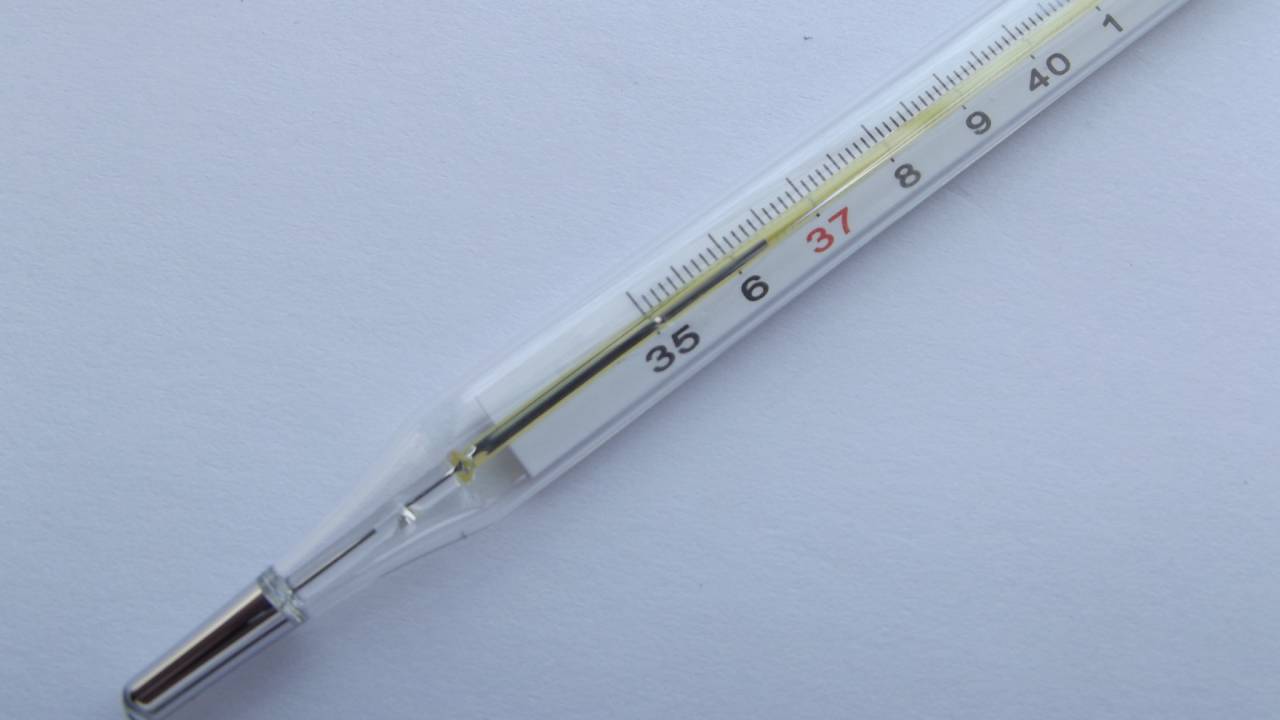
Temperature is a word that children tend to be familiar with in their everyday life. In school, they are first introduced to it in Chapter 15 (‘Blow Hot, Blow Cold’) of the Grade V Environmental Studies (EVS) textbook (NCERT, 2024-2025).1 At this stage, students may not realize that the sense of touch is not a reliable way to estimate temperature. They may also not be aware that temperature can be measured and used to describe the condition of materials (including the air that surrounds them).2 But learning to quantify and measure physical quantities, like temperature, with accuracy is a fundamental skill in science. As shared in the National Curriculum Framework for School Education (NCF-SE) 2023, science education in the middle stage needs to provide students with the opportunity to: “…identify and measure physical properties and determine the mathematical relationship between physical properties…“3 It is in Chapter 7 (‘Temperature and its Measurement’) of the Grade VI science textbook (NCERT, Reprint 2025-2026) that students are formally introduced to the process of measuring temperature using clinical and laboratory thermometers.4 While this process may seem straightforward, it involves a complex combination of concepts and skills that develop over years.5 Research indicates that the principles of measurement are difficult for many students and require more attention in school than is usually given.6 For example, I have observed that students find it difficult, initially, to identify the liquid column, locate the meniscus (the curved upper surface of the liquid in the glass tube), and read the temperature (see Fig. 1). Or, they may struggle with recording the temperature accurately because they are not sure what the smaller subdivisions on the scale represent. They may also report measurements taken on the Celsius scale and Fahrenheit scale interchangeably because they do not recognise the importance of consistent standard units in measurement.
For these reasons, it may be necessary to ensure that each student is given the opportunity to handle thermometers themselves and practice making accurate measurements with them. But this may not be feasible in some classrooms due to safety and cost considerations. In such cases, a paper model of a thermometer can act as an inexpensive and useful teaching aid.
Using paper models in class
Paper models of thermometers can be used:
- For demonstrations: I have found these models very useful in classroom demonstrations. The liquid column in a glass thermometer moves with variations in the surrounding temperature. Also, the meniscus may not be visible to students. In contrast, the reading in a paper model is static. Models can be constructed in different sizes. I use large ones for demonstrations. The markings on these models are clearly visible to students, even those sitting at a distance. Also, paper models can be easily manipulated by the teacher.
- For hands-on experiences: Students enjoy making their own paper models (see the Activity Sheet). The process of construction is simple and the materials required for it are inexpensive. Working in pairs or small groups, students can practise taking multiple readings of the temperature marking on these models before they handle a glass thermometer (see the Worksheet). This can also help them develop more confidence in making temperature measurements (see Box 1).
Box 1. Curricular connections:
Activities and discussions around a paper model of a thermometer can help meet the following:
- Curricular goal for middle stage science: CG-1: [The student] explores the world of matter and its constituents, properties, and behaviour. Specifically, it helps students develop the competency (C-1.3) to: “Explain the importance of measurement and measure physical properties of matter (such as volume, weight, temperature, density) in indigenous, non-standard and standard units using simple instruments.”3
- Learning outcomes for:
- Grade VI science: [The student] measures physical quantities and expresses in SI units, e.g., length; and constructs models using materials from surroundings and explains their working…
- Grade VII science: Measures and calculates, e.g., temperature; pulse rate; speed of moving objects; time-period of a simple pendulum, etc.7
Learning measurement concepts
A paper model of a thermometer can be used to introduce or reinforce the following measurement concepts:
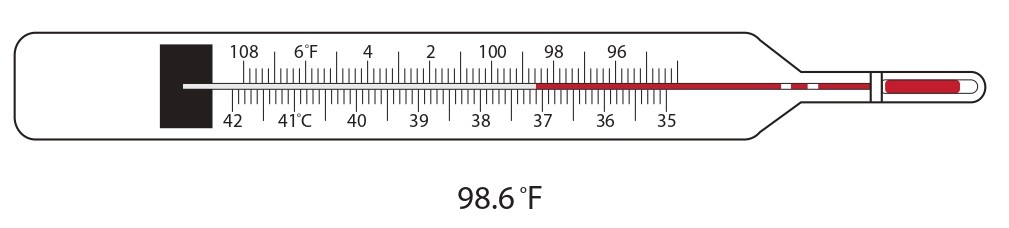
- Units of measurement: The units that a thermometer is calibrated in is marked on it. You could use different thermometers (or their photographs) calibrated in Celsius and Fahrenheit units, respectively, to show students how to locate this information. You could also construct paper models with one or the other scale, distribute them among students, and ask them to read out the temperature marked on the model they have picked (see Fig. 2). Students will need to be reminded that a measurement is more than a number. The numerical value has no meaning unless the units of measurement have also been noted and recorded. For example, you could ask students whether they would feel hot or cold if the temperature was 40° outside, without mentioning the units of measurement. Students in India, where weather reports usually use the Celsius scale, are likely to say “hot”. You could point out that 40° would be very cold weather if the units of this temperature measurement are in Fahrenheit (since 40°F is equal to 4.4°C), but it would be hot weather if the units are in Celsius. Thus, the phrase “40 degrees” is not meaningful unless the units are specified.
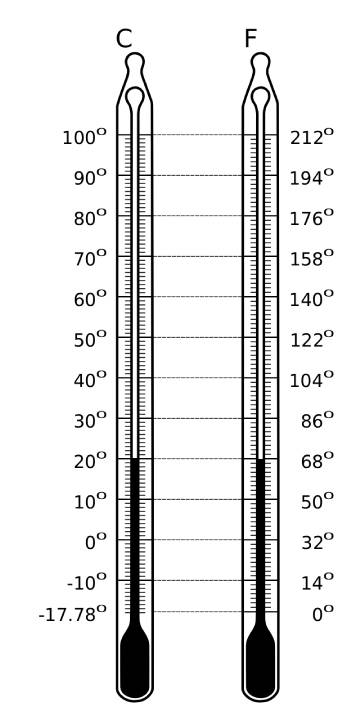
- Range of the thermometer: This is the span of values for which an instrument is designed to provide accurate and reliable measurements. Students can determine the range of a thermometer or a paper model of it using the steps outlined in Activity 7.3 in Chapter 7 of the Grade VI science textbook (NCERT, Reprint 2025-2026).4 Knowing the range of different thermometers can help in selecting the right instrument for an application. For example, a clinical mercury thermometer is designed to measure human body temperatures, which remain within a few degrees of 37°C. Therefore, it has a narrow range of 35°C to 42°C. In contrast, a weather thermometer has a larger range of −30°C to 50°C. This is because it is designed to measure atmospheric temperature, which shows much greater variation than the human body temperature. You could create paper models of both kinds of thermometers, invite students to determine their range, and discuss applications where they would be most effective.
- Least count: This is the smallest value that can be measured with a thermometer. It is the smallest division on the measuring scale. Students can determine the least count of a thermometer or a paper model of it using the steps outlined in Activity 7.4 in Chapter 7 of the Grade VI science textbook (NCERT, Reprint 2025-2026).4 This value determines the precision and reliability of the measurements we make with a thermometer. So if the smallest difference between the markings on a thermometer is 1°C (its least count), the value being recorded should be rounded to the nearest degree for a precise scientific measurement. Again, teachers could use paper models with different least counts to give students the opportunity to determine this value by themselves.
Practising measurement skills
Handling a glass thermometer can be very different from handling a paper model of it. But you could use a paper model to introduce students to parallax errors.
Parallax is the apparent displacement of an object against the background when seen from two different perspectives. Here is a quick way to demonstrate the parallax effect to students: Ask them to look around and find an object with a vertical edge (like a window frame). Then, ask students to close their right eye and align their index finger with the edge. Next, without moving their finger, ask them to open their right eye and close their left one. Ask them if their index finger still looks aligned to the edge. The edge will appear to have moved sideways. This is because the position of our right eye is different from our left one.
A parallax error occurs when a measurement is not taken at eye level. The reading can then end up being higher or lower than the actual one. Students are introduced to parallax errors in Chapter 5 (‘Measurement of Length and Motion’) of the Grade VI science textbook (NCERT, Reprint 2025-2026).8 You could connect what they learn in this chapter to the process of measuring temperature by asking: “What do you think is the correct position of the eye while reading the scale on the thermometer?” Emphasize the fact that students will need to position their eyes correctly to read the temperature scale accurately.
Discuss how even small changes in this position can cause parallax errors. To demonstrate this, you could ask students to read a specific marking on the temperature scale of their paper models, while keeping the model at eye level. They could then change the angle at which the model is held in relation to their eyes and read the marking again. Is there a difference in the readings they record? Can they think of a way to reduce this difference?
Moving to a glass thermometer
Once students are able to read the temperature scale on their paper models with accuracy and confidence, they can be given the opportunity to handle and read the temperature on a glass (clinical or laboratory) thermometer. I ensure that the units, range, and least count in the paper model I use for class demonstrations are identical to those in the laboratory thermometer available in the classroom. This makes it easier for students to transfer their learning from a paper model to a glass one. However, students might still need additional support in making this transition, especially with aspects that cannot be practised with a paper model. For example, students may have some difficulty identifying the liquid column in a laboratory thermometer. Teachers may need to demonstrate how to hold and rotate the thermometer from side to side to identify the thread of mercury (or alcohol) in the thin tube. This skill can be developed with practice. Students will also need to:
- Ensure adequate contact between the liquid bulb and the material whose temperature is being measured.
- Allow time for the liquid column to stop moving before recording a reading.
- Take multiple readings at a time of the temperature of the same material.
Parting thoughts
The ability to think in precise and quantitative ways about physical phenomena is a fundamental skill in the development of scientific thinking. Thus, as students progress through different stages of schooling, their ability to measure and calculate becomes increasingly important in ‘doing’ science. According to the NCF-SE (2023): “… from verifying similar properties at earlier stages,… [students] progress to making quantitative predictions and measurements to arrive at theories…”3 This includes the ability to select the appropriate instrument for a specific application, handle the instrument correctly, and make accurate measurements using standard units.
Measurement-related concepts and skills are systematically included in different topics in the school curriculum. For example, Chapter 7 of the Grade VI science textbook (NCERT, Reprint 2025-2026) shares ideas for a series of activities that can be used to introduce students to the basic concepts and skills involved in making accurate temperature measurements.
A paper model of a thermometer allows students to have hands-on experience of working with some of these concepts and skills. This can help students transition to using a glass thermometer correctly both in the science classroom and in the real world. What students learn through this experience can also provide a sound basis for learning more advanced measurement concepts at higher stages of schooling.
Key takeaways
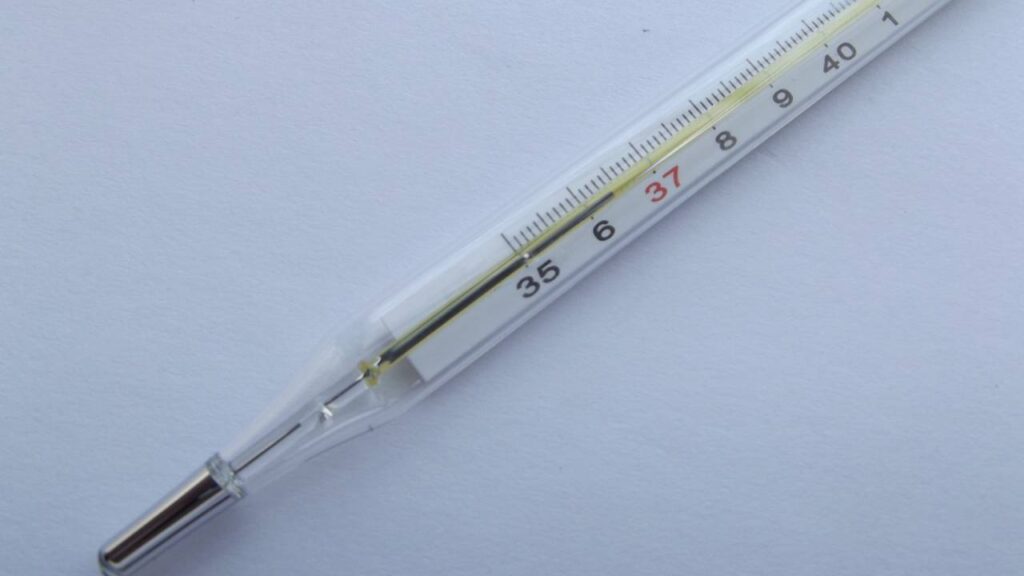
- Grade VI students are expected to learn to measure temperature using clinical and lab thermometers.
- Making accurate measurements requires a complex combination of concepts and skills that students are expected to develop as they progress through different stages of schooling.
- Involving students in constructing their own inexpensive paper models of thermometers can help them develop the skill to manipulate materials and become more familiar with these instruments.
- Paper models of thermometers also act as useful teaching aids in the science classroom. They can be used to help students develop an understanding of some important measurement concepts and practice some basic measurement-related skills.
- While practicing with a paper model of a thermometer can prepare students to use a glass thermometer more skillfully, they will need support in learning the additional skills needed to make this transition.
Notes
- Credits for the image (‘Reading a thermometer’) used in the background of the article title: saulhm. URL: https://pixabay.com/photos/ thermometer-temperature-instrument-106380/. License: Public Domain.
- This article includes two detachable classroom resources: Activity Sheet: Make Your Own Paper Thermometer Model and Worksheet: What Can You Learn From a Paper Thermometer Model?.
References
- National Council of Educational Research and Training (2024-2025). ‘Chapter 15: Blow Hot, Blow Cold’. Looking Around, Textbook for EVS for Grade V: 139-146. URL: https://ncert.nic.in/textbook/pdf/eeap115.pdf.
- Driver, R., Squires, A., Rushworth, P., & Wood-Robinson, V. (2014). ‘Making Sense of Secondary Science: Research Into Children’s Ideas’. Routledge.
- National Steering Committee for National Curriculum Frameworks (2023). ‘National Curriculum Framework for School Education 2023’. National Council of Educational Research and Training. URL: https://ncert.nic.in/pdf/NCFSE-2023-August_2023.pdf.
- National Council of Educational Research and Training (Reprint 2025-2026). ‘Chapter 7: Temperature and its Measurement’. Curiosity, Science Textbook for Grade VI: 123-141. URL: https://ncert.nic.in/textbook.php?fecu1=7-12.
- Development and Research in Early Math Education (DREME) Network (n.d.). ‘The Mathematics of Measurement’. URL: https://prek-math-te. stanford.edu/measurement-data/mathematics-measurement. Retrieved 22 June 2025.
- Lee, M. Y. & Francis, D. C. (2016). ‘5 Ways to Improve Children’s Understanding of Length Measurement’. Teaching Children Mathematics, 23 (4): 218–224. URL: https://doi.org/10.5951/teacchilmath.23.4.0218.
- National Council of Educational Research and Training (2017). ‘Learning Outcomes at the Elementary Stage’. National Council of Educational Research and Training. URL: https://ncert.nic.in/pdf/publication/otherpublications/tilops101.pdf.
- National Council of Educational Research and Training (Reprint 2025-2026). ‘Chapter 5: Measurement of Length and Motion’. Curiosity, Science Textbook for Grade VI: 79-100. URL: https://ncert.nic.in/textbook.php?fecu1=5-12.