
Perceiving size


Many exploratory and hands-on activities in the preschool curriculum (NCERT, 2020) are designed to help children develop a range of learning skills. These include visual perception skills like size constancy.1 This skill: “…involves the ability to perceive and recognise the actual size of an object regardless of factors that may change its apparent size.”1 One of these factors is distance. The more the distance between us and an object, the smaller the image captured by the retina of the eye is. But, with size constancy, children understand, for example, that the school building is of the same size whether they are close to it or far away. Providing opportunities for children to develop this skill is important in enabling them to accurately observe and compare objects in their surroundings (see Box 1).
Perceiving size
I was visiting a small government primary school (with Grades I-V) in a remote village in Hoshangabad district in Madhya Pradesh. While interacting with one of the teachers, I expressed interest in engaging with the Grade V students. He was generous enough to offer me the opportunity. Rather than interact with the students within the confines of the classroom, I invited them to join me in exploring the open school grounds. I often carry a frugal microscope (called Foldscope) with me. Whenever I have the opportunity, I use it with students to discover the unseen in our surroundings—from tiny microorganisms to the cells in plants. To set the stage for such an exploration, I began with some relatable, yet thought-provoking, questions: “How do things look when they are far away? How do they look when they are close? Have you observed any difference?”
Since we were gathered under the open sky, I asked the students to consider the stars that shine at night: “Those stars glittering in the sky—how large do you think they are?” Some students promptly responded with confident hand gestures, suggesting that the stars were only as small as little balls. Their reasoning was clear: Stars look tiny. So, in their minds, they were tiny. I was intrigued (and a bit concerned) by this common misconception—the idea that distant objects are small because they ‘appear’ small to our eyes.
To probe further, I pointed to a tall tree at the far end of the ground and asked, “Look at the tree there. How tall does it appear to us from here? If you were to walk up to it, would its actual size be the same as it appears from here, or would it be more than that?” Again, the students asserted that the tree’s actual size would be exactly as it appeared to them from this distance. I tried a different example. We were standing near some plants. I pointed to a flower and asked, “How big is this flower? If I moved this pot to the far end of the ground, would it look smaller or bigger?” The students expressed the view that the flower would look as big as it looked to them now, irrespective of where the pot was placed.
The problem was clear to me now. The students were conflating the apparent sizes of objects with their actual sizes.
Box 1. Curricular connections:
Opportunities that allow students to develop size constancy can help meet the following curricular goals for the foundational stage:
- CG-2: Children develop sharpness in sensorial perceptions. Specifically, it helps children develop the competency (C-2.6) to: “Begin integrating sensorial perceptions to get a holistic awareness of their experiences.”
- CG-7: Children make sense of the world around through observation and logical thinking. Specifically, it helps children develop the competency (C-7.1) to: “Observe and understand different categories of objects and relationships between them.”
- CG-13: Children develop habits of learning that allow them to engage actively in formal learning environments like a school classroom. Specifically, it helps children develop the competency (C-13.3) to: “Observe minute details of objects, wonder, and explore using various senses, tinker with objects, ask questions.”2
Bridging perception with theory
Chapter 11 (‘Sunita in Space’) of the Grade V Environmental Studies (EVS) textbook (NCERT, 2024-2025) draws attention to the relationship between distance and size. Two fictional characters, Shahmir and Uzaira, compare the apparent size of the Moon as perceived from the Earth with that of a coin. The textbook invites students to try this activity themselves: “How many centimetres away from the eye did you keep the coin to hide the moon?”3 While the students may have tried this activity in class, it was clear that they had not connected it to their lived experience. I tried thinking of a simple activity to bridge this gap that could be done, right there, on the playground. Looking around, I noticed some grass and plucked a blade of it. Holding it up for the students to see, I asked, “Can everyone see the blade of grass in my hand?” The students nodded their yeses. Standing just a few feet away from me, the blade was clearly visible to them. Then, I asked the students to walk backward, one step at a time, and to stop the moment the blade seemed to disappear from their view (see Fig. 1).
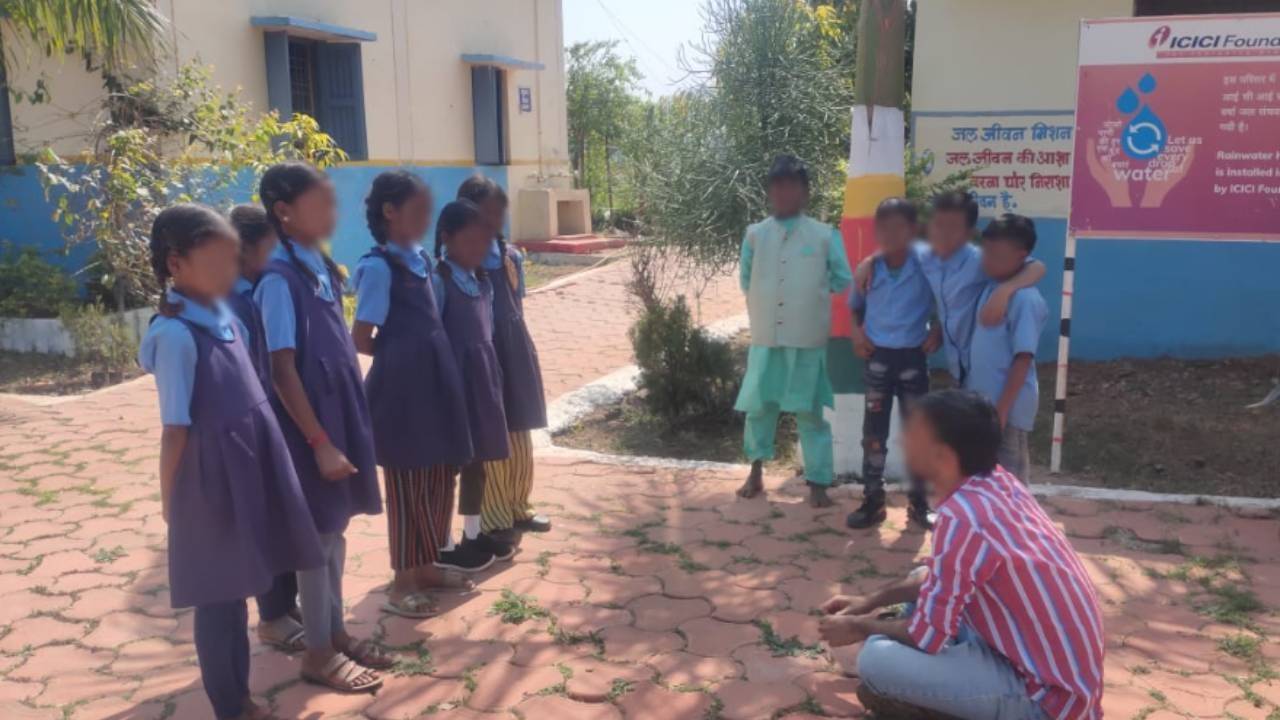
There was a buzz of excitement as the students shuffled backward, eyes fixed on the blade of grass in my hand. One by one, they halted at various distances. Soon, most had reached a point where they could no longer see the blade of grass.
I now moved to the second part of the activity. I asked the students to start walking forward slowly, one small step at a time, until the blade came back into sight. They were to stop and call out when it reappeared. They eagerly complied. Soon we had a rough boundary of visibility, with the positions of the students indicating how distance had made the straw vanish from sight. We gathered in a circle to discuss this. I asked: “Did the blade suddenly blink out of existence at a certain distance? Or did it appear to gradually become smaller and fainter till it was too small to see?” The students shared that the farther they moved from me, the smaller the blade had looked until, finally, it was no longer visible. This was an aha moment for them. I could almost see the shift in their understanding.
I brought their attention back to the size of distant stars and of the tree at the other end of the ground, “Are they actually as small as they appear to us from here?” This time, I saw the students pause. I waited for the experience with the blade of grass to sink in. Some of the students broke into smiles of realisation, but hesitated to state their new understanding. One of the students stretched her hands wide apart to communicate that the actual size of a star was likely to be much bigger than it appeared to be in the night sky. Some of the other students said that the actual size of the tree on the other side of the ground must be more than what it appeared to be from this side of it.
In each of the examples we had explored till this point, the apparent size of the object was smaller than its actual size. To provide some contrast, I introduced them to a magnifying lens and invited them to use it to observe anything that caught their interest. Still sitting in a circle, they started with looking at a single letter on a piece of paper; then, at some pebbles; and, finally, at some crystals of sand. They could see how the magnifying lens made these objects appear much larger than their actual size. At this point, I showed them the Foldscope. Working together, we prepared a paper slide for the sand crystals that had caught their interest. Taking turns to observe the sand crystals through the Foldscope, they were amazed at the amount of detail that was visible to them (see Fig. 2). I ended our discussion by encouraging students to use drawing as a way to record how the sand crystals had looked from under the Foldscope.

Parting thoughts
Rabindranath Tagore emphasized the need for education to unfold in harmony with nature, with the child learning through direct engagement with the world.4,5 My experience reaffirmed that stepping outside the classroom has the potential to transform not just the scenery, but our pedagogical approach in powerful ways. Under the open sky, traditional roles blurred. I was no longer the sole bearer of knowledge, and the students were no longer passive listeners. Instead, we became co-explorers in the unfolding investigation. This change in environment encouraged the students to participate more freely—they moved around, pointed at objects, and looked more comfortable with asking questions. In essence, stepping outside turned the lesson into a shared adventure. A simple shift in setting had made learning feel organic and alive, illustrating how a small tweak in our pedagogical approach can greatly boost student engagement. It was a reminder that, sometimes, the most effective ‘classroom’ is not a room, but the world just beyond its door. Tagore also believed that pedagogical approaches need not emerge from books. They can come as a result of the interplay of observation and experience. For example, the students did not just hear about size and distance; they saw, tested, and felt the reality of these concepts through their own inquiry.
Jiddu Krishnamurti saw education as a means to awaken the mind—to free it from fear, conformity, and passive acceptance.6 Being outdoors offered an experience of freedom that fueled student curiosity. I noticed the students did not wait for me to explain everything; they became active investigators in this exploration. Some of the students tried their own little variations of the blade test, giggling as they waved at a friend to see how far apart they could move before their features were no longer visible to each other. I handed them the magnifying lens after less than half a minute of demonstration. Without much prompting, they started to examine everything from the texture of pebbles to the print of their books, driven purely by their own wonder. The lesson had turned into an open-ended exploration. It was a joy to see students who had held a common misconception until a few minutes ago chase new questions on their own. Moments like this affirm that giving learners space to explore lets them ride on their innate curious instincts. There is enormous potential in children when they are given the chance to discover things for themselves. Their questions become deeper, their observations keener, and their confidence in finding answers grows. By stepping back slightly, I saw them step forward and take charge of their learning. In those few minutes, they were occupied in creating knowledge for themselves and each other. By stepping away from structured instruction, the students experienced the joy of questioning, the power of seeing with their own eyes, and the confidence to revise their own assumptions. Their hesitation in reconsidering the size of stars was not just a cognitive shift; it was a glimpse into the deeper process of liberation and acceptance, an act of courage in breaking free from conditioned thinking.
Key takeaways

- The foundational-stage curriculum has many exploratory and hands-on activities that invite children to observe and compare the sizes of different objects in their environment. But children may continue to conflate the apparent sizes of objects with their actual sizes.
- Activities that allow students to make observations of the role of distance in shaping their perception of size can help address this challenge.
- Using the outdoors as a classroom and offering students the opportunity to use simple tools (like a magnifying lens or a frugal microscope) themselves can expand the scope of these observations and foster deeper engagement with learning.
Notes
- Credits for the image (Field with trees in the distance) used in the background of the article title: sarangib. URL: https://pixabay.com/photos/ rice-fields-gangavati-karnataka-204128/. License: Public Domain.
- The facial features of the children in Fig. 1 and Fig. 2 have been blurred to protect their privacy.
References
- Department of Elementary Education (2020). ‘Readiness activities for beginners: Activity Book-1’. National Council of Educational Research and Training. URL: https://ncert.nic.in/dee/pdf/readinessactivitiesvol1.pdf.
- National Steering Committee for National Curriculum Frameworks (2022). ‘National Curriculum Framework for Foundational Stage 2022’. National Council of Educational Research and Training. URL: https://ncert.nic.in/pdf/NCF_for_Foundational_Stage_20_October_2022.pdf.
- National Council of Educational Research and Training (2024). ‘Chapter 11: Sunita in Space’. Looking Around, Textbook for EVS for Grade V: 106. National Council of Educational Research and Training. URL: https://ncert.nic.in/textbook/pdf/eeap111.pdf.
- Atole, Pushpa et. al. (2022). ‘Tagore’s Philosophy of Education: Harmony Between Nature, Culture, and Creativity’. NIU International Journal of Human Rights, Volume 9: 41-46. URL: https://naac.mituniversity.ac.in/DVV/3_4_4/Education_Paper_4.pdf.
- Mukherjee, H. B. (1962). ‘Education for Fullness: A Study of the Educational Thought and Experiment of Rabindranath Tagore’. Routledge India.
- Krishnamurti, J. (1974). Krishnamurti on education. Krishnamurti Foundation India.