
Does air add weight to an inflated balloon?

The introductory ‘Probe and Ponder’ section of Chapter 7 (‘Particulate Nature of Matter’) of the Grade VIII science textbook (NCERT, 2025-2026) poses this question: “We cannot see air, so how does it add weight to an inflated balloon?”1
This question offers students the opportunity to bring together some important science concepts that they learn about in different grades. For example, in Chapter 10 (‘This World of Things’) of the Grade III Environmental Studies (EVS) textbook (NCERT, 2025-2026), students learn that: “…objects can be classified as solids, liquids, and gases.”2 They also learn that: “Air does not stay in a cup; it just floats in and out. That is because air is a gas.”2 In Chapter 7 of the Grade VIII science textbook, students learn that matter exists in three states: solids, liquids, and gases.1 This would suggest that air is matter.
In Chapter 6 (‘Materials Around Us’) of the Grade VI science textbook (Reprint 2024-2025), students learn that: “Anything that occupies space and has mass is called matter.”3 This would suggest that air, too, has mass. Yet, the idea that air is ‘massless’ is a widespread student misconception.4 In Chapter 7 of the Grade VIII science textbook, students also learn that: “…matter is composed of a large number of extremely small particles. These particles are so small that they cannot be seen even through an ordinary microscope.”1 While students are able to associate the particulate nature of matter to solids and liquids, they find it difficult to think of air in the same way. So they may interpret one gram of water vapourising on boiling into massless vapour!
How do students arrive at the misconception that air is massless? We often tend to think of matter only in terms of human senses and capabilities. For example, how much of it can we see with our eyes? Can we feel its weight if we hold it in our hands? So students can think of even something as light as a feather or an eyelash as being made up of matter. But they may find it challenging to think of something invisible or transparent, like air, as matter. Especially because they do not experience its weight. If told that air does have mass, students ask if it can be measured and what its exact value is. In some cases, students express the interesting argument that, ‘’The mass of air cannot be measured because air does not push down, it rises.” On probing, students share the observation that party balloons rise into the air when inflated with helium. Here, again, students are associating mass and weight with objects that do not rise by themselves or can be used to keep an inflated balloon from floating away.
Demonstrating that air has mass
Chapter 6 of the Grade VI science textbook introduces the concept of mass through an activity idea (Activity 6.8: Let Us Measure). Students are asked to take three identical cups and fill them with water, sand, and pebbles, respectively. They are invited to predict which of these would be heavier and which lighter. Then, they are asked to test their prediction by weighing the three cups on a balance. This activity idea ends with the following words: “… we can say that any object which is heavier or lighter can be measured in terms of a property called mass. The one which is heavier has more mass and the one which is lighter has less mass.“3
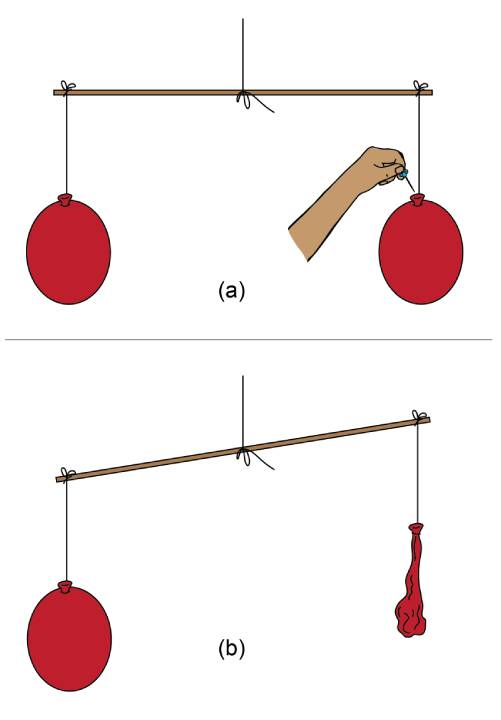
A similar activity can be used to give students visual evidence that air, too, has mass (see the Activity Sheet). In this activity, two nearly identical balloons are inflated to similar sizes. Each balloon is tied to one end of a long stick (like a one-metre scale). A string tied to the middle of the stick is used to suspend it from a hook on a wall or a door handle in such a way that it hangs freely. The position of the string on the stick is carefully adjusted to ensure that the stick is balanced (aligned parallel to the ground). Then, a pin is used to deflate one of the balloons. To do this without bursting the balloon, the pin is slowly inserted into the thicker rubber near the knot or neck of the balloon. Once the balloon is fully deflated and the stick becomes steady again, the stick is seen to lean slightly towards the end with the inflated balloon (see Fig. 1).
Credits: i wonder… License: CC BY-NC-ND 4.0.
Since beam balances are common in their everyday world, students often associate this setup with one. When asked why the stick leans towards the end with the inflated balloon, they tend to infer that the inflated balloon is heavier than the deflated one. Students know that the balloons are made of identical material and are nearly similar in size. So if asked, “Why is the inflated balloon heavier?”, most of them conclude that the difference in the weight of the two balloons is due to the mass of the air trapped in the inflated one. Seeing the stick return to being parallel to the ground can help confirm to students that the difference in weight seen in the previous step was due to the air in the inflated balloon. Here, it may be important for teachers to emphasise that air’s mass is only one factor that causes the balance to tip.
Box 1. Is the apparent weight of the inflated balloon different from its actual weight?
Yes. Let us take the case of the two balloons in this activity. The actual weight of each balloon is the gravitational force acting on its mass. Its apparent weight, however, is influenced by the fact that the balloons, like all objects on land, are immersed in atmospheric air. Air, like other fluids, exerts an upward force on objects immersed in it. In Chapter 5 (‘Exploring Forces’) of the Grade VIII science textbook (NCERT, 2025-2026), students learn that: “The force applied by a liquid on an object in the upward direction is known as upthrust or buoyant force.”5 The magnitude of this buoyant force is equal to the weight of the air displaced by the object. Because the buoyant force acts upwards, the apparent weight of an object immersed in air is slightly less than its actual weight.
- Buoyant force acting on an object immersed in air = weight of the volume of air displaced by the object.
- The apparent weight of an object immersed in air = actual weight of the object – weight of air displaced by the object.
Factors that affect this activity
The air added to the inflated balloon makes its actual weight more than that of the deflated balloon. However, the inflated balloon also occupies more space than the deflated one. So it displaces more surrounding air than the deflated balloon. Thus, the difference in weight that students can observe (~ apparent weight) between the two balloons is likely to be very small (see Box 1). What factors can help us observe this difference more clearly?
- The density of air inside the inflated balloon: In Chapter 9 (‘The Amazing World of Solutes, Solvents, and Solutions’) of the Grade VIII science textbook (NCERT, 2025-2026), students learn that: “A wooden stick and an iron rod may be of the same size, yet the iron rod feels much heavier. When we say that iron is heavier than wood, we are referring to a special property known as density, which describes the heaviness of an object… Density is defined as the mass present in a unit volume of… [a] substance.”6 When we use an air pump to ‘push’ air into a balloon, the air inside it is at a slightly higher pressure than the air outside it and (at the same temperature) is therefore denser. In other words, there are ‘more’ air particles inside the balloon than in the same volume of the surrounding air. This helps ensure that the weight of air inside the inflated balloon is greater than the weight of air it displaces. Therefore, the difference in weight between the inflated and deflated balloons might be more noticeable.
What if we were to inflate the balloons by blowing air into them with our mouth? The composition of air in a balloon inflated with a hand pump is the same as that of the surrounding air. This is also the air that we inhale. But the composition of air in a balloon inflated with our mouth is the same as that of the air we exhale. Since students read about ‘Respiration in Humans’ in Chapter 9 (‘Life Processes in Animals’) of the Grade VII science textbook (NCERT, 2025-2026), you could share the fact that exhaled air has more carbon dioxide and water vapour and less oxygen than inhaled air.8,9 You could also tell students that oxygen is lighter than carbon dioxide and heavier than water vapour. How will the difference in composition between inhaled and exhaled air affect the difference in weights between the inflated and deflated balloon? Will this difference still be clearly visible to us? It may be useful to invite students to make predictions and test this. They could also compare the results of this method with those obtained by using balloons inflated with the air pump.
- The sensitivity of the beam balance: The beam balance we use in this activity of a metre-long stick and a piece of string. It does not have the strength and stability that students may associate with the more common examples of such balances (like those used to weigh fruits and vegetables) that they see in their everyday world. But it has a remarkable sensitivity that allows detection of the small difference in weights between the two balloons.
Based on our observations, a stick shorter than one metre can reduce the sensitivity of the balance. It may be useful to invite students to compare the results of using the balance recommended in the activity sheet against a traditional balance. They could also experiment with the effect of reducing or increasing the length of the stick (or the string used to suspend it or the balloons from it) on their ability to see a difference in weight between the two balloons. For example, in our trials, using a stick shorter than one metre made the difference in weight more difficult to observe.
Box 2. Curricular connections:
This activity and discussions around it can help meet the following curricular goals outlined in the NCF- SE (2023) for middle-stage science:
- CG-1: [The student] explores the world of matter and its constituents, properties, and behaviour. Specifically, they can support students in developing the competency to:
- (C-1.1): “Classify matter based on observable physical (solid, liquid, gas…) and chemical characteristics.”
- (C-1.2): “Describe changes in matter (physical and chemical) and use particulate nature to represent the properties of matter and the changes.”
- CG-6: [The student] explores the nature and processes of science through engaging with the evolution of scientific knowledge and conducting scientific inquiry. Specifically, they can support students in developing the competency (C-6.2) to: “Formulate questions using scientific terminology (to identify possible causes for an event, patterns, or behaviour of objects) and collect data as evidence (through observation of the natural environment, design of simple experiments, or use of simple scientific instruments).”
- CG-7: [The student] communicates questions, observations, and conclusions related to science. Specifically, they can support students in developing the competency (C-7.1) to: “Use scientific vocabulary to communicate science accurately in oral and written form, and through visual representation.”7
Parting thoughts
Many observations and experiences of the properties of air in the real world may lead students to believe that it is massless. If not addressed early, this misconception can persist through higher stages and even adulthood. This simple activity that students can do by themselves provides concrete visual evidence that air contributes to the weight of an inflated balloon through its mass. It might also help students apply the particulate model of matter to air (see Box 2).
The use of inexpensive and everyday objects (like balloons, sticks, and string) to set up the activity can help students become more resourceful and allow them the freedom to explore these materials in new and creative ways. For example, in their everyday world, students are familiar with beam balances being used to measure the absolute mass of objects against a standard mass. However, the model that students construct for themselves in this activity only allows them to compare the mass of an inflated balloon with that of a deflated one. On the other hand, students are frequently astonished by the sensitivity with which this model can detect even small differences in weight. Inviting students to try variations in setting up the activity, like using different ways of inflating balloons or using different lengths of sticks, can help them develop their prediction, observation, and experimentation skills. All of these are important science skills.
Key takeaways
- The middle-stage science curriculum introduces students to the particulate nature of matter, its different states, and its properties. Yet, students often show difficulty in relating these concepts to air.
- The idea that air is massless is a widespread student misconception. A simple activity with inexpensive everyday objects like two balloons, a metre-long stick, and some string can offer visual evidence that air has mass.
- Encouraging students to identify and experiment with factors that allow them to see the difference in weights between an inflated and deflated balloon can help them develop more familiarity with related concepts and practice important science skills.
Notes
- Credits for the image (Balloon Floating in the Sky) used in the background of the article title: PickPik. URL: https://www.pickpik.com/balloon- sky-blue-green-fly-helium-70975. License: Royalty Free.
- This article includes one detachable classroom resource: Activity Sheet: Does Air have Mass?
- This digital version was last updated on Aug 10, 2026.
References
- National Council of Educational Research and Training (2025-2026). ‘Chapter 7: Particulate Nature of Matter’. Curiosity, Textbook of Science for Grade VIII: 98-115. URL: https://ncert.nic.in/textbook.php?hecu1=7-13.
- National Council of Educational Research and Training (2025-2026). ‘Chapter 10: This World of Things’. Our Wondrous World, Textbook of EVS for Grade III: 123-134. URL: https://ncert.nic.in/textbook.php?ceev1=10-12.
- National Council of Educational Research and Training (Reprint 2025-2026). ‘Chapter 6: Materials Around Us’. Curiosity, Textbook of Science for Grade VI: 101-121. URL: https://ncert.nic.in/textbook.php?fecu1=6-12.
- M, Ramesh, Victor SR & Nagaraju MTV (2020). ‘Misconceptions in Certain Science Concepts Among Tribal Students’. Shodh Sanchar Bulletin. 10: 24-28. URL: https://www.researchgate.net/publication/350007120_MISCONCEPTIONS_IN_CERTAIN_SCIENCE_CONCEPTS_AMONG_ TRIBAL_STUDENTS.
- National Council of Educational Research and Training (2025-2026). ‘Chapter 5: Exploring Forces’. Curiosity, Textbook of Science for Grade VIII: 62-79. URL: https://ncert.nic.in/textbook.php?hecu1=5-13.
- National Council of Educational Research and Training (2025-2026). ‘Chapter 9: The Amazing World of Solutes, Solvents, and Solutions ‘. Curiosity, Textbook of Science for Grade VIII: 140-148. URL: https://ncert.nic.in/textbook.php?hecu1=9-13.
- National Steering Committee for National Curriculum Frameworks (2023). ‘National Curriculum Framework for School Education 2023’. National Council of Educational Research and Training. URL: https://ncert.nic.in/pdf/NCFSE-2023-August_2023.pdf.
- National Council of Educational Research and Training (2025-2026). ‘Chapter 9: Life Processes in Animals’. Curiosity, Textbook of Science for Grade VII: 121-136. URL: https://ncert.nic.in/textbook.php?gecu1=9-12.
- Bitesize. ‘The respiratory system in humans–WJEC: Gas exchange’. BBC. URL: https://www.bbc.co.uk/bitesize/guides/zsry39q/revision/5. Accessed on Aug 19, 2025.