
Making and using pinhole camera models


Earlier this year, on April 25 and 26, I was facilitating a workshop on the theme of ‘Light’ with middle-stage (Grade VI to VIII) government school science teachers. The workshop aimed to explore ways of making teaching learning materials (TLMs) that were different from those prescribed in the textbook. This included, for example, making a periscope using an empty agarbatti (incense sticks) box as a TLM for reflection and a kaleidoscope to teach multiple image formation. We also wanted to make a pinhole camera. One method of construction of a pinhole camera model is described in Chapter 8 (‘Light, Shadows and Reflections’) of the Grade VI science textbook (NCERT, 2020-2021).1 This method is also included in Chapter 11 (‘Light: Shadows and Reflections’) of the latest Grade VII science textbook (NCERT, 2025-2026).2 I found this model bulky. While searching for a simpler method, I came across the article ‘Pedagogy of Making: Pinhole Camera’ by Shiv Pandey in the Dec 2024 issue of i wonder…3 This article is accompanied by a classroom resource titled ‘Activity Sheet: Make Your Own Pinhole Camera’.4 This resource is divided into sections that provide instructions on how to make the model, how to use it, what teachers can observe and, most importantly, what is to be discussed with students. This can support teachers not only in making this TLM, but also in using it to build a grade-appropriate conceptual understanding of light. After I had made the model described in the Activity Sheet and confirmed that it worked, I decided to use this resource in the workshop.
Model making in the workshop
I started the session with the teachers by sharing an online version of the Hindi translation of the article.5 None of the teachers had read the article. So I introduced it and briefly explained the main ideas presented in it. Then, I shared printouts of the Activity Sheet (one copy per participant), gave them 10-20 minutes to read their copies, and facilitated a discussion using questions like: What was the underlying concept of the activity? Is this concept part of the middle-stage science syllabus? How do you explain this concept in class? Would you like to make the model? What materials will you need to make it? Seeing the enthusiasm they showed for the idea of making their own models, I indicated that they could start work on it.
I provided materials like disposable cups, black marker pens, butter paper, tubes of glue and Fevicol, needles, and rubber bands for the model-building exercise. The teachers were divided into groups. The 4-5 teachers in each group shared the same material, but each teacher built their own model. To encourage the teachers to think creatively, this was the guidance I offered: “The process shared in the Activity Sheet is one way of making this model. If you wish to, you could choose other ways of making your models.” Walking around the room, I noticed that some of the teachers had started introducing small variations in their models. For example, the sheet instructs teachers to blacken the sides and bottom of the paper cup using a black marker pen. But a couple of teachers asked for black poster colour and used a paintbrush to darken the surface of their cups (see Fig. 1). Another teacher saw a bottle of black ink in the room and tried using it. But they dropped the idea after seeing that the result was not dark enough to block light effectively.
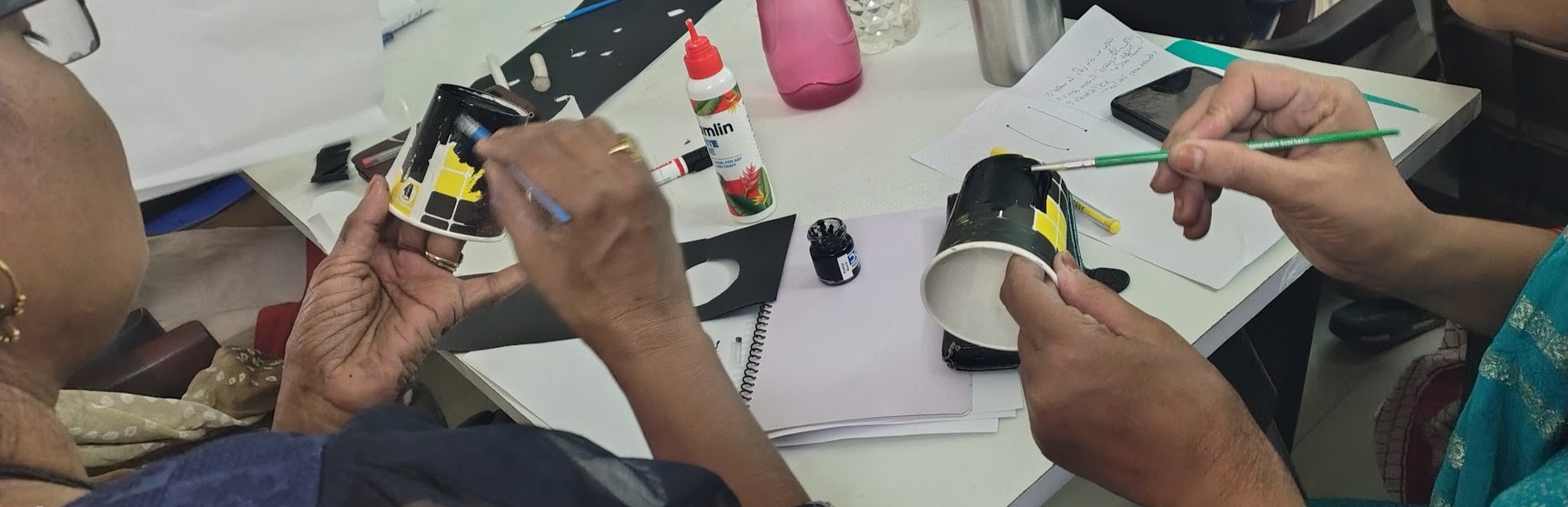
A third teacher used a strip of black sheet to cover the sides of the cup (see Fig. 2). The sheet also instructs teachers to use glue to fix a butter paper to the open mouth of their cups. This would act as a ‘screen’ to capture the image created by the pinhole camera. I asked one group of teachers to try using tracing paper instead. The idea for this variation had come to me while procuring materials for the workshop. The butter paper was kept near tracing paper. On examining the texture of the tracing paper, I wondered how it would affect the clarity of the image formed by the pinhole camera. One of the teachers used a bigger-than-usual piece of butter paper for the screen.

It covered more than half the length of their cup. Similarly, while some teachers used glue or Fevicol to fix their screens to their cups, others used rubber bands. These variations led to active discussion on questions like, “Will the size of the butter paper affect the clarity of the image?”, or “Why blacken the bottom and sides of the paper cup?’’ or ‘’Will the image formed on tracing paper be as clear as the one formed on butter paper?” These discussions not only made the session more interactive, but also increased the teachers’ interest in related concepts of light.
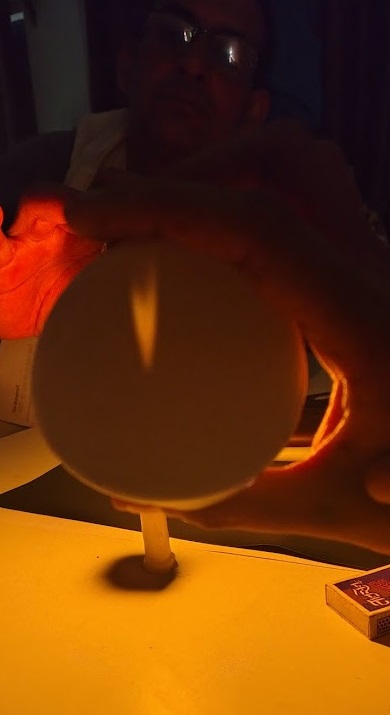
Once all our models were ready, we lit some candles and tested them using the questions and prompts in the sheet to guide our observations (see Fig. 3). The teachers engaged in this process with enthusiasm. I encouraged them to write their observations against each question to help maintain a record of what they did and observed. One interesting observation was that the image formed on a screen made of tracing paper was sharper compared to the one formed on butter paper.
Parting thoughts
Overall, it was a great experience for the teachers and me. Many of the teachers had used the method recommended in the textbook to demonstrate the making of a pinhole camera in class. But they found the method in Shiv Pandey’s Activity Sheet simple enough to allow each of their students to use it to construct their own models. All of us found the language and articulation of the instructions in the Activity Sheet very simple and easy to follow. The prompts for observation and discussion shared in the sheet are fantastic! They are very specific and provide direction to help deepen observation skills. They helped teachers think about the kinds of discussions they could have while trying this activity with their students. The teachers also appreciated the collaborative approach we had used in the workshop: Sharing resources with a group, but making their own models; helping one another; and discussing their observations and experiences with each other. They expressed the intention of using a similar approach in their classrooms.
The article helped teachers think out of the box and look for alternative ways of doing this textbook activity. They participated in every stage of this session with zeal and enthusiasm, observing and discussing the effect that different factors (like switching off the lights in the room or adjusting the distance between the pinhole and the candle) had on the clarity of the image produced on the screens of their models. Many of the teachers asked questions about their observations and shared what they had learnt with their peers. Listening to them, I could see that this exercise had not only introduced them to a different way of making pinhole camera models, but had also increased their engagement with underlying concepts. The Activity Sheet had played a vital role in creating an environment that inspired their enthusiasm and supported their learning. This is the magic of using the right resource!
Notes
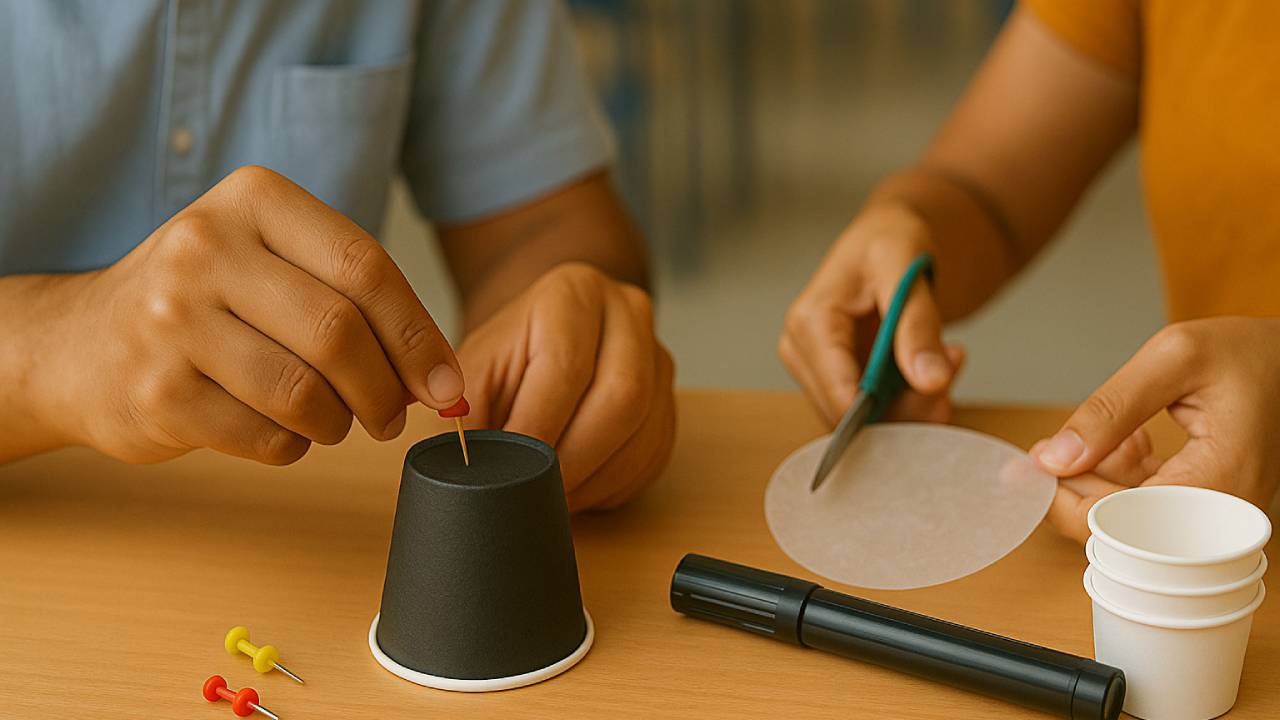
- The image (Constructing a Pinhole Camera) used in the background of the article title was created for i wonder… using ChatGPT, under prompting by Vijeta Raghuram (Aug 2025). License: CC BY-NC-ND 4.0.
References
- National Council of Educational Research and Training (2020-2021). ‘Chapter 8: Light, Shadows, and Reflections’. Science Textbook for Grade VI: 110. URL: https://betrained.in/CBSE/6-Science/Light-Shadows-And-Reflections.
- National Council of Educational Research and Training (2025-2026). ‘Chapter 11: Light: Shadows and Reflections’. Curiosity, Textbook of Science for Grade VII: 163. URL: https://ncert.nic.in/textbook/pdf/gecu111.pdf.
- Pandey, Shiv (2024). ‘The Pedagogy of Making: Pinhole Camera’. i wonder… (11): 4-10. ISSN 2582-1636. URL: https://publications. azimpremjiuniversity.edu.in/5894/.
- Pandey, Shiv (2024). ‘Activity Sheet: Make Your Own Pinhole Camera’. i wonder… (11): 9-10. ISSN 2582-1636. URL: https://publications. azimpremjiuniversity.edu.in/5893/.
- पाण्डेय, शिव (2024) ‘मॉडल निर्माण का शिक्षणशास्त्र: पिनहोल कैमराः आई वंडर… रीडिस्कवरिंग स्कूल साइंस (11). 4-12. URL: https:// anuvadasampada.azimpremjiuniversity.edu.in/4979/.