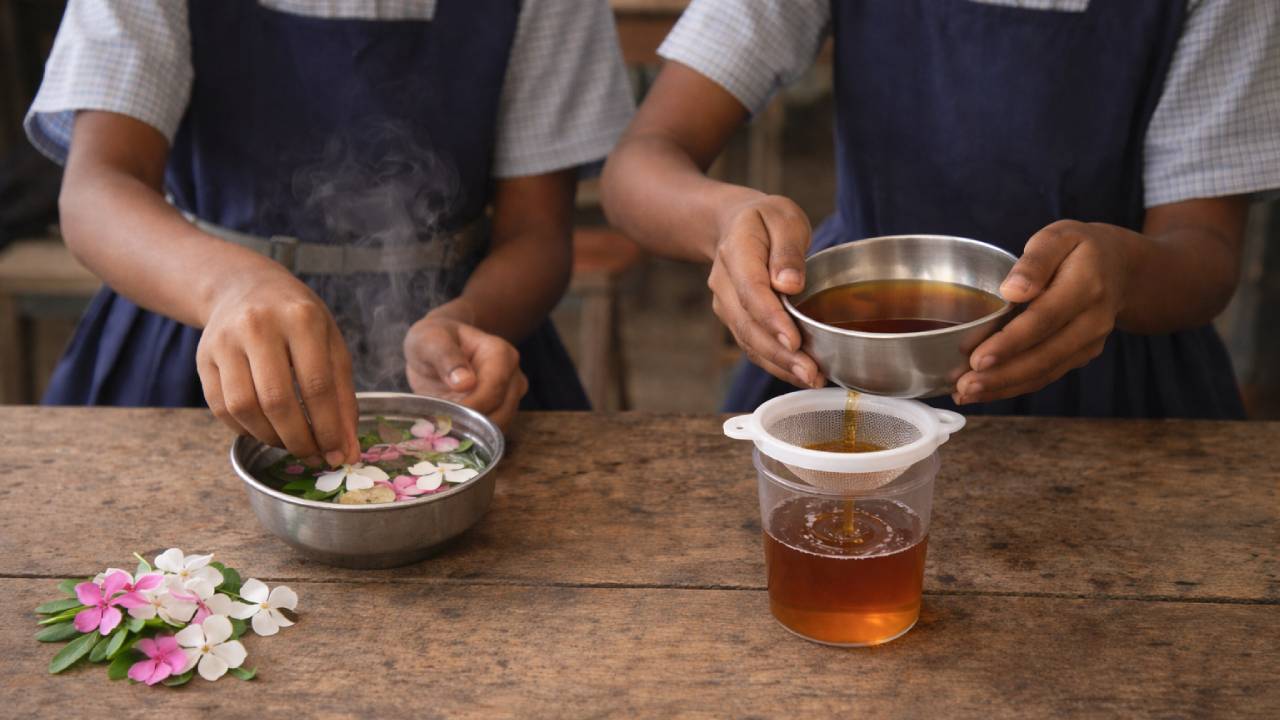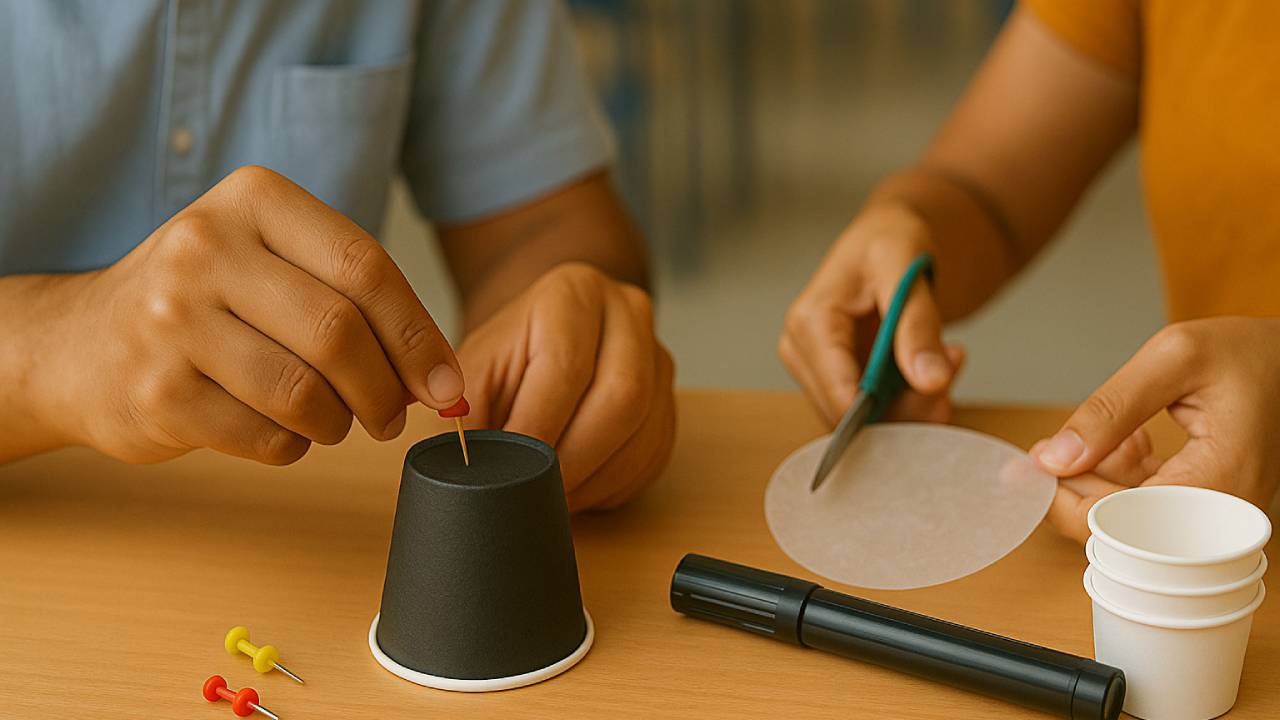

Kapila Baideu: Hearing student questions


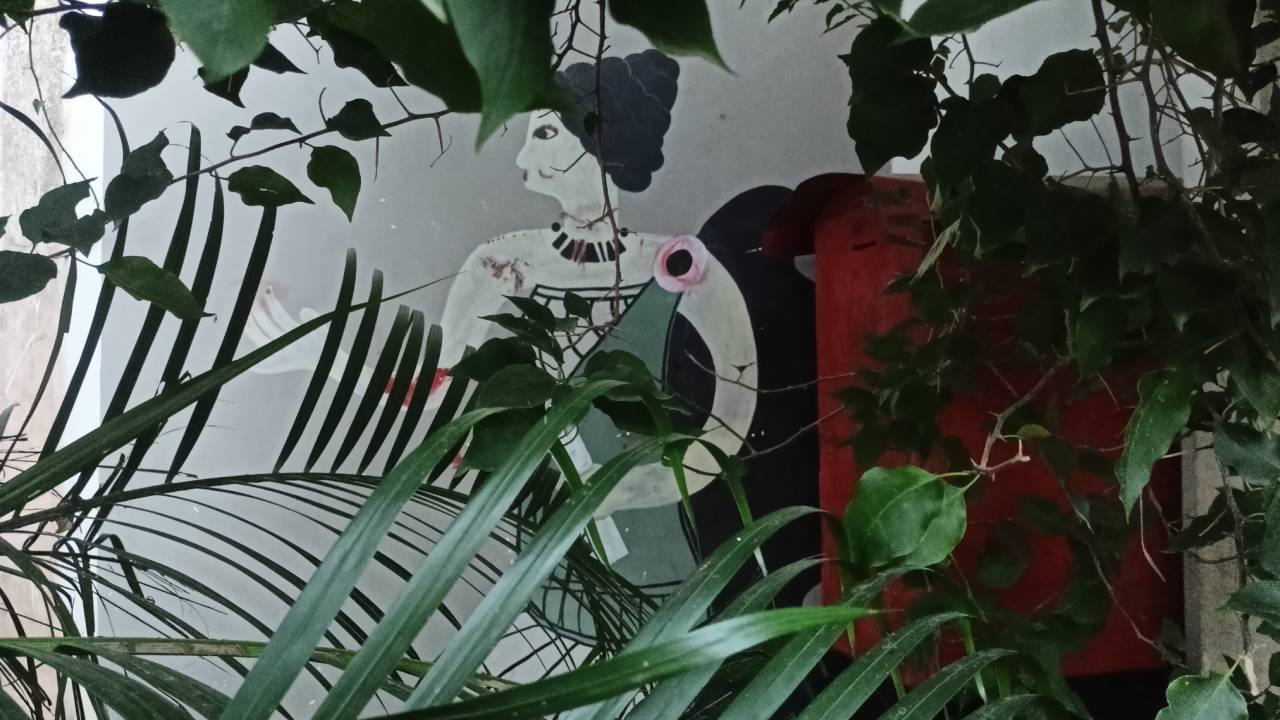
On September 14, 2022, I watched the i wonder… webinar titled ‘Asking Questions in Science’.1 This webinar featured a conversation between Madhav Kelkar (from Eklavya, Bhopal) and Saurav Shome (from Azim Premji Foundation). Madhav Kelkar shared how the Eklavya team had created a fictional character called ‘Sawaliram’ to invite children to share any science questions that sparked their curiosity. It worked. Children from many different schools sent their questions on postcards addressed to Sawaliram. The Eklavya team sent back responses as handwritten letters signed by Sawaliram.2 It was a beautiful idea, reflecting the value of both curiosity and the intimacy of handwritten communication. Inspired by this, I wondered, “Why not try something like this in our school?”
Inviting questions from students
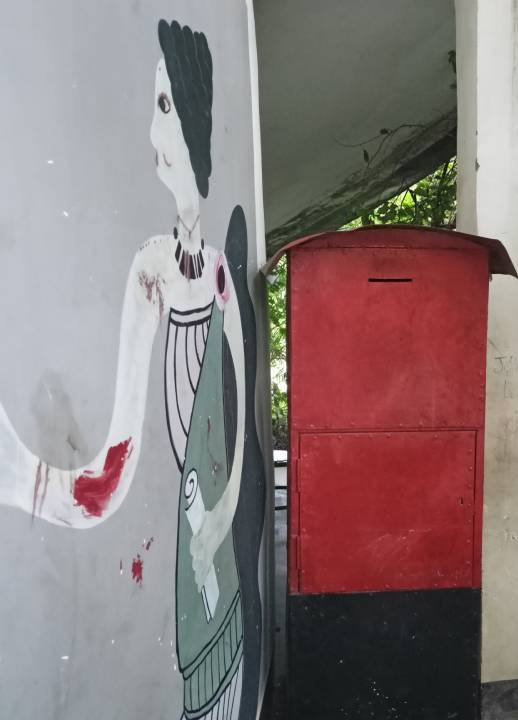
Hummingbird School, located in the Majuli district of Assam, primarily serves children from the Mishing community on the island. We have always tried to nurture a culture of questioning and exploration in the school. Inspired by Sawaliram, we formally launched an initiative to invite questions from our students in 2023. Students were introduced to a fictional character called Kapila Baideu. This name was chosen with care. ‘Kapila’ means ‘why’ in the Mishing tribal language, and ‘Baideu’ means ‘elder sister’ in Assamese. Put together, ‘Kapila Baideu’ loosely translates to ‘Why Didi’. The hope is that students think of her as a caring and inquisitive elder sister who will listen to and respond to their questions with thoughtfulness and depth. Knowing students would be curious about Kapila Baideu’s life, we created a backstory. Belonging to a fictional country called Rationalia, she teaches at the University of Peace in the Department of Humanities. A polymath by nature, she seems to know a great deal about everything—be it science, society, or emotions. To receive our students’ questions, we designed a special ‘Kapila Baideu box’ that is styled to look like a traditional letter box (see Fig. 1).
From the beginning, this initiative has thrived. Our students eagerly drop their questions into the box, and we are often joyfully overwhelmed by their volume and depth. A small group of 4-5 teachers, including me, works diligently to respond to each question. We try to send a response within 15 days of receiving it. Students get impatient with delays. The process of responding to these questions is deeply collaborative. Every question we receive is entered into a spreadsheet that is visible to all members of the team. Teachers sign up to respond to questions that speak to them. We also read each other’s drafts and offer suggestions. As a team, we often rely on discussion and internet research to understand topics well enough to offer thoughtful responses. Also, team members often consult other people.
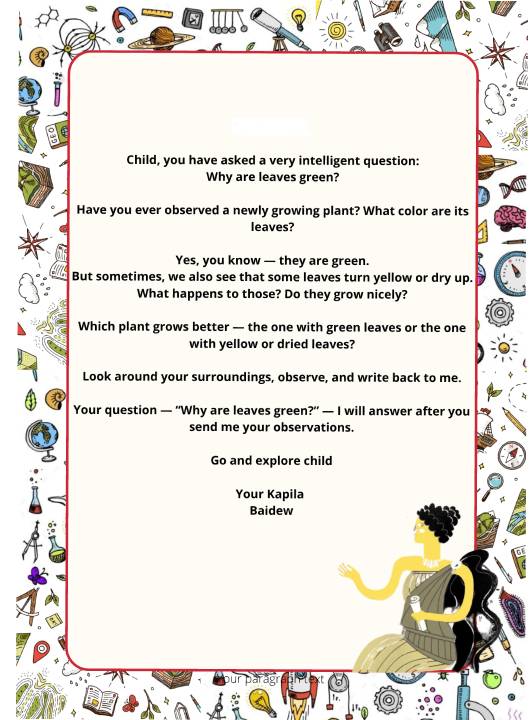
For instance, if a student asks about floods or natural disasters, we reach out to local teachers familiar with such experiences for their input. While we make no claims to expertise, we try to ensure that the voice of Kapila Baideu carries both care and credibility. When Kapila Baideu answers scientific questions like “Why are leaves green?”, she does not just state textbook definitions or facts. Instead, she invites students into a conversation. The answers often lead to a back-and-forth exchange of letters, nudging students to think more deeply. For example, the discussion may flow into what makes plants green, why that colour matters, and how plants live and grow (see Fig. 2). Through these thoughtful dialogues, Kapila Baideu becomes a one-on-one mentor, tuning her responses to each student’s curiosity and understanding. This helps ensure that the process of inquiry is no longer about information sharing; it is about building relationships.
Initially, we thought Kapila Baideu would remain focused on generating curiosity around science-related questions. Indeed, many students ask, “Why are leaves green?” or “How do stars shine?” But to our surprise (and delight), the questions have quickly become more diverse. Some students share personal concerns: “Why do I have no friends?” or “Why is my hair short?” Others ask social or philosophical questions, like: “Why does our school have a student union body?” These letters are no longer just an expression of simple questions—they have become windows into the emotional and intellectual worlds of our students. One of our team members is the school counsellor. They respond to emotionally sensitive letters, particularly those related to fear, sadness, or low self-esteem. Students sometimes write things like: “Why am I not good at Math?” or “I failed my test and feel ashamed”. In such cases, the respective subject teacher steps in to respond, even if they are not part of the core Kapila team.
Our students believe that the responses they receive to their questions are written by Kapila Baideu. So, in writing our responses, we always keep the character of Kapila Baideu in mind. We try to ensure that all the team members stay on the same page. We cannot contradict each other. We cannot say different things in different letters. This is also the reason we abandoned the intention to respond with handwritten letters. Students might have recognised a teacher’s handwriting. So, once our responses are finalised, we print them in a special ‘Kapila’ format. This is a delicate typewritten design that preserves anonymity, while still feeling personal. It is also less laborious. We are currently experimenting with ways to make the letter-receiving experience even more memorable. A new team member with an interest in design is helping us add small, personalised elements to each letter.
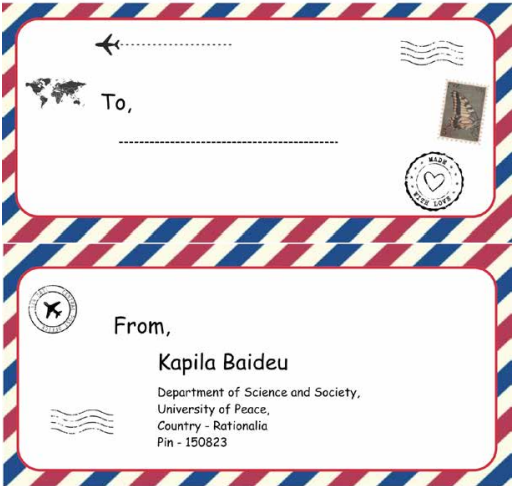
For example, if a student writes about their admiration for a particular sports person, we might include a small card or token related to that interest. We even have a postman to deliver these letters! This is one of our beloved colleagues, who helps with school maintenance and tends to the school gate. Carrying letters from Kapila Baideu in his jhola (cloth bag), he steps into a class, calls out a student’s name, and hands them their letters with a quiet smile (see Fig. 3). This has now become a treasured ritual.
Parting thoughts
Our attempt to invite students to think of and ask questions has become a full-fledged initiative at Hummingbird School. Kapila Baideu has grown into a silent, yet powerful, presence in our school, fostering curiosity, empathy, and reflection.
Why has this initiative been so successful? Here are some reasons I can think of:
- The first is the mystery around Kapila Baideu. Students associate this character with the letter box in a quiet corner of the school and the letters that are delivered to them. This simple set-up builds curiosity and excitement. Who is writing these letters? This question plays an important role in keeping students’ anticipation alive. Younger students believe that Kapila Baideu is a real character. This is reflected in some of the questions they send to her. For example, they often ask, “Where do you live?”, “Who are your friends?”, “Will you be my friend?”, “When will you come to our school?” The older or more rational students may suspect that someone from school is writing Kapila Baideu’s replies. But they, too, like the mystery. Especially because they do not know which teacher is behind this initiative or how they operate. On our part, we like the fact that the mystery around Kapila Baideu allows this initiative to remain spread out. Because it is not associated with any one teacher, multiple people from the school can come forward to speak in Kapila Baideu’s voice. Sometimes, we actively encourage the mystery. For example, we recently observed that letters from many students asked questions without telling us their names or grades. Without these details, how would we send them personal responses?! We shared our challenge with students in a letter from Kapila Baideu. The letter was read out in the morning assembly. Not by a teacher, but by a student leader from the student council. This allowed us to send a message to students without revealing our identity. In other instances, this sense of mystery allows us to connect students to the larger world through their imagination. For example, as 2024 unfolded, changes in the school timetable disrupted the rhythm of our initiative. Several of our team members became too pressed for time to write responses. For about eight months, this initiative fell into a dormant phase. The questions from students kept coming, but the answers paused. Students began discussing the possibility that Kapila Baideu had died. This rumour started spreading in school. Some of our students even dropped letters to her, asking, “What happened to you?” Thankfully, new members joined the responding team of teachers. To explain the pause in a way that made sense to our students, we created a backstory: Kapila Baideu had travelled to Europe to cover the war between Ukraine and Russia. This is why she could not write back to our students. She expressed regret. This simple step allowed us to revive the initiative.
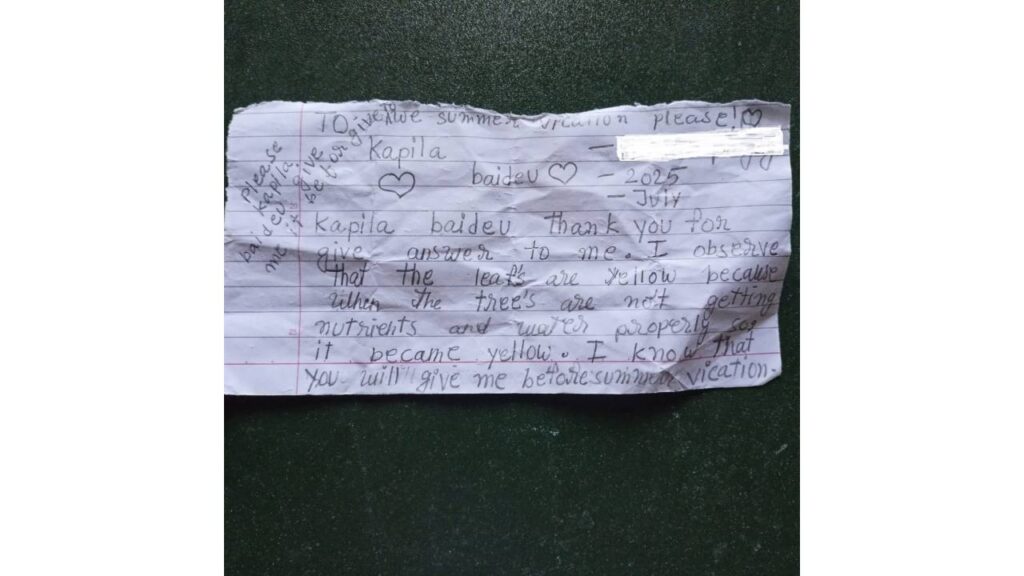
- The second is that this initiative gives students the freedom to express their curiosity without hesitation. At first, we played with the idea of asking students to write ‘proper’ letters. Or insisting that they use a certain kind of paper for their questions. But, after some thought, we decided not to impose any rules. Students write to Kapila Baideu however they want. Whenever they find a moment, they drop in their questions. They send their questions on any paper they can find—hard, soft, or even strips torn from a notebook (see Fig. 4). Sometimes, they even put a small photograph of themselves inside the box. Maybe, they want to believe that Kapila will see these photos.
- The third is how students feel when they receive Kapila Baideu’s letters. Each letter is delivered by hand to students in their class. The student opens the letter to hear a warm and gentle voice. The content of the letter is pitched at the level of the student receiving it. While personal, the letter does not lecture or make students feel uncomfortable. Students feel safe communicating with Kapila.
There may be many things that teachers can do to adapt this initiative to their schools and students. For us, this is just the beginning. We are still learning, and there is plenty of room for growth. We hope to try many more ways to let our students know that their questions are important and to feel that they are heard.
Notes
- Credits for the image (The Kapila Baideu corner in school) used in the background of the article title: Deepak Rajput. License: CC BY-NC-ND 4.0.
References
- Azim Premji University (2022). ‘i wonder… Webinar : Asking Questions in Science’. URL: https://www.youtube.com/watch?v=eQdloz9PgRU.
- Eklavya. ‘Sawaliram’. Tata Institute of Fundamental Research (TIFR Centre for Interdisciplinary Sciences), Hyderabad, and Eklavya, Bhopal. URL: https://sawaliram.org/. Accessed on Aug 6, 2025.