
Metals and nonmetals: A teaching plan

One of the competencies that students are expected to develop from the middlestage science curriculum is the ability to use observable properties of everyday materials to classify them as metals or nonmetals (see Box 1).1,2 The concepts that support this competency are introduced gradually across different grade-level textbooks for preparatory-stage environmental studies (EVS) and middle-stage science.3-7 I had the opportunity to explore this theme with 56 Grade IX students from three government senior secondary schools. When asked what they knew about metals, most students could list commonly taught properties— hardness, shine, malleability, ductility, and conductivity of heat and electricity—or provide examples such as gold and silver. To probe their understanding more deeply, I created a classroom display of 15 everyday objects and asked students to classify them into three categories—metals, nonmetals, or neither— based on observable properties (see the Activity Sheet). After completing the task, students were invited to justify their classifications. These discussions revealed significant gaps in their understanding of metals and nonmetals.8 In this article, I describe the key features of a teaching plan developed to address these gaps.
Box 1. Curricular connections:
Discussions and activities around the classification of materials into metals and nonmetals can help teachers meet the following:
- Curricular goals for middle-stage science:
- CG-1: Explore the world of matter and its constituents, properties, and behaviour. Specifically, it can help students develop the competency (C-1.1) to: “Classify matter based on observable physical (solid, liquid, gas… translucent… conducting, non-conducting) and chemical (pure, impure; acid, base; metal, non-metal; element, compound) characteristics.“
- CG-6: Explore the nature and processes of science through engaging with the evolution of scientific knowledge and conducting scientific inquiry. Specifically, it can help students develop the competency (C-6.2) to: “Formulate questions using scientific terminology… and collect data as evidence (through observation of the natural environment, design of simple experiments, or use of simple scientific instruments).“1
- Learning objectives for middle-stage students:
- Differentiate between commonly known materials based on their ability to be bent and formed into sheets, be drawn into wires, their ability to produce a ringing sound, their ability to conduct electricity, and their ability to conduct heat in order to define various properties of metals.
- Categorise commonly known materials as metals and nonmetals in order to explain their physical properties.2
What are the properties of metals and nonmetals?
Middle-stage science textbooks introduce students to nine properties of metals (see Table I).4,6,7 Most students were familiar with six. None mentioned sonority, corrosion on exposure to air and water, or the formation of alkaline oxides. Although students could recite textbook definitions of the six properties they were familiar with, they struggled to apply them accurately. For example, many students classified marble as a metal because it appeared shiny and malleable—they had seen polished, sheet-like marble floor tiles.8 This misunderstanding persisted despite explicit discussion in textbooks:
- Chapter 6 (‘Materials Around Us’) of the Grade VI science textbook (NCERT, Reprint 2025-2026) shares the following: “Are all lustrous materials metals? ‘All that glitters is not gold’ goes an old saying! Not all the materials that shine are metals. Surfaces of some materials are made shiny by polishing or coating them with thin layers of plastic, wax or any other material which makes them look shiny. These materials may not be them.“4 I explained that marble is not naturally lustrous like metals, but can be made shiny through polishing.
- Chapter 4 of the Grade VII science textbook (NCERT, 2025) shares the following: “Can you give some examples of metal sheets? You might have seen thin silver foil on some sweets and aluminium foil used for wrapping food items. These are formed due to their malleability. Gold and silver are the most malleable metals. A piece of coal or a lump of sulfur does not show this behaviour. They break into pieces and are said to be brittle. On the other hand, wood neither gets flattened into a sheet nor breaks into pieces. Therefore, wood is neither malleable nor brittle.“6 This chapter suggests that teachers allow students to try hammering a collection of metals and nonmetals to observe these differences for themselves. On asking, I found that none of the students had seen marble being hammered.
| S. No. | Metal property | Textbook definition | Textbook chapter |
|---|---|---|---|
| 1 | Lustrous | “Materials that typically have shiny surfaces are said to have a lustrous appearance. Such materials with lustre are usually metals.” | Chapter 6 (‘Materials Around Us’) of the Grade VI science textbook (NCERT, Reprint 2025–2026). |
| 2 | Hard | “Materials which can be compressed or scratched easily are soft, while other materials which are difficult to compress or scratch are hard.” | Chapter 6 (‘Materials Around Us’) of the Grade VI science textbook (NCERT, Reprint 2025–2026). |
| 3 | Sonorous | “This property of metals that enables them to produce a ringing sound is called sonority, and metals are said to be sonorous in nature.” | Chapter 4 (‘The World of Metals and Non-metals’) of the Grade VII science textbook (NCERT, 2025). |
| 4 | Malleable | “This property by which materials can be beaten into thin sheets is called malleability. Most metals possess this property.” | Chapter 4 (‘The World of Metals and Non-metals’) of the Grade VII science textbook (NCERT, 2025). |
| 5 | Ductile | “This property of materials by which they can be drawn into wires is called ductility. This property of ductility is mainly possessed by metals.” | Chapter 4 (‘The World of Metals and Non-metals’) of the Grade VII science textbook (NCERT, 2025). |
| 6 | Good conductor of heat | “Materials like metals that allow heat to pass through them easily are called good conductors of heat.” | Chapter 7 (‘Heat Transfer in Nature’) of the Grade VII science textbook (NCERT, 2025). |
| 7 | Good conductor of electricity | “Materials that allow electricity to flow through them easily are called good conductors of electricity.” | Chapter 4 (‘The World of Metals and Non-metals’) of the Grade VII science textbook (NCERT, 2025). |
| 8 | Corrodes on exposure to air and water | “Gradual deterioration of metal surfaces caused by air, water, or other substances is known as corrosion.” | Chapter 4 (‘The World of Metals and Non-metals’) of the Grade VII science textbook (NCERT, 2025). |
| 9 | Forms basic oxides | “Generally, oxides of metals are basic in nature.” | Chapter 4 (‘The World of Metals and Non-metals’) of the Grade VII science textbook (NCERT, 2025). |
Discussion revealed that students had been introduced to the properties of metals and nonmetals as definitions to memorise, rather than as ideas to be explored through observation and activity. This was surprising, given that the textbook chapters on this theme include examples and activity ideas to help students develop a clearer understanding of these properties (see Table II).3-7 Although some students recalled these activities being read aloud in class, none had actually performed them. To address this, we tried each of the activity ideas from Chapter 6 of the Grade VI textbook (NCERT, Reprint 2025-2026) and Chapter 4 of the Grade VII textbook (NCERT, 2025).4,6 For example, I brought the following samples to class: iron nails, pieces of coal, bricks, pieces of marble, pieces of hard plastic, thick copper wires, artificial gemstones, graphite rods, thick aluminium wires, coins, etc. Students observed and recorded what happened when each sample was struck with a hammer—did it flatten into a sheet or break into pieces? At the end of this exercise, I compiled their observations on the board and used them to discuss malleability. When asked which materials were malleable, none of the students mentioned marble. When asked why, they explained that it had broken into pieces when hammered. I confirmed that marble is not malleable and clarified that the sheet-like tiles they had seen were produced by cutting and polishing, not by hammering.
| Property | Activity idea | Textbook chapter |
|---|---|---|
| Hardness | “When you press different objects or materials with your hands, some of them, like stones, may be hard to compress, while others, like an eraser, can be easily compressed. Take a metal key and use it to scratch the surface of a piece of wood, aluminium, stone, iron, candle, chalk, and any other material or object. Can some materials be scratched more easily than others?” | Chapter 6 (‘Materials Around Us’) of the Grade VI science textbook (NCERT, Reprint 2025–2026). |
| Sonority | “Take metal spoon and at least five objects made up of different materials—wood, metal, plastic, cloth, and glass. Gently tap the spoon on each of them. Listen to the sound that each of them makes. Make your own words to describe all these different sounds. Try to capture those sounds in words, like ting-ting, dhum-dhum, dub-dub…” | Chapter 10 (‘This World of Things’) of the Grade III EVS textbook (NCERT, 2025). |
| “Take a few objects, such as a metal spoon, a coin, a piece of coal, and a block of wood. (a) Drop them one by one from a certain height. (b) Do you notice any difference in the sound produced by these objects…” | Chapter 4 (‘The World of Metals and Non-metals’) of the Grade VII science textbook (NCERT, 2025). | |
| Malleability | “Collect some wet pieces of copper and aluminium, an iron nail, a piece of coal, a pea-sized lump of sulphur (gandhak), and a block of wood. Now, place each of these items one by one on any hard surface and beat them with a hammer. What do you think will happen? Do the objects become slightly flattened or do they break into pieces?” | Chapter 4 (‘The World of Metals and Non-metals’) of the Grade VII science textbook (NCERT, 2025). |
| Conduction of heat | “Place a glass tumbler on a table. Fill it with hot water. Take a metal spoon and a wooden spoon of almost the same size and thickness. Immerse both the spoons simultaneously into the hot water… and leave them undisturbed for a few minutes. Now, carefully touch the upper end of each spoon… Which of the spoons gets hotter? What does this experiment tell us about heat transfer along the two spoons?” | Chapter 4 (‘The World of Metals and Non-metals’) of the Grade VII science textbook (NCERT, 2025). |
| “Take a strip of metal, such as aluminium or iron, about 15 cm long. Attach four pins to the strip with the help of wax such that they are arranged at nearly equal distances (about 2 cm apart)… Secure the strip to a stand and label the pins as I, II, III, and IV. (If a stand is not available, place the strip between two bricks for support.) Heat the end of the strip that is away from the stand with a candle or a spirit lamp. What will happen to the pins? Will they remain attached to the strip or will they fall? Predict the order in which the pins will fall from the strip… Do you think that heat is being transferred along the metal strip from the end that is being heated?” | Chapter 7 (‘Heat Transfer in Nature’) of the Grade VI science textbook (NCERT, 2025). | |
| Conduction of electricity | “Connect an electric cell and a lamp while leaving the two ends of the wires free… Touch the two free ends of the wires momentarily. Does the lamp glow? If yes, our tester is ready. We can use this tester to identify the materials through which electric current passes. Collect objects of different materials, such as metal spoons, coins, cork, rubber, glass, keys, pins, plastic scale, wooden block, aluminium foil, candle, sewing needle, cardboard, paper, and pencil lead. One by one, touch the free ends of the tester’s wires to both ends of each object you have collected… Make sure the wires do not touch each other. Does the lamp glow every time?” | Chapter 3 (‘Electricity: Circuits and their Components’) in the Grade VI science textbook (NCERT, 2025). |
| Corrosion on exposure to air and water | “Take a few shining iron nails. If you are using old iron nails, make sure to remove brown deposits from their surface by scrubbing them with the help of a small piece of sandpaper. (a) Take three clean, dry glass bottles or test tubes with tight-fitting caps or stoppers. Label them A, B, and C. (b) Take three iron nails and tie each iron nail with a thread. (c) Place one iron nail and some silica gel in the glass bottle ‘A’, and tighten the cap or stopper. (d) Place one iron nail in the glass bottle ‘B’. Pour freshly boiled and cooled water (to remove dissolved gases) into it until the iron nail is completely dipped in it. Now, pour some oil to form a layer over the surface of the water… Cap the glass bottle tightly. (e) Place one iron nail in the glass bottle ‘C’, and pour some water so that the iron nail is partially dipped. Keep this glass bottle undisturbed. This allows the iron nail to come into contact with both water and air. (f) Place all the glass bottles undisturbed at room temperature and observe the changes for 8–10 days.” | Chapter 4 (‘The World of Metals and Non-metals’) of the Grade VII science textbook (NCERT, 2025). |
| pH of oxides | “Take a magnesium ribbon about 3–4 centimetres long. Clean it by rubbing with a piece of sandpaper. Hold it with a pair of tongs. Ignite the other end using a spirit lamp or a candle… Let the magnesium ribbon burn. What do you observe? Add a few drops of warm water to this white powder, stir it well… Find out whether the solution of magnesium oxide is acidic or basic or neutral in nature. You can use any acid-base indicator. What effect does this solution have on blue and red litmus papers?” | Chapter 4 (‘The World of Metals and Non-metals’) of the Grade VII science textbook (NCERT, 2025). |
Are all materials either metals or nonmetals?
Six of the 15 objects used in the initial classification activity—wood, plastic, chalk, marble, brick, and the green board—were neither metals nor nonmetals. Although students had the option to use this category, very few did so (see Table III).8 Discussion revealed that many students believed that all materials must be either metals or nonmetals. As a result, they relied on the metal properties they were familiar with to classify objects into these categories:
- Objects that showed one or more of these properties were often classified as metals. For example, over half the students classified wood and plastic as metals because they were hard. Some noted that plastic could appear shiny, while others referred to plastic sheets and insulated wires to argue that plastic was malleable and ductile.
- Objects that did not show these properties were typically classified as nonmetals. Chalk, for example, was widely classified as a nonmetal because it was neither hard nor shiny—two properties many students believed all metals must possess.
| Objects |
Number of student responses (total = 56) |
|||
|---|---|---|---|---|
| Metals | Nonmetals | Neither | Blank | |
| Wooden chair and table | 33 | 23 | 0 | 0 |
| Piece of hard plastic | 34 | 22 | 0 | 0 |
| Chalk | 0 | 35 | 11 | 10 |
| Piece of marble | 41 | 0 | 0 | 15 |
| Brick | 4 | 22 | 10 | 20 |
| Green board | 2 | 21 | 10 | 23 |
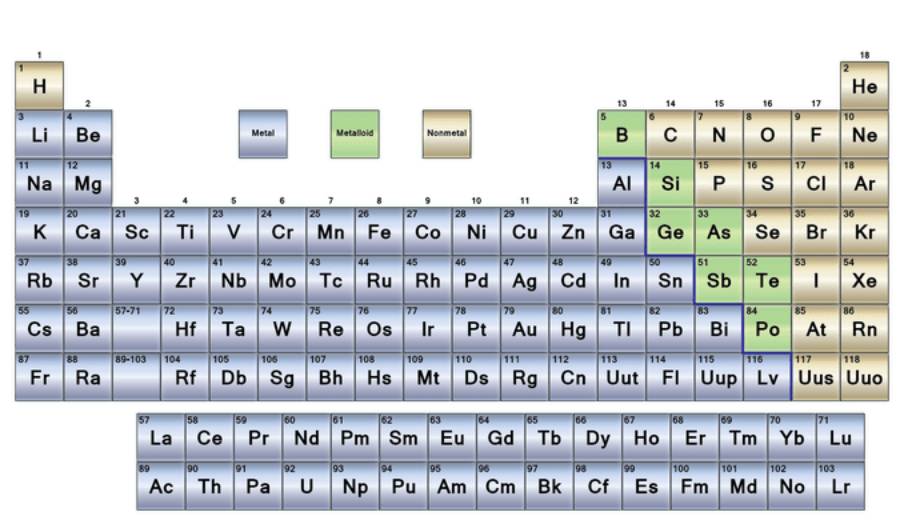
Chapter 4 of the Grade VII science textbook (NCERT, 2025) defines nonmetals in the following way: “Substances like sulfur and phosphorus… are usually soft and dull in appearance. They are neither malleable nor ductile, and they are not sonorous. They are also poor conductors of heat and electricity. These are called nonmetals. Their oxides are acidic in nature. Some other nonmetals are oxygen, hydrogen, nitrogen, carbon, etc.“6 But this chapter also points out that nonmetals “…must not be confused with materials such as plastic, glass, wood, rubber, and paper. These materials are not classified as metals or nonmetals because they are not elements.“6 It then introduces students to the term ‘elements’: “Metals and nonmetals are sub-categories of substances called elements. An element is a substance that cannot be broken down into simpler substances. in nature. Presently, 118 elements are known. These elements are the basic building blocks of all matter.“6 I discussed these ideas in more detail with the students. I then displayed a periodic table, highlighting only those elements that are mentioned in the preparatorystage EVS and middle-stage science curricula (see Fig. 1). Among metals, I highlighted sodium, potassium, magnesium, calcium, iron, cobalt, nickel, copper, zinc, gold, silver, mercury, and aluminium. Among nonmetals, I highlighted carbon (including coal, graphite, and diamond), hydrogen, nitrogen, oxygen, sulphur, and iodine. This provided an opportunity to explain that while most metals and nonmetals showed the properties listed in their textbooks, there are some exceptions. I reminded the students that:
- Most of them (43 of 56 students) had classified mercury as a nonmetal because it is a liquid at room temperature and lacks hardness, lustre, malleability, and ductility.
- Most of them (45 of 56 students) had classified diamond as a metal because of its hardness and shine.
- Most of them (43 of 56 students) had classified graphite as a metal because it is shiny and conducts electricity—something the students had tested using a simple circuit provided in class.8
I also pointed out that:
- Not all elements are metals or nonmetals; some are metalloids. Metalloids show properties of both (for example, they are hard and solid, but brittle and non-sonorous).9
- Not all materials are elements. Some are compounds, and others are mixtures. Both these materials can contain metals and/or nonmetals. But compounds “…are formed when different elements combine in fixed ratios to form something entirely new.“9 So the properties of compounds are different from their constituent elements. In contrast, mixtures are formed when “…two or more substances are mixed, where each substance retains its properties.“9 Here, I drew the students’ attention to the coins and the steel spoon. Fifty-five of 56 students had classified both as metals because of properties such as shine, hardness, malleability, and electrical conductivity (which they had tested using the circuit). I confirmed that both objects do show metal-like properties, but explained that they are alloys. This concept of alloys as “mixtures of metals” is first introduced to students in Chapter 10 (‘This World of Things’) of the Grade IV EVS textbook (NCERT, 2024).3 This chapter includes the following note to the teacher: “Show the children some common metals around you, such as iron, copper, aluminium, gold, silver, mercury in a thermometer or alloys such as steel, brass, and bronze.“3 It also suggests some activity ideas for the classroom (see Table IV).3 I supplemented this discussion by showing the students a collection of everyday objects made of different alloys, including cutlery, tools, doorknobs, medals, cans, pipes, and simple jewellery.
| S. No. | Activity ideas |
|---|---|
| 1 | “Understand your classroom: Draw a picture of your classroom in your notebook. Label the things that you have drawn. The hinges, nails, and latches of the door are made of some metals.” |
| 2 | “Spot the metals: Find as many things or parts of things that are made of metals. Which metals do you recognise around you? If you do not know the name of the metal, ask your friends or an elder. Make a list of these metals in your notebook.” |
| 3 | “What material is your spoon made of? Is it made of metal, wood, or some other material? Can you guess?” |
Parting thoughts
A month after the initial exercise, I invited students to repeat the classification activity. During their first attempt, the students had based their classification mainly on: (a) Their ability to identify materials mentioned as examples of metals or nonmetals in the middle-stage science textbooks, and (b) The presence or absence of 1-2 properties, typically hardness and shine. This time, the students analysed the objects for the presence or absence of each of the seven physical properties they had learned to associate with metals. After the students had finished the exercise, I asked if they could identify one property in the list that all metals show and no nonmetals show. The answer was, “No.” When asked about hardness and shine, most students agreed that neither property was, alone, sufficient to classify a material as a metal. When asked why, they explained that mercury is a metal, but not hard; while diamond and steel are hard and shiny, but not metals. I then drew attention to the wording used in Chapter 4 of the Grade VII science textbook (NCERT, 2025): “We learnt that metals are generally hard, lustrous, malleable, ductile, and good conductors of heat and electricity.“6 Emphasising the word ‘generally’. I suggested that analysing a material’s composition and observing as many of its properties as possible can make our classification of it more accurate. We ended the class on this note.
Key takeaways
- Multiple chapters of the preparatory-stage EVS and middle-stage science textbooks describe the properties of metals and nonmetals, and share examples of these materials from our everyday world.
- Students may accurately memorise these definitions and examples, but asking them to apply the ideas to unfamiliar materials or to exceptions often reveals gaps in understanding.
- One such gap lies in students’ understanding of the properties of metals and nonmetals. The textbooks suggest several hands-on activities to help students explore these properties and identify exceptions through direct handling of materials. It is important that teachers give students the opportunity to do these activities in class.
- Another gap concerns the idea that metals and nonmetals are categories of elements. Not all elements belong to these categories, and not all materials are elements. This can be addressed through a basic introduction to elements, compounds, and mixtures that focuses only on the metals and nonmetals that middle-stage students are familiar with.
Notes
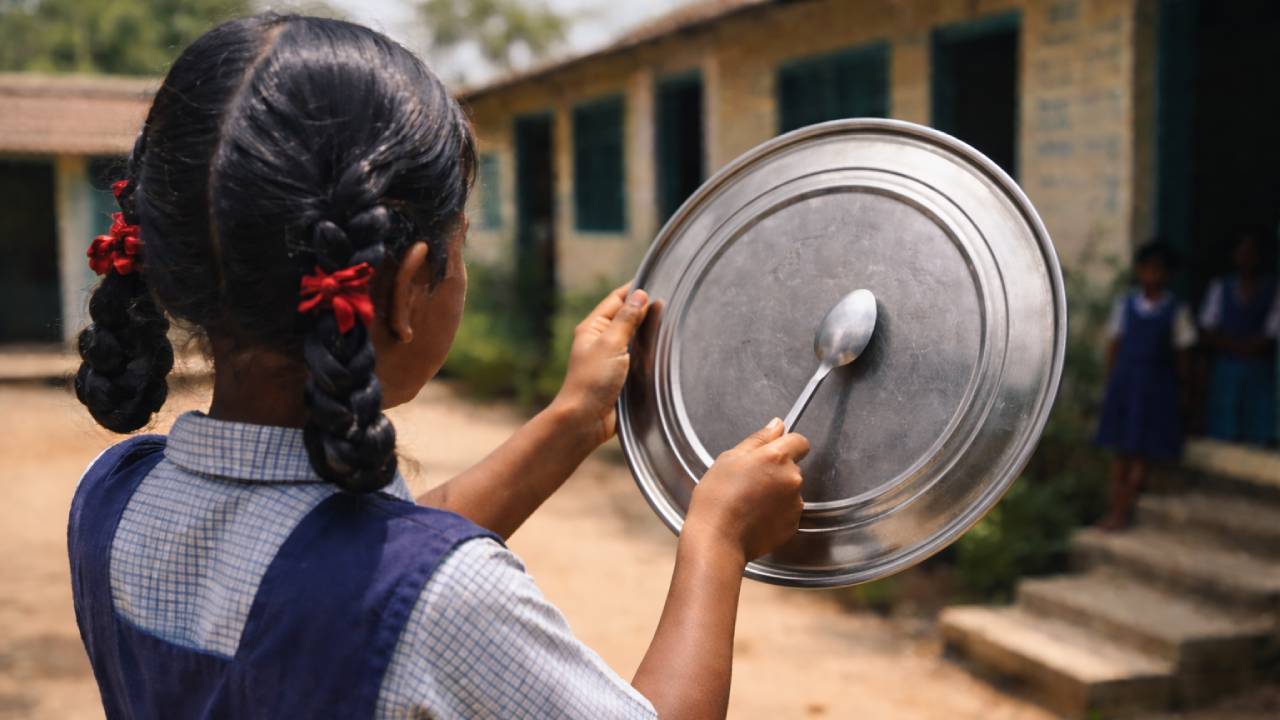
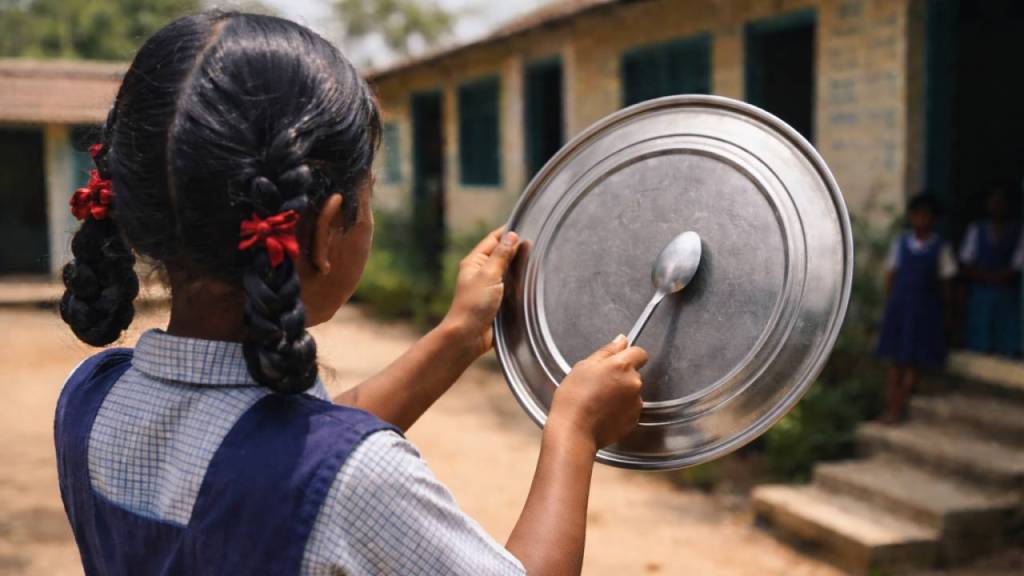
- Credits for the image (Listening to the sound of tapping a steel thali with a steel spoon in schoolyard) used in the background of the article title: Created for i wonder… using ChatGPT, under prompting by Chitra Ravi (Nov 2025). License: CC BY-NC-ND 4.0.
- This article includes one detachable classroom resource: Activity Sheet: Are these Everyday Objects Made of Metals or Nonmetals?
References
- National Steering Committee for National Curriculum Frameworks (2023). ‘National Curriculum Framework for School Education 2023’. National Council of Educational Research and Training. URL: https://ncert.nic.in/pdf/NCFSE-2023-August_2023.pdf.
- Central Board of Secondary Education (2020). ‘Teachers’ Resource for Achieving Learning Outcomes, Classes 1 to 10′. URL: https:// cbseacademic.nic.in/web_material/Manuals/TeachersResource_LODoc.pdf.
- National Council of Educational Research and Training (2025). ‘Chapter 10: This World of Things’. Our Wondrous World, Textbook of EVS (The World Around Us) for Grade III: 123-134. URL: https://ncert.nic.in/textbook.php?ceev1=10-12.
- National Council of Educational Research and Training (Reprint 2025-2026). ‘Chapter 6: Materials Around Us’. Curiosity, Textbook of Science for Grade VI: 101-122. URL: https://ncert.nic.in/textbook.php?fecu1=6-12.
- National Council of Educational Research and Training (2025). ‘Chapter 3: Electricity: Circuits and their Components’. Curiosity, Textbook of Science for Grade VII: 23-40. URL: https://ncert.nic.in/textbook.php?gecu1=3-12.
- National Council of Educational Research and Training (2025). ‘Chapter 4: The World of Metals and Nonmetals’. Curiosity, Textbook of Science for Grade VII: 41-56. URL: https://ncert.nic.in/textbook.php?gecu1=4-12.
- National Council of Educational Research and Training (2025). ‘Chapter 7: Heat Transfer in Nature’. Curiosity, Textbook of Science for Grade VII: 89-104. URL: https://ncert.nic.in/textbook/pdf/gecu107.pdf.
- Khan, Shifa (2025). ‘Classifying everyday materials as metals and nonmetals’. i wonder…, 13: 32-38. ISSN 2582-1636. URL: https:// publications.azimpremjiuniversity.edu.in/6318/.
- National Council of Educational Research and Training (2025-2026). ‘Chapter 8: Nature of Matter: Elements, Compounds, and Mixtures’. Curiosity, Textbook of Science for Grade VIII: 116-133. URL: https://ncert.nic.in/textbook.php?hecu1=8-13.