
Why was Pluto a planet for 76 years?

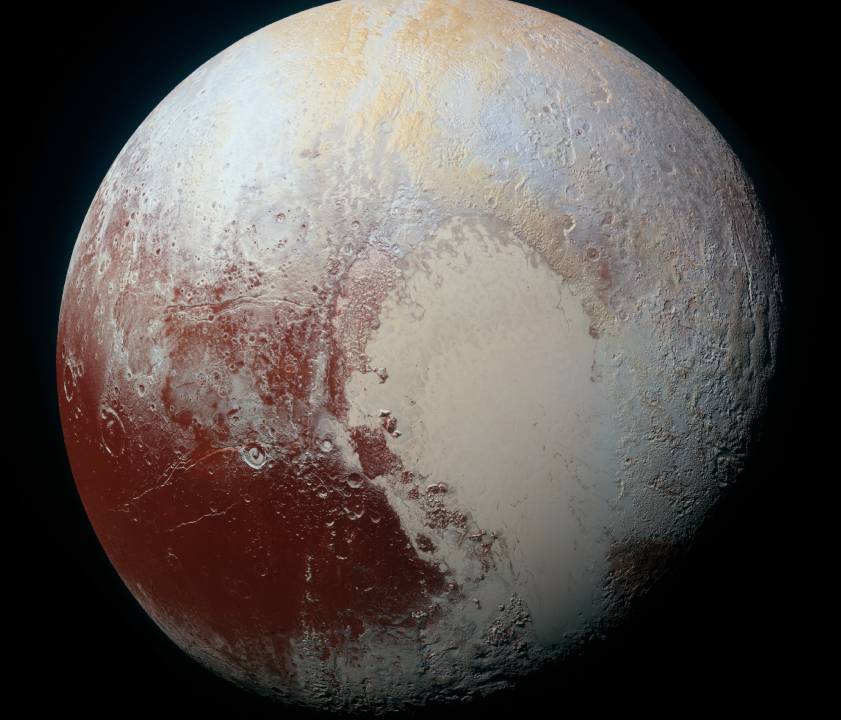
Chapter 12 (‘Beyond Earth’) of the Grade VI science textbook (NCERT, 2024-2025) introduces students to the concept of a planet as being: “…a large, nearly spherical object that revolves around the Sun”. In the same chapter, students learn about the eight planets in the solar system. They also learn how an object that scientists believed to be the ninth planet of the solar system for nearly 76 years is now seen as a dwarf planet. According to the textbook, this change in Pluto’s status happened when in 2006, “the International Astronomical Union (IAU)… redefined the requirements of an object to be called a planet”.1 This brief description may leave curious students and teachers with questions like: What led scientists to believe Pluto was a planet? Was this belief supported by any evidence? The answer to this question is linked to the story of its discovery (see Box 1).
Box 1. Connections to the curriculum:
Discussions around this story can help teachers meet two of the nine curricular goals that the National Curriculum Framework for School Education (NCF-SE) 2023 recommends for the middle stage (see Teacher’s Guide: Pluto in the Classroom):
- CG-6: “Explores the nature and processes of science through engaging with the evolution of scientific knowledge and conducting scientific inquiry”. Specifically, it can help students develop the competency to: “Illustrate how scientific knowledge and ideas have changed over time (description of motion of objects and planets, number of planets) and identify the scientific values that are inherent and common across the evolution of scientific knowledge (scientific temper, science as a collective endeavour…)”.
- CG-9: “Develops awareness of the most current discoveries, ideas, and frontiers in all areas of scientific knowledge in order to appreciate that Science is ever evolving and that there are still many unanswered questions”.4
The search begins
By the early 19th century, the first seven planets of the solar system had been discovered.2 But astronomers observed that the actual path (orbit) that Uranus took around the Sun did not match their predictions. What could be causing this difference? In 1841, the British astronomer John Couch Adams proposed that Uranus may be pulled from its predicted path around the Sun by another, yet to be discovered, planet in the solar system.3
In 1846, the French astronomer Urbain Le Verrier used mathematical calculations to predict the likely position of such a planet. He sent these details to the German astronomer Johann Gottfried Galle. On the night he received Verrier’s letter, Galle and his student Heinrich Louis d’Arrest were able to locate this planet within a degree of its predicted position. This planet was named Neptune.3
But observations of Neptune and calculations of its mass did not fully explain Uranus’ deviations from its predicted orbit. In fact, Neptune’s path around the Sun was also slightly different from what astronomers had predicted for it. Could these differences be caused by the presence of another object? In 1902, the wealthy American astronomer Percival Lowell proposed that this object was the ninth planet of the solar system. He called it ‘Planet X’ (‘X’ here is the English alphabet, not the Roman numeral).5
Lowell’s Planet X
Born in 1855, Lowell was the son of a wealthy businessman. In 1876, he graduated from Harvard College, with a distinction in mathematics. In 1893, Lowell read a description of ‘canals’ on the surface of Mars in the book ‘La planète Mars’ written by the French astronomer Camille Flammarion. His determination to explore these canals led Lowell to a career in astronomy.6,7 Within a year, he had used his personal wealth and influence to establish the Lowell Observatory at Flagstaff, Arizona, USA. It was here, in 1906, that he started a search for Planet X.
In the first phase of this search, Lowell, like Verrier, used mathematical calculations to identify the most likely position of the new planet. Astronomers at the Lowell Observatory used its 42-inch telescope to photograph these specific regions of the sky on different days. Lowell used a hand magnifier to painstakingly examine every inch of these photographic glass plates (see Box 2). By 1910, Lowell’s team had taken close to 200 photographs and recorded the positions of thousands of stars. But had found no evidence for Planet X.
Lowell decided to change his approach. First, he hired a team of ‘human computers’. Human computers were people, often women, who performed complex mathematical calculations. Led by the American astronomer Elizabeth Williams, this team’s work allowed Lowell to more accurately predict regions of the sky where Planet X was likely to be found. Second, Lowell borrowed a 9-inch telescope from Sproul Observatory, Pennsylvania. He believed that the smaller telescope would be better suited to observing finer details of the night sky. Lastly, Lowell bought a specialized stereo microscope, popularly called a ‘blink comparator’ (see Fig. 1). This instrument allowed him to examine and compare two photographic plates one after the other in short order. This process was popularly called ‘blinking’ (see Box 3).

Early versions of this instrument could hold 6-inch x 7-inch plates. But Lowell’s team found that viewing 14-inch x 17-inch plates would be better suited to their purpose. The American astronomer Carl Lampland, who was part of this team, modified the blink comparator to include slip frames that allowed Lowell to compare a quarter of the larger plates at a time.5
Lowell used this combined mathematical and observational approach to scan the night sky for Planet X till his sudden death from a stroke in 1916.7 His wife contested his decision to leave most of his million-dollar estate to the observatory. This led to a long legal battle, during which the Lowell Observatory’s search for Planet X was put on hold. In 1927, the litigation was resolved in the observatory’s favour and the search for Planet X resumed.7,9 In 1929, the American astronomer Dr Vesto Slipher, the acting director of the observatory, assigned the task of finding Planet X to a 23-year-old man called Clyde Tombaugh.
Box 2. What was Lowell looking for?
Lowell was examining photos of the night sky on different days to spot objects that had changed their position. Let us assume that he found such an object. How would he know it was a planet and not a star? Stars move too. The answer lies in the fact that our ability to spot distant objects in the sky depends on the tools we use. Lowell may have counted on the possibility that the telescopes he was using to search for Planet X were powerful enough to capture the movement of another planet in our solar system. Even one he believed to be farther away from all the planets we knew of at the time. But these instruments were not powerful enough to capture the movement of stars, which are much farther away from us.
Box 3. What is a blink comparator?
How would you compare two images of the night sky to see if any objects in them had moved? You could do this by looking at each object in the first image and checking its position in the second image. This would likely be a slow process. Imagine you were doing this every day for months at a stretch with many images (like that of the night sky) and each image had many small and similar-looking objects! It would quickly get tiring. A blink comparator allows you to flip between two images very, very quickly. Our short-term memory of the two images allows us to spot differences between them much more easily.8
Enter Tombaugh
Tombaugh was the son of a farmer. Born in the year Lowell started his search for Planet X, Tombaugh graduated from high school in 1925. He was unable to afford a college education. In 1924, Tombaugh read a magazine article titled ‘The Drift of Jupiter’s Markings’ written by the amateur astronomer Latimer J Wilson. Fascinated by Wilson’s drawings of the markings on the surface of Jupiter, Tombaugh wanted to see these features himself. So, in 1926, at the age of 20, Tombaugh built his first telescope with discarded car parts and farm machinery. Not satisfied with it, he spent the next two years honing the skill of building telescopes, grinding his own mirrors and lenses for them. In 1928, Tombaugh built a telescope that allowed him to observe markings on the surface of Jupiter and Mars (see Fig. 2).
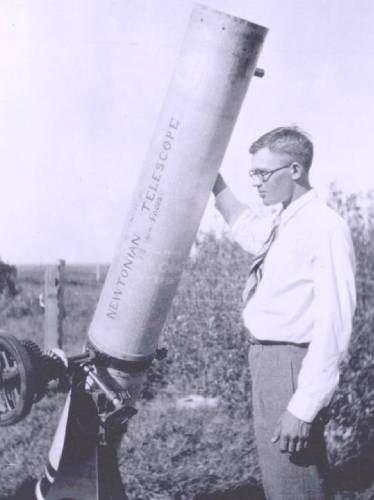
To control temperature and air flow, Tombaugh operated this telescope from a 24 feet long, 8 feet deep, and 7 feet wide pit that he dug himself. He sent detailed drawings of his observations to the Lowell Observatory.10,11 Impressed with his keen observation skills, Slipher offered Tombaugh a position with a three-month trial period.
At the observatory, Tombaugh began a systematic survey of the night sky. Learning from Lowell’s efforts, Tombaugh would fit a 14-inch x 17-inch photographic plate in a powerful 13-inch telescopic camera and take long exposures of the night sky (see Box 4). He focused on observing regions where Lowell had predicted Planet X’s presence. Often, he would need three hours to take one photo. He would then fix a fresh plate in the camera, focus on an adjacent region of the sky, and take another photo. Every few days, he would revisit the same regions of the sky and photograph them. In the day, he would develop the plates and use the blink comparator to compare photos of the same region.5 Like Lowell, he would examine each inch of these photos for any tiny dot that had changed position. This was a tedious task and demanded extreme concentration. Every half hour, Tombaugh would take a short break by walking away from the comparator. The stakes were too high to afford any lapse in concentration.
By January 1930, Tombaugh had spent thousands of hours on the blink comparator and had scanned the positions of 15 lakh stars. He had observed many dots that had moved, but at speeds that suggested they were too close to Earth to be Planet X. Finally, on February 18, 1930, Tombaugh noticed a tiny object that was in different positions in the plates taken on January 23 and January 29. The image was too sharp to be that of a comet. Its speed was too slow to be that of an asteroid or space debris, but suggested that it was far enough from Earth to be beyond Neptune.10,12 This was just as Lowell had predicted.
Box 4. Why did Tombaugh use long exposures?
Because he was taking photographs of the night sky. By choosing long exposures, Tombaugh was ensuring that the aperture of the camera remained open for as long as possible, letting in as much light as possible in an otherwise dim environment. This kind of exposure may also have been better suited to contrasting static objects with moving ones, although it may have caused moving objects to look blurred.
Announcing the discovery of Planet X
When Tombaugh reported this observation to Slipher, the entire team at the Lowell Observatory became involved in checking if this object met Lowell’s predictions for Planet X. Based on Lowell’s calculations, the mass of this object would be seven times that of Earth and it would be at a mean distance of 43 astronomical units (AU) from the Sun. This is how Chapter 12 of the Grade VI textbook introduces this unit of distance: “The distance of the Sun from the Earth is about 150 million km. A useful unit for expressing distances within the solar system is ‘astronomical unit’ (au) which is approximately the distance between the Sun and the Earth”.1 Tombaugh took more images of the same region of the sky with his 13-inch telescope and the 24-inch telescope that Lowell had used to observe Mars. Based on his observations, Tombaugh estimated the mass of this object to be roughly the same as that of Earth. Lampland tried to get a clearer image of the object by photographing it with the 42-inch telescope that Lowell had used in the first phase of his search. But its images remained faint and did not have the disc-like appearance that other planets had.13 To determine its path around the Sun, Tombaugh and Lampland recorded its position every day till May 26. Since no one at the Lowell Observatory had any experience calculating planet orbitals, Slipher asked astronomers from other observatories for help in this task.5
Finally, on March 12, 1930, Slipher sent a telegram with details of this discovery to the Harvard College Observatory. Based on the evidence the team at the Lowell Observatory had so carefully collected, the discovery was announced on March 13. This would have been Lowell’s 75th birthday. As news of this discovery spread, the Lowell Observatory received more than a thousand suggestions for names. The most popular choices were Minerva, Persephone, and Cronus.9,10 The name ‘Pluto’ (the Roman God of the underworld) was suggested by a 11-year-old called Venetia Phair. Her grandfather, Falconer Madan, loved the name and shared it with the Lowell Observatory through an astronomer friend.14 When a vote was taken, this name received 150 nominations. The Lowell Observatory got this name approved by both the American Astronomical Society and the Royal Astronomical Society. By May 1, 1930, Planet X was officially known as Pluto.
Key takeaways
- The presence of a ninth planet in the solar system was proposed when observations of Neptune could not explain differences between the predicted and observed orbitals of Uranus.
- The astronomer Percival Lowell started the search for this planet, which he called Planet X, in 1906 at the Lowell Observatory, Arizona, USA. Between 1906 and 1916, Lowell and his team developed a combined mathematical and observational approach to search for this planet in the night sky. They also refined the tools (telescopes and blink comparator) they used for this search.
- In 1929, Vesto Slipher from the Lowell Observatory resumed the search for this planet and assigned this task to Clyde Tombaugh, a gifted telescope builder and an amateur astronomer. In February 1930, using Lowell’s methods and his tools, Tombaugh discovered an object that was planet-like in its movement and far enough from Earth to be beyond Neptune.
- In March 1930, the discovery of this planet was announced. The name ‘Pluto’ was suggested by a eleven-year-old called Venetia Phair.
Acknowledgements
The authors thank Hridaykant Dewan for emphasizing the need to present this story not as a collection of historical facts, but as a window to the process of science and scientific thinking. We thank Radha Gopalan for drawing our attention to excerpts related to the ‘concept of a planet’ and ‘AU as a unit to measure distances in space’ from the Grade VI science textbook (NCERT, 2024-2025).
Notes
- Credits for the image used in the background of the article title: Pluto, NASA, Wikimedia Commons. URL: https://en.wikipedia.org/wiki/File:Pluto-01_ Stern_03_Pluto_Color_TXT.jpg. License: CC BY.
- This article has one detachable classroom resource: Teacher’s Guide: Pluto in the Classroom.
References
- National Council of Educational Research and Training (2006, 2022). ‘Chapter 12: Beyond Earth’. Science Textbook for Class VI (Rationalised 2023-24): 231-252. URL: https://ncert.nic.in/textbook.php?fecu1=12-12.
- Jennifer Whitten (2024). ‘The Planets in Our Solar System—A Timeline’. National Air and Space Museum, Smithsonian. URL: https://airandspace.si.edu/stories/ editorial/planets-our-solar-system-timeline.
- Davor Krajnovic (2020). ‘Adams: mathematical astronomer, college friend of George Gabriel Stokes and promotor of women in astronomy’. Philosophical Transactions of the Royal Society A. 378: 20190517. URL: https://doi.org/10.1098/rsta.2019.0517.
- National Steering Committee for National Curriculum Frameworks. ‘National Curriculum Framework for School Education 2023’. National Council of Educational Research and Training. URL: https://ncert.nic.in/pdf/NCFSE-2023-August_2023.pdf.
- Lowell Observatory. ‘History of Pluto’. Lowell Observatory. URL: https://lowell.edu/discover/history-of-pluto/. Accessed 22 November 2024.
- Wikimedia Foundation (2024). ‘Percival Lowell’. Wikipedia, The Free Encyclopedia. URL: https://en.wikipedia.org/wiki/Percival_Lowell. Accessed 22 November 2024.
- Nola Taylor Tillman (2013). ‘Percival Lowell Biography’. Space, Future US, Inc. URL: https://www.space.com/19774-percival-lowell-biography.html. Accessed 22 November 2024.
- Dr. Erica. (2017). ‘Discovering Pluto: Playing with Blink Comparators’. Rosie Research. URL: https://rosieresearch.com/blink-comparator-pluto/. Accessed 22 November 2024.
- Erik Gregersen (2015). ‘10 Important Dates in Pluto History’. Encyclopedia Britannica. URL: https://www.britannica.com/list/10-important-dates-in-pluto- history. Accessed 22 November 2024.
- Academy of Achievement (2022). ‘Çlyde Tombaugh: Discoverer of the Planet Pluto’. American Academy of Achievement. URL: https://achievement.org/ achiever/clyde-tombaugh/. Accessed 22 November 2024.
- Wikimedia Foundation (2024). ‘Clyde Tombaugh’. Wikipedia, The Free Encyclopedia. URL: https://en.wikipedia.org/wiki/Clyde_Tombaugh. Accessed 22 November 2024.
- Gianluigi Filippelli (2015). ‘Lovecraft and the discovery of Pluto’. Doc Manhattan, Field of Science. URL: http://docmadhattan.fieldofscience.com/2015/07/ lovecraft-and-discovery-of-pluto.html. Accessed 22 November 2024.
- Rhett Allain (2015). ‘Why Is It So Difficult to See Pluto?’. WIRED. URL: https://www.wired.com/2015/06/difficult-see-pluto/. Accessed 22 November 2024.
- NASA (2006). ‘Venetia Burney Phair: The Girl Who Named Pluto’. National Aeronautics and Space Administration. URL: https://science.nasa.gov/people/ venetia-burney-phair/. Accessed 22 November 2024.