
Following plant growth in the classroom


Plant growth is an important theme in the preparatory stage EVS curriculum. I decided to teach this theme to students from Grades III–V through an activity that allowed them to observe how plants grow over time. I chose this approach because hands-on activities can be an effective and lively way to engage students’ interest at this stage. This would also allow students to observe and discuss this process together.
Observing plant growth
Since many of my students were from farming families, I started the class with a discussion to draw out what they knew about plant growth from everyday experience. Students were aware that plants need water, soil, and sunlight to grow. They could describe how several kinds of local seeds looked and could tell the specific time of the year when each kind of seed was sown. I invited them to bring different kinds of local seeds to class, with one condition: the seeds should be from plants whose growth changes become visible within about 10–15 days. Chapter 5 (‘Seeds and Seeds’) of the Grade V EVS textbook (NCERT, 2024-2025) poses the following question to students: “Do some plants grow without seeds?“1 My students did not think this was possible. They believed that all plants grow from seeds. I suggested that we try planting stem cuttings of mint (pudina) and rose plants and observe how these change over time.
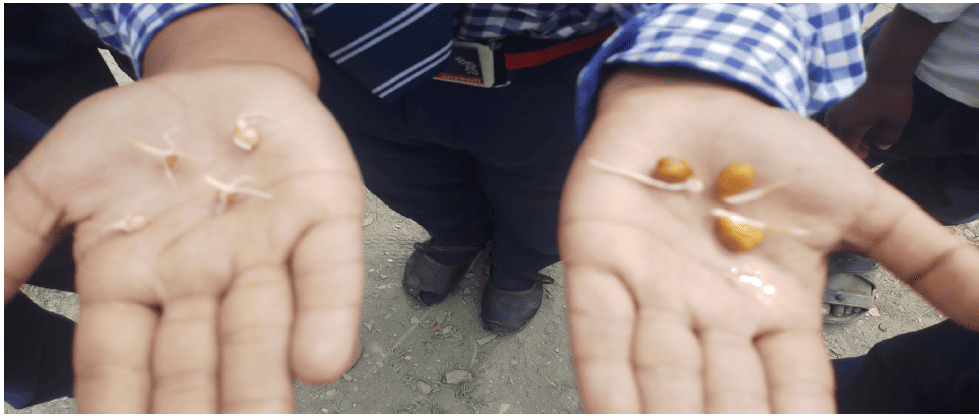
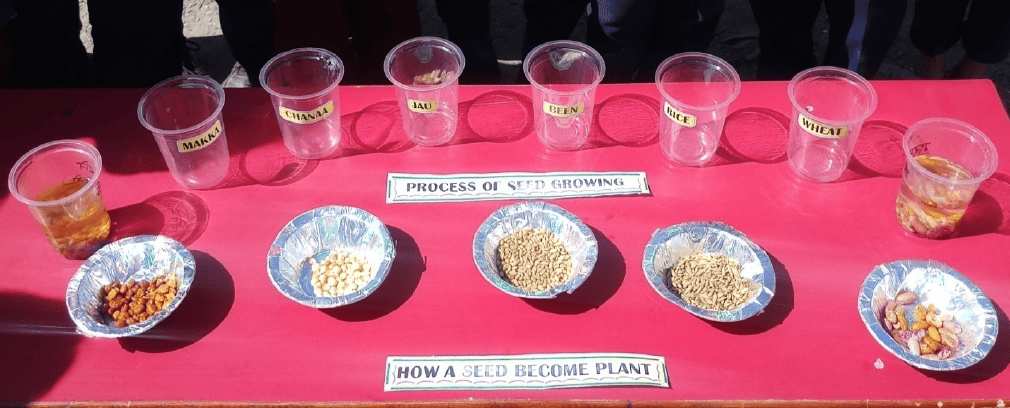
The students collected seeds of plants like wheat, rice, beans, corn (makka), kidney beans (rajma), and chickpea (channa). In Chapter 5 of the Grade V EVS textbook (NCERT, 2024-2025), students learn that “sprouting time of seeds may vary according to the temperature and humidity of the weather.”1 At the time of the activity, the weather in the region was quite cold. Since this could slow down the process of germination, we decided to soak some seeds in cold water and others in warm water. Chapter 19 (‘Abdul in the Garden’) of the Grade IV EVS textbook (NCERT, 2024-2025) suggests the following activity: “Soak a few seeds (5-6) overnight in a bowl full of water… Did you observe the seedlings come out of the seeds… What difference did you observe in the seeds after soaking? Compare with dry seeds and write.“2 Students observed that soaked seeds swell up in size and feel softer than unsoaked seeds (see Fig. 1). The outer covering of some seeds becomes slightly looser and more wrinkled. Within a couple of days, some of the soaked seeds had begun to germinate. Those soaked in warm water sprouted faster than those soaked in cold water.
License: CC BY-NC-ND 4.0 International Deed.
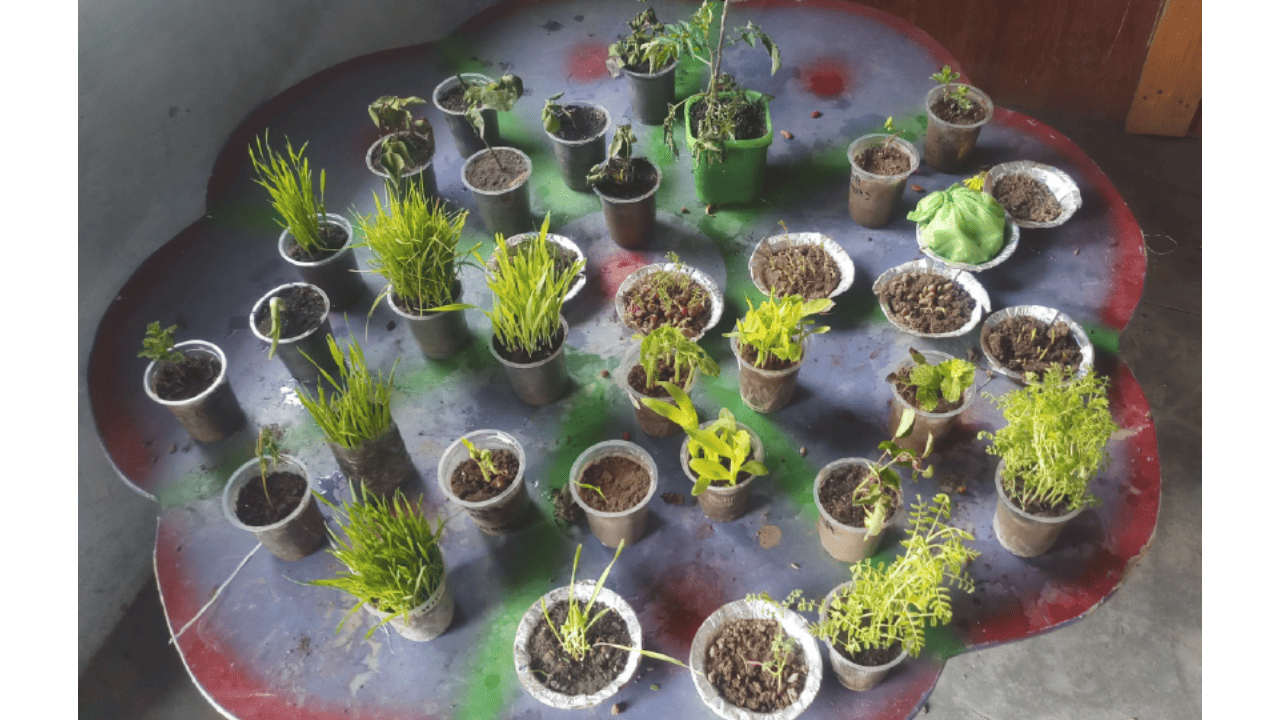
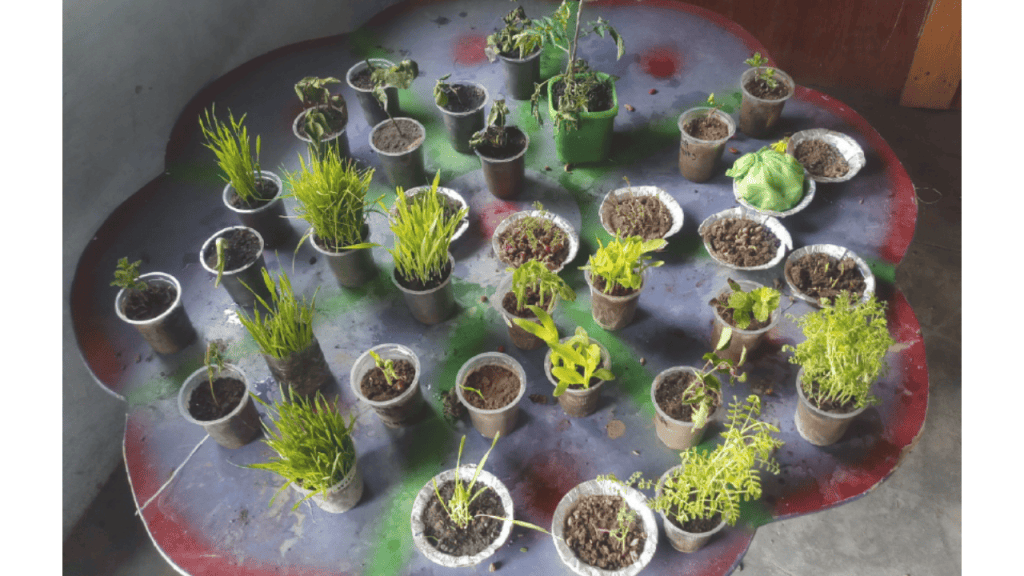
In Chapter 5 of the Grade V EVS textbook (NCERT, 2024-2025), students are invited to sow seeds in “a clay pot or a tin can with a wide mouth” and observe: “How long did it take for the plant to come out from the soil?… Did new leaves come out of the plant every day? Was there any change in the stem of the plant?“1 We decided to plant the seeds and cuttings in disposable plastic cups. Since they have transparent sides, we would be able to observe root growth below the soil surface. These cups are also easily available and inexpensive. Students attached a label to each cup with the name of the plant. They then made a small hole at the bottom of each cup and filled it with fertile soil from the garden. In some cups, part of a stem cutting was buried in the soil. In others, 2–3 seeds of the same kind were pressed into the soil (see Fig. 2). All the cups were kept in a place with enough light for the plants to grow. For the next 15–20 days, we observed the cups every day. Students recorded that roots became visible along the sides of the cup within 4–5 days. These thin, white, filament- like structures were seen growing downward into the soil. Chapter 19 of the Grade IV EVS textbook (NCERT, 2024-2025) suggests that students grow plants in cotton wool and observe the following: “In which direction did the roots grow?… What is the colour of the roots? Did you see any hair on the roots? Try and pull out one little plant from the cotton wool. Were you able to pull it out? Why? Did you see how the roots grip the cotton wool? Do you think that the roots hold the soil in the same way?“2 We cut open a few of the cups and carefully removed the soil around their roots. Students were able to see how the roots had grown and spread inside the soil. This exercise also allowed students to observe for themselves how roots hold the soil. Within 6–7 days, small green shoots began to appear above the soil.
Credits: Harish Nautiyal. License: CC BY-NC-ND 4.0 International Deed.
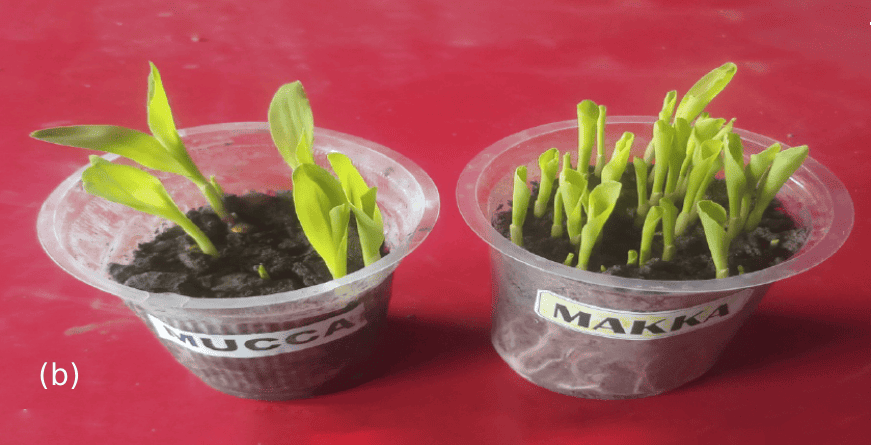
Students were excited to see seedlings emerging from seeds that had appeared dry and lifeless just a few days earlier. At this stage, we compared the physical features of rice and bean seedlings. Students were able to see how the bean seedlings showed two thick, fleshy seed leaves, while the rice seedling showed one thin, shoot-like blade. I used this clearly visible feature to introduce students to the difference between monocots and dicots. This concept is lightly touched upon in Chapter 3 (‘Nature Trail’) of the Grade IV EVS textbook (Reprint 2026–27), when students are invited to observe the different colours, textures, and shapes of leaves: “…did you observe that the leaves also have different types of lines on them? These lines are called veins.“3 This is followed by images of two different kinds of leaves showing parallel and reticulate venation respectively.3 Student observations in the preparatory stage can lay the foundation for a more formal understanding of these ideas at later stages. For example, the difference between monocots and dicots is developed in greater detail in Chapter 2 (‘Diversity in the Living World’) of the Grade VI science textbook (NCERT, Reprint 2026-2027):

License: CC BY-NC-ND 4.0 International Deed.
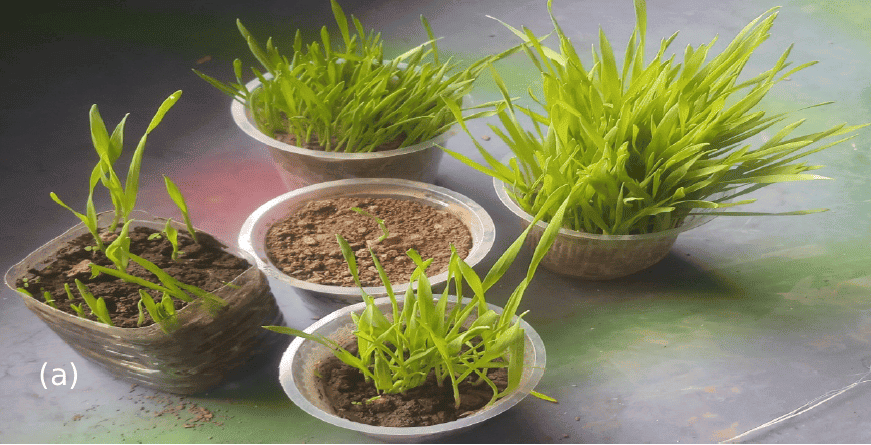
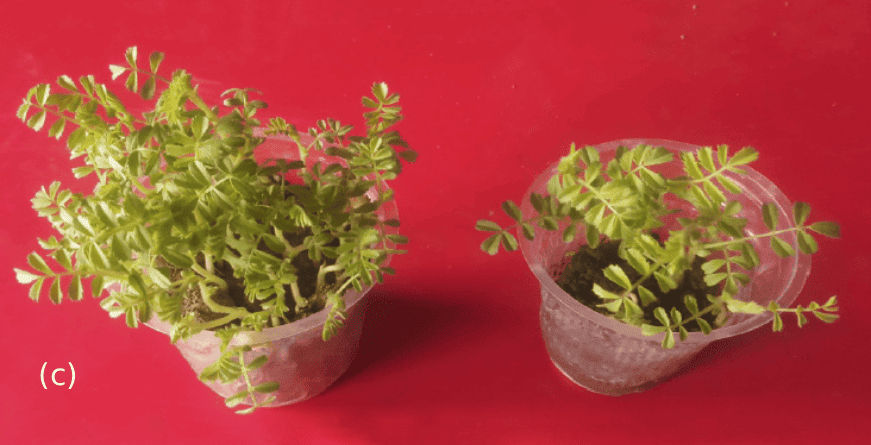
“You would notice that chickpea seeds are split into two parts… Each part is called a cotyledon. Plants that have seeds with two cotyledons are called dicotyledons (dicots). Maize has a single thin cotyledon… Plants with such seeds are called monocotyledons (monocots).“4 The same chapter also invites students to observe other features of these two categories of plants: “What relation do you observe among leaf venation, root types, and the number of cotyledons in seeds of a plant? Dicot plants have reticulate venation and a taproot system while monocot plants have parallel venation and a fibrous root system.“4 Over the following days, students continued to observe the different kinds of seedlings grow. They noticed and recorded differences in the shape and size of the true leaves of these different categories of plants (see Fig. 3). As students observed these changes, the discussion began to move from how seeds germinate to the broader question of how plants grow and develop. Students had observed that new plants could grow from stems as well. I used this observation to introduce them to the idea that plants can reproduce in different ways. This idea is developed in Chapter 8 (‘Reproduction in Plants’) of the Grade VII science textbook (NCERT, Reprint 2024-2025), where students are expected to learn that vegetative propagation is a process in which “new plants are produced from roots, stems, leaves and buds.“5 But at this stage, I focused on helping students recognise that familiar plants such as mint and rose can grow from plant parts other than seeds.
Box 1. Curricular connections:
This activity and related discussions can help teachers meet the following:
- Curricular goals for preparatory-stage EVS:
- CG-1: [The student] explores and engages with the natural and socio-cultural environment in their surroundings. Specifically, this lesson can help students develop the competency (C-1.2) to: “Ask questions and make predictions about simple patterns observed in the immediate environment.“
- CG-4: [The student] develops sensitivity towards social and natural environment. Specifically, this lesson can help students develop the competency (C-4.1) to: “Observe and describe diversity among plants… in their immediate environment (shape, sounds, food habits, growth, habitat).“6
- Learning objectives for preparatory-stage EVS students:
- Observe and share experiences for different phenomena such as how seeds germinate and the direction in which roots and shoots grow and conduct simple experiments and activities to find out the same.
- Conduct activities and simple experiments to check the properties/ features of different seeds.7
Parting thoughts
Since many of my students were from agricultural backgrounds, they were familiar with many aspects of plant growth. For example, they knew that seeds grow into new plants. But this activity allowed them to observe the sequence of growth— roots emerge first, followed by shoots, and then leaves. They knew that seeds are often soaked before sowing, but were now able to understand how soaking helps speed up germination. They had assumed that new plants emerge only from seeds. But they had now seen how some plants emerge from vegetative parts. Using transparent cups allowed students to observe changes that were often not visible to them. For example, they were able to see how roots grow downward and spread into the soil. They were also able to identify certain patterns in plant growth. For example, they observed that not all seeds germinate, that different kinds of seeds show different growth rates, and that the leaves of different plants can vary in many ways (see Box 1). These observations also led students to more carefully observe familiar plants in their surroundings and ask new questions about them. For example:
- Why do bananas not have seeds? How do these plants grow?
- Is soil always necessary for plant growth?
- Can plants grow in water alone?
- Who grows plants in forests, and who looks after them?
- How do forest plants get nutrients?
- Why are the leaves of different plants different in shape?
- Why is it that only certain plants grow in our fields?
For students, following plant growth in the classroom made concepts related to this phenomenon more meaningful than simply reading about them in a textbook. This activity also created opportunities to connect what they already knew from their surroundings with what they were learning in the classroom, and to ask new questions about both.
Key takeaways
- Students from agricultural backgrounds might already know that seeds grow into new plants. Following plant growth in the classroom can help draw their attention to how this happens and in what sequence.
- Such students may be familiar with local seeds, the practice of soaking them before sowing them, and even know when it might be best to sow them. Classroom activities that engage with these aspects can help students examine them more closely and understand how conditions like temperature and moisture can affect plant growth.
- Choosing different kinds of plants for this exercise based on their ability to grow from vegetative parts as well as seeds allows students to see that plants can reproduce in multiple ways. This can lead students to more carefully observe how different plants in their surroundings reproduce and ask new questions.
Notes
- Credits for the image (Plants in the classroom) used in the background of the article title: Harish Nautiyal. License: CC BY-NC-ND 4.0 International Deed.
- Teachers interested in trying an activity-based approach on this theme in the middle stage classroom may find it useful to refer to this article by Dhanya K: ‘An Inquiry-Based Approach to Germination’ in the December 2022 issue of i wonder… (https://publications. azimpremjiuniversity.edu.in/5118/).
References
- National Council of Educational Research and Training (2024–2025). ‘Chapter 5: Seeds and Seeds’. Looking Around: Environmental Studies, Textbook for Grade V: 42–50. URL: https://ncert.nic.in/textbook/pdf/eeap105.pdf.
- National Council of Educational Research and Training (2024–2025). ‘Chapter 19: Abdul in the Garden’. Looking Around: Environmental Studies, Textbook for Grade IV: 158–165. URL: https://ncert.nic.in/textbook/pdf/deap119.pdf.
- National Council of Educational Research and Training (Reprint 2026-27). ‘Unit 4: Things Around Us.’ Our Wondrous World, EVS Textbook for Grade IV: 35-56. URL: https://ncert.nic.in/textbook.php?deev1=3-10.
- National Council of Educational Research and Training (Reprint 2026-2027). ‘Chapter 2: Diversity in the Living World’. Curiosity, Textbook of Science for Grade VI: 9-34. URL: https://ncert.nic.in/textbook.php?fecu1=2-12.
- National Council of Educational Research and Training (Reprint 2024-2025). ‘Chapter 8: Reproduction in Plants’. Textbook of Science for Grade VII: 81-91. URL: https://ncert.nic.in/textbook/pdf/gesc108.pdf.
- National Steering Committee for National Curriculum Frameworks (2023). ‘National Curriculum Framework for School Education 2023’. National Council of Educational Research and Training. URL: https://ncert.nic.in/pdf/NCFSE-2023-August_2023.pdf.
- National Council of Educational Research and Training (2017). ‘Learning Outcomes at the Elementary Stage’. National Council of Educational Research and Training. URL: https://ncert.nic.in/pdf/publication/otherpublications/tilops101.pdf.