Exploring natural acid base indicators: Teaching experiences



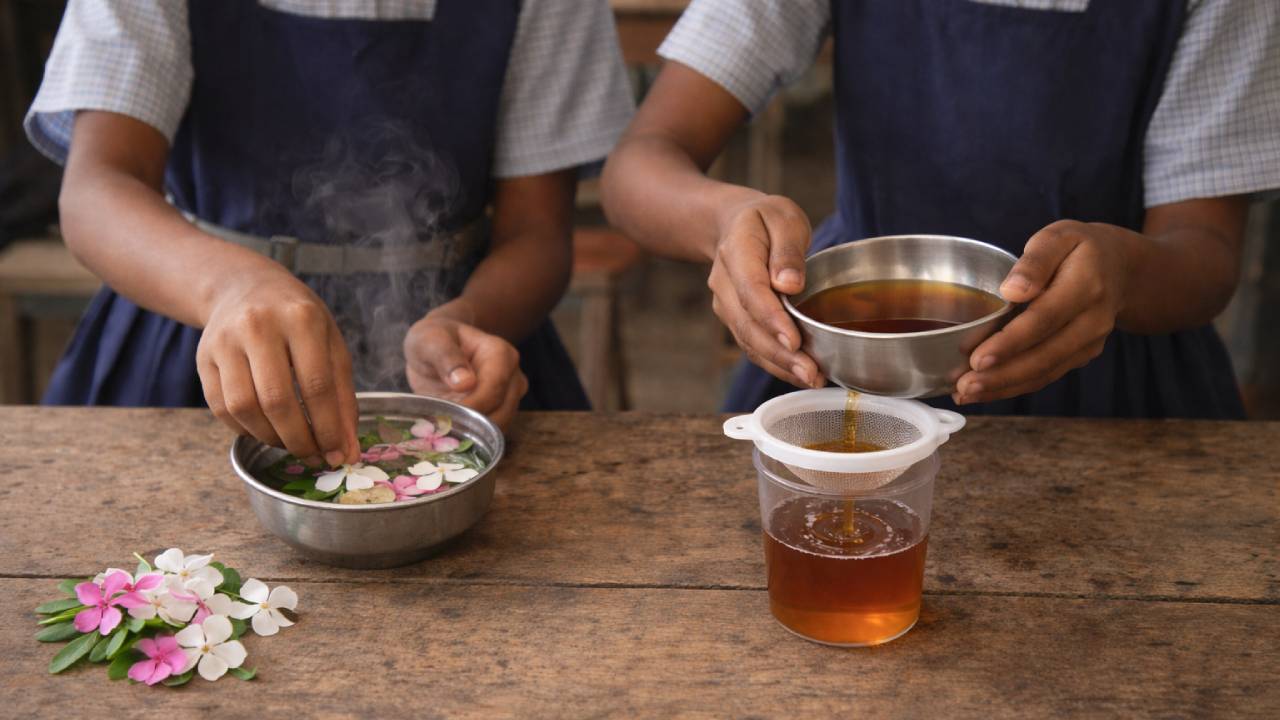
According to the National Curriculum Framework for School EducaCredits’ to the previous linetion (NCF-SE) 2023, one of the goals of the middle-stage science curriculum is to help students develop the ability to classify substances as acidic, basic, and neutral based on their chemical characteristics.1 Chapter 2 (‘Exploring Substances: Acidic, Basic and Neutral’) of the latest Grade VII science textbook (NCERT, 2025–2026) defines these categories in terms of the colour change they cause in litmus paper: “litmus paper is available in two colours—blue and red…substances…, such as lemon juice, amla juice, tamarind water, and vinegar, turned the blue litmus paper to red, implying that these substances are acidic in nature… substances…, such as soap solution, baking soda solution, lime water, and washing powder solution, turned the red litmus paper to blue. Hence, these substances are basic in nature… substances…, such as tap water, sugar solution, and salt solution, did not change the colour of either litmus paper. Can you predict their nature? These substances are said to be neutral because they are neither acidic nor basic.“2 But many government schools do not have access to litmus paper. Even where it is available, teachers can only afford to use it for demonstrations. To address this limitation, the chapter suggests two other approaches: (a) test edible substances by taste; and (b) test non-edible substances with natural indicators. We share some practical guidelines for exploring the second approach. These are based on our experiences of exploring this theme with students and teachers from Vijayapura, Karnataka and Pithoragarh, Uttarakhand.
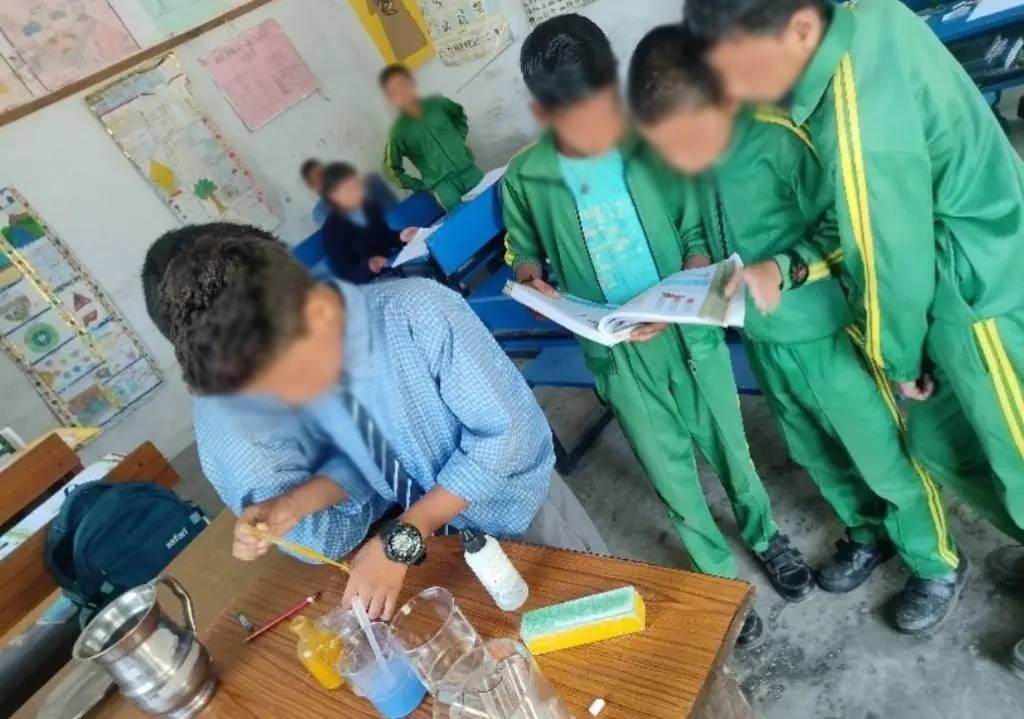
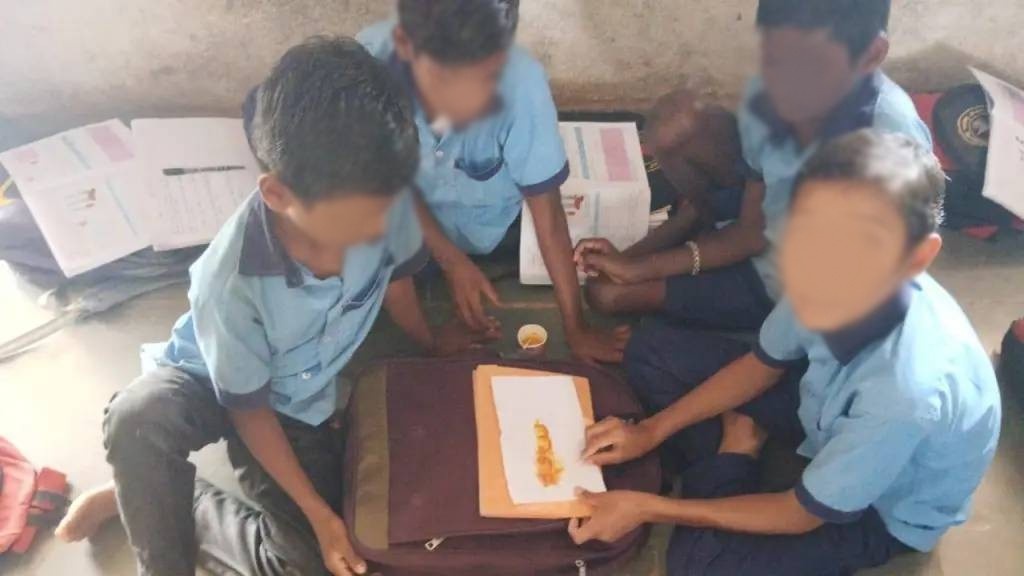
Credits: Megha Arora. Shared here with permission from the parents of the children. License: CC BY-NC-ND 4.0.
- Introduce the purpose of the exploration:
Students may find the concept of acids and bases abstract. Inviting students to classify edible substances into these categories by tasting them is a simple way of making this concept relatable to them. For example, Chapter 4 (‘Acids, Bases, and Salts’) of the older Grade VII science textbook (NCERT, 2024-2025) introduces these two categories in the following way: “Curd, lemon juice, orange juice, and vinegar taste sour. These substances taste sour because they contain acids. The chemical nature of such substances is acidic… What about baking soda? Does it also taste sour? If not, what is its taste? Since it does not taste sour, it means that it has no acids in it. It is bitter in taste. If you rub its solution between your fingers, it feels soapy. Generally, substances like these, which are bitter in taste and feel soapy on touching, are known as bases. The nature of such substances is said to be basic.“3 Activity 2.2 in Chapter 2 of the latest Grade VII science textbook (NCERT, 2025-2026) presents students with a list of 11 everyday substances (see Table I).2 Students are asked to consider which of these are edible and can be classified as acids and bases based on taste. The correct sentence is: Since the list includes non-edible substances such as soap solution, lime (chuna) water, and washing powder solution, students recognise the need for other methods of classification. For example, when asked why taste alone is insufficient for this purpose, a Grade VII student from Pithoragarh reasoned that some substances are too harmful to touch or taste. But knowing whether they are acidic or basic can help us handle them safely.
| S. No. | Substance | Edible or not? |
|---|---|---|
| 1 | Lemon juice | |
| 2 | Soap solution | |
| 3 | Gooseberry (amla) juice | |
| 4 | Tamarind water | |
| 5 | Vinegar | |
| 6 | Baking soda solution | |
| 7 | Lime (chuna) water | |
| 8 | Tap water | |
| 9 | Washing powder solution | |
| 10 | Sugar solution | |
| 11 | Salt solution |
- Emphasise the need for hands-on experience:
Both Chapter 4 of the older Grade VII science textbook (NCERT, 2024–2025) and Chapter 2 of the latest Grade VII textbook (NCERT, 2025–2026) suggest some commonly available sources of natural indicators and simple, inexpensive methods for preparing them.2,3 Ankita Chaturvedi shares other sources and similar processes in ‘Teacher’s Guide I: Extracting potential natural indicators’ (i wonder…, Apr 2025).4 Her methods—chopping, mashing, steeping, and straining—are used in kitchens everyday. Yet many students and teachers only read about indicators. Students in Pithoragarh reported that they had never prepared or used any indicators, and teachers in both Vijayapura and Pithoragarh shared that they had been unable to try these activities in class.
It is important to emphasise the need for students and teachers to engage in hands-on experiences around this theme. One of the authors did this by narrating a personal anecdote to a group of government school teachers from Vijayapura. While preparing for a class, she asked her son to collect periwinkle flowers. Watching her prepare an extract and test it with lemon juice and soap water sparked his curiosity. He began bringing other flowers (like roses and wildflowers) to test, eager to see what colour changes they would produce. Although some extracts produced unclear results, his enthusiasm was undamped. The author used this experience to highlight how natural indicators can spark genuine curiosity and self-driven exploration in children. Teachers were encouraged to offer students similar opportunities, either in school or at home (if time in class was a constraint). A few of the teachers later reported having tried this.
- Begin from the textbook:
Many teachers might prefer starting hands-on work with sources recommended in textbooks. For example, after learning that none of the teachers she was working with had prepared indicators, one author shared Ankita Chaturvedi’s Teacher’s Guide II: Colour Change in Natural Indicators (i wonder…, April 2025).5 Her aim was to inspire the teachers by highlighting the many sources of natural indicators that Ankita had experimented with. In the following session, she learned that all the teachers had prepared indicators using turmeric and China rose—the two sources listed in Chapter 4 of the Grade VII science textbook (NCERT, 2024–2025).3 None had explored any other sources.
In such cases, beginning with the textbook can help teachers build confidence in working with their hands. Teachers and students can then be encouraged to modify methods or explore new sources. For example, the teachers in Vijayapura went on to prepare indicators by modifying textbook methods in small ways:
- Indicator solutions: While the textbook recommends filtering the coloured extract produced by ‘steeping’ China rose flowers in hot water, the teachers boiled them.3 They also prepared a solution by mixing turmeric powder with water.
- Indicator strips: The textbook suggests rubbing ‘turmeric’ paste on ‘filter’ paper before drying it and cutting it into thin strips.3 The teachers used plain paper and made strips with a paste of China rose flowers, too.
- Encourage exploration of local sources:
A common challenge reported by students and teachers was the local or seasonal unavailability of some known sources of indicators (see Table II). For example, students in Pithoragarh had not seen lichens near their school or homes. The teachers in Vijayapura reported that red cabbage and purple yams were not locally available. Although strawberries were available in November and December, they were unavailable at the time of this discussion (July). Although the teachers believed that red bell peppers might be available in certain shops, they had not seen them in the local markets where they bought their produce. In such cases, students and teachers can be encouraged to think about sources that are locally and seasonally available to them. For example, the teachers in Vijayapura extracted indicators from beetroot, pomegranate, and grapes—all of which are locally grown and readily available to them throughout the year.
| S. No. | Known sources of natural indicators | Where do students/ teachers read about it? |
|---|---|---|
| 1 | Turmeric root | Chapter 4 of the Grade VII science textbook (NCERT, 2024-2025) |
| 2 | China rose flowers | |
| 3 | Lichens | |
| 4 | Red rose flowers | Chapter 2 of the latest Grade VII science textbook (NCERT, 2025-2026) |
| 5 | Beetroot | |
| 6 | Indian blackberry (jamun) fruit | |
| 7 | Red/purple cabbage | |
| 8 | Purple yam | Ankita Chaturvedi’s ‘Teacher’s Guide II: Colour Change in Natural Indicators’ (i wonder…, Apr 2025) |
| 9 | Red bell pepper | |
| 10 | Red spinach leaves | |
| 11 | Strawberry fruit | |
| 12 | Pomegranate peels and seeds | |
| 13 | Black grapes |
The unavailability of known sources of natural indicators can also be used to encourage students and teachers to discover new sources. This can engage their natural curiosity and observation skills. For example, when given this opportunity by their teachers, some Grade VI and VII students from Vijayapura prepared extracts from wildflowers that were in bloom at the time, even though they did not know the plants’ names. Some of their teachers, too, experimented with these wildflowers. In addition, they tested extracts from some new but familiar sources like coffee and neem. In some cases, it might be helpful to draw attention to a specific source. For example, since the teachers from Vijayapura had expressed a preference for exploring local produce, one author suggested testing extracts from the dragon fruit grown in the region.
- Emphasise caution while handling unsafe or unknown plants:
Children can be very curious about plants in their surroundings. But some local plants may not be safe to handle. For example, a student in Vijayapura tested oleander (called kanagli in Kannada) flowers; unaware that all parts of this plant are highly toxic and contact with its sap can cause skin irritation. Similarly, Grade VII students from Pithoragarh suggested testing stinging nettle (Urtica dioica) as a potential source. When asked why, the students explained that they had seen the plant growing near their school and had long been curious about it. They had heard that touching the plant—locally known as Bicchu ghaas—causes a stinging sensation. For this reason, students associated the plant with having a ‘strong’ or ‘chemical-like’ nature. They reasoned that because it produces a noticeable reaction on the skin, it might contain substances that react differently with acidic and basic solutions.
To reduce risk, teachers should insist that students discuss any new source before investigation. Toxic plants should be avoided, and unfamiliar plants should be researched and handled only by teachers using appropriate precautions. Students must also be reminded to:
- Never taste or eat substances used in explorations
- Wash hands thoroughly with soap and water after each exploration, and
- Conduct such explorations at home or school only under adult supervision.
- Use discussion to support learning and further exploration:
Through discussion, one of the authors learnt that some of the teachers in Pithoragarh that she worked with hesitated to explore indicators in class mainly due to limited resources and concerns about procedural accuracy. She emphasised that the value of these activities lies not in perfect laboratory conditions, but in supporting students’ ability to observe, think, and question. She also shared how important it was to allow students to decide not only the source they want to explore, but also the methods they use for it. For example, in one classroom, she observed that students divided a plant extract into two cups and added lemon juice to one and detergent solution to the other (see Fig. 1). The first solution turned red in colour and the second turned blue. Procedurally, this approach can raise some concerns, particularly regarding the ratio of indicator volume to the test solution. The usual recommendation is to add indicators in small amounts to the solution being tested, as this reduces the likelihood of errors arising from the weak acidic or basic properties of the indicator itself. But the author recognised that the students had adopted this approach simply to “see what happens.” Keeping this in mind, she began the post-activity discussion by emphasising that indicators produce observable and distinct colour changes in acidic and alkaline substances. She then explained the importance of—and the reasons for—adding the smallest possible volume of indicator (gradually, in drops) to test solutions, in order to minimise experimental error.
The other author introduced the teachers in Vijayapura to the process of extracting and testing indicators by demonstrating the procedure and discussing each step in detail. This encouraged many of the teachers to prepare and test some indicators themselves (see Table III). It also motivated some of them to try this approach with their students. For example, one teacher assigned this activity as homework for her students and supported their exploration through discussion in the following ways:
- Before the activity, the teacher shared clear instructions about suitable sources and methods. She suggested some common and easily available fruits and flowers that students could start with, and explained how indicators could be prepared at home by crushing the source material in a small amount of room-temperature water. Students were instructed not to try boiling water on their own, and to carefully record all their observations and questions.
- After the activity, the teacher invited students to share their observations and questions in class. Many students had tested their indicators on household products such as shampoo, coffee decoction, bathing soap, and washing soap. One challenge they reported was that indicators did not always produce a clearly visible colour change. For example, when an indicator was added to dark brown coffee decoction, students found it difficult to detect any change in colour. Another challenge was interpreting the observations. Each indicator produced a different type of colour change in different test solutions, and students were unsure how to use these changes to classify the household products as acidic or basic.
| S. No. | Source of indicator | Colour change in a known acid | Colour change in a known base |
|---|---|---|---|
| 1 | Turmeric | Yellow | Reddish-brown |
| 2 | Oleander | Pink | Greenish |
| 3 | China rose | Red | Green |
| 4 | Periwinkle | Pink (dark) | Greenish (dark) |
| 5 | Neem | Colorless | Light yellow |
| 6 | Coffee solution | Dark brown but not distinguishable | No change |
| 7 | Red Rose | Deep red | Green |
| 8 | Wildflower growing in a neighboring field (name unknown) | Colorless | Greenish |
| 9 | Onion | Retains smell | No smell |
| 10 | Beetroot | No specific change observed | No specific change observed |
Interestingly, students also reported that extracts prepared from both white and pink periwinkle flowers produced the same type of colour changes in the test solutions. To address these difficulties, the teacher suggested that students begin by testing their indicators with substances whose nature they already knew to be acidic or basic, such as lemon juice, tamarind extract, soap solution, and lime water. She also shared a modified version of Table 4.3 from Chapter 4 of the Grade VII science textbook (NCERT, 2024–2025) and asked students to record their observations using this format (see Table IV).3 When students continued to find the results confusing, the teacher explained that: (a) many natural indicators show different colour changes at different pH values, and (b) different indicators may produce different colours in the same substance. She then repeated the activity in class, allowing students to use litmus paper to classify the test samples as acids or bases. This helped students appreciate that litmus paper produces more distinct and reliable colour changes. They also learned that while natural indicators are valuable tools for exploration, they may not always yield accurate results. The teacher used this exercise to highlight how litmus paper provides a simple and reliable way to link colour change with the acidity or alkalinity of a substance.
- Encourage reflection on connections with the textbook and everyday life:
Our first recommendation is to begin with a discussion on the purpose of exploring natural indicators (as simple, low-cost tools to classify substances as being acidic, basic, or neutral). Our ast recommendation is to end with a discussion on the relevance of this classification:
- For students: It can be useful to link these discussions to aspects of the exploration that students themselves show interest in. For example, after a group of Grade VII students from Vijayapura determined that coffee decoction was acidic in nature, their teacher invited them to consider what effects drinking it in excess could have on their health. In another case, participating in this exploration led a Grade VII student from Pithoragarh to reason that ENO (the brand name of a commonly used antacid) must be basic in nature, explaining: “We use it when we have acidity in our stomach.” To illustrate a direct and engaging application of this learning, some of the teachers in Vijayapura encouraged students to use natural indicators to create and display secret messages during the annual Kalika Habba, an exhibition of students’ learning and science day celebrations (see Fig. 2). Students enjoyed this activity, and it helped them appreciate the relevance of the exploration in a different and more playful way.
Credits: Rakshit Patel. Shared here with permission from the parents of the children. License: CC BY-NC-ND 4.0.
- For teachers: It may be helpful to connect this exploration with other topics in the middle-stage science curriculum. For example, in discussions with teachers from Vijayapura, one of the authors pointed out that the methods used to extract natural indicators—described by Ankita Chaturvedi in her article ‘Exploring Acids & Bases with Natural Indicators’ (i wonder…, Apr 2025)— are the same methods that students are expected to learn in Chapter 9 (‘Methods of Separation’) of the Grade VI science textbook (NCERT, Reprint 2025–2026).6,7 For example, when students observe a teacher extracting an indicator from China rose, they see the flowers being boiled in water (sometimes to reduce excess water and obtain a more concentrated solution) and the solution being filtered. These steps can be related to the processes of evaporation and filtration. In contrast, when indicators are extracted from wildflowers without boiling, students crush the flowers, soak them in water, and then filter the solution. These steps can be linked to decantation and filtration. To support such connections, the author suggested that teachers ask guiding questions such as: How do we prepare a natural indicator? What steps are involved? Which separation methods are used in this process? Teachers who tried this approach reported that it made it easier for them to explain the key concepts in Chapter 9 of the Grade VI science textbook (NCERT, Reprint 2025–2026).7 The same author also drew teachers’ attention to the fact that the colour changes produced by indicators can be linked to the concept of chemical changes introduced in Chapter 5 (‘Changes Around Us: Physical and Chemical’) of the Grade VII science textbook (NCERT, 2025).8 One teacher shared this connection in her classroom by explaining that the colour change observed when an indicator is added to an acid or a base results from a chemical reaction, rather than simple physical mixing. She reported that this example helped students relate to the idea of chemical changes in a more visual and concrete way.
| S. No. | Test solution | Effect on turmeric solution | Effect on China rose solution | Effect on other indicator (specify name) | Remarks |
|---|---|---|---|---|---|
| 1 | Lemon juice | ||||
| 2 | Orange juice | ||||
| 3 | Vinegar | ||||
| 4 | Milk of magnesia | ||||
| 5 | Baking soda | ||||
| 6 | Lime water | ||||
| 7 | Sugar | ||||
| 8 | Common salt |
Box 1. Curricular connections:
Activities and discussions around this exploration with natural indicators can help meet the following:
- Curricular goals for middle-stage science:
- CG-1: [The student] explores the world of matter and its constituents, properties, and behaviour. Specifically, it can support students in developing the competency (C-1.1) to: “Classify matter based on observable… chemical (pure, impure; acid, base; metal, nonmetal; element, compound) characteristics.“
- CG-6: [The student] explores the nature and processes of science through engaging with the evolution of scientific knowledge and conducting scientific inquiry. Specifically, it can support students in developing the competency (C-6.2) to: “Formulate questions using scientific terminology (to identify possible causes for an event, patterns, or behaviour of objects) and collect data as evidence (through observation of the natural environment, design of simple experiments, or use of simple scientific instruments).“
- CG-7: [The student] communicates questions, observations, and conclusions related to science. Specifically, it can support students in developing the competency (C-7.1) to: “Use scientific vocabulary to communicate science accurately in oral and written form, and through visual representation.“1
- Learning outcome for Grade VII science: [The student] conducts simple investigations to seek answers to queries like: ‘Can the extract of coloured flowers be used as acid-base indicators?‘9
Parting thoughts
Involving students in the exploration of natural indicators can help teachers address multiple curricular goals of middle-stage science (see Box 1).1 Such activities can spark students’ curiosity and strengthen their understanding of how science operates in everyday contexts. Another important outcome is the development of a scientific temperament. Through these explorations, students learn to observe carefully, make predictions, and draw evidence-based conclusions. This enables them to learn science by doing rather than by memorisation, leading to deeper conceptual understanding. In addition, students feel more respected and confident in sharing their ideas, helping to create a positive and supportive classroom environment.
Key takeaways

- An important curricular goal of the middle-stage science curriculum is to help students classify everyday substances as acidic, basic, or neutral. Natural indicators act as simple and inexpensive tools for classification.
- Allowing students and teachers to begin their exploration of natural indicators from sources listed in the textbook can help build their confidence.
- In preparing indicators, prioritising hands-on experience over procedural precision can give students and teachers the opportunity to observe, think, and question.
- Using seasonal or local constraints in indicator sources as opportunities for discovery of new sources can engage students’ and teachers’ curiosity in local plants.
- Discussions before and after exploration can help address misconceptions, examine procedural choices, and deepen understanding
Acknowledgements
The examples of practice shared in this article were first provided by Shalom Sunaina and Megha Arora in separate responses to a request by Shiv Pandey for feedback on earlier issues of i wonder… Additional details were later shared by email with Radha Gopalan and Chitra Ravi. These experiences have been brought together, reframed, and compiled into this article by Chitra Ravi. The i wonder… team thanks the authors for generously sharing their experiences and for their permission to present them in this form.
Notes
Credits for the image (Extracting indicator from periwinkle flowers) used in the background of the article title: Created for i wonder… using ChatGPT, under prompting by Chitra Ravi (Dec 2025). License: CC BY-NC-ND 4.0.
References
- National Steering Committee for National Curriculum Frameworks (2023). ‘National Curriculum Framework for School Education 2023’. National Council of Educational Research and Training. URL: https://ncert.nic.in/pdf/NCFSE-2023-August_2023.pdf.
- National Council of Educational Research and Training (2025). ‘Chapter 2: Exploring Substances: Acidic, Basic, and Neutral’. Curiosity, Textbook of Science for Grade VII: 7-22. URL: https://ncert.nic.in/textbook.php?gecu1=2-12.
- National Council of Educational Research and Training (2024). ‘Chapter 4: Acids, Bases, and Salts’. Curiosity, Textbook of Science for Grade VII: 38-46. URL: https://www.ncert.nic.in/textbook/pdf/gesc104.pdf
- Chaturvedi, Ankita (2025). ‘Teacher’s Guide I: Extracting potential natural indicators’. i wonder… (12): 72. ISSN 2582-1636. URL: https://publications.azimpremjiuniversity.edu.in/6057/.
- Chaturvedi, Ankita (2025). ‘Teacher’s Guide II: Colour change in natural indicators’. i wonder… (12): 73-74. ISSN 2582-1636. URL: https://publications.azimpremjiuniversity.edu.in/6058/.
- Chaturvedi, Ankita (2025). ‘Exploring acids & bases with natural indicators’. i wonder… (12): 68-71. ISSN 2582-1636. URL: https://publications.azimpremjiuniversity.edu.in/6055/.
- National Council of Educational Research and Training (Reprint 2025-2026). ‘Chapter 9: Methods of Separation in Everyday Life’. Curiosity, Textbook of Science for Grade VI: 163-181. URL: https://ncert.nic.in/textbook.php?fecu1=9-12.
- National Council of Educational Research and Training (2025). ‘Chapter 5: Changes Around Us: Physical and Chemical’. Curiosity, Textbook of Science for Grade VII: 57-72. URL: https://ncert.nic.in/textbook.php?gecu1=5-12.
- National Council of Educational Research and Training. ‘Learning Outcomes at the Elementary Stage’. First Edition. National Council of Educational Research and Training (2017). URL: https://ncert.nic.in/pdf/publication/otherpublications/tilops101.pdf