
Investigating how milk turns to curd


Chapter 1 (‘Exploring the Investigative World of Science’) of the Grade VIII science textbook (NCERT, 2025) opens with the following passage: “We don’t want you to just learn new facts; we want you to learn how to find new facts. Investigation in science means more than just looking at something and asking only simple questions. Now you can ask more focused questions, and design ways to perhaps do simple experiments to answer those questions, and then use your observations to improve your understanding. In doing so, each of you will not just be learners but also investigators, young scientists, exploring real-world puzzles. These may range from everyday life… to the bigger mysteries of Earth and beyond…“1 One such real-world puzzle that can be used to introduce students to scientific investigation is the conversion of milk to curd.
Students are likely to be familiar with this process, as setting curd is a routine practice in many Indian households. Investigating this familiar process in the science classroom, however, can open up rich learning opportunities for curious students who are just beginning to explore the world of science. For example, Activity 2.9 in Chapter 2 (‘The Invisible Living World: Beyond Our Naked Eye’) of the Grade VIII science textbook (NCERT, 2025) encourages students to compare the effect of adding a spoonful of curd to lukewarm milk versus cold milk.2 But this is only one aspect of curd formation. There are many other questions related to this process that students can explore through simple and inexpensive activities. A small space, careful observation, and a willingness to experiment with milk and curd (and clean up afterwards) may be all that is needed for such investigations (see Box 1).3,4 I share some possibilities.
Box 1. Curricular connections:
These activities and discussions can help meet the following:
- Curricular goals for middle-stage science:
- CG-6: [The student] explores the nature and processes of science through engaging with the evolution of scientific knowledge and conducting scientific inquiry. Specifically, it can help students develop the competency (C-6.2) to: “Formulate questions using scientific terminology… and collect data as evidence (through observation of the natural environment, design of simple experiments, or use of simple scientific instruments).”
- CG-7: [The student] communicates questions, observations, and conclusions related to science. Specifically, it can help students develop the competency (C-7.1) to: “Use scientific vocabulary to communicate science accurately in oral and written form, and through visual representation.”3
- Curricular expectations for middle-stage science: Students are expected to develop process skills of science which includes observation(s), posing question(s), searching various resources of learning, planning investigations, hypothesis formulation and testing, using various tools for collecting, analysing, and interpreting data, supporting explanations with evidences, critically thinking to consider and evaluate alternative explanations, reflecting on their own thinking.4
- Learning outcomes (LO) for middle-stage science:
- Conduct simple investigations to seek answers to queries.
- Relate processes and phenomena with causes.
- Apply the learning of scientific concepts in day-today life.4
How is curd different from milk?
Students can begin by comparing small, unlabelled samples of milk and curd. They should be encouraged to use all their senses except taste, and to record observations to justify their answers. Students typically note that curd is thicker and has a sour smell. These initial observations can be expanded with questions such as:
- Is milk always runny? Can boiling affect its thickness? How thick is curd? Can curd be thin and runny? Can its thickness be controlled?
- What does milk smell like? Does curd always smell sour? Is fresh curd different from older curd? Would adding a few drops of lemon juice to milk produce a curd-like smell? (This can be tested in class.)
These observations set the stage for deeper investigation into the properties of milk and curd (see Activity Sheet I). Two suggested methods are:
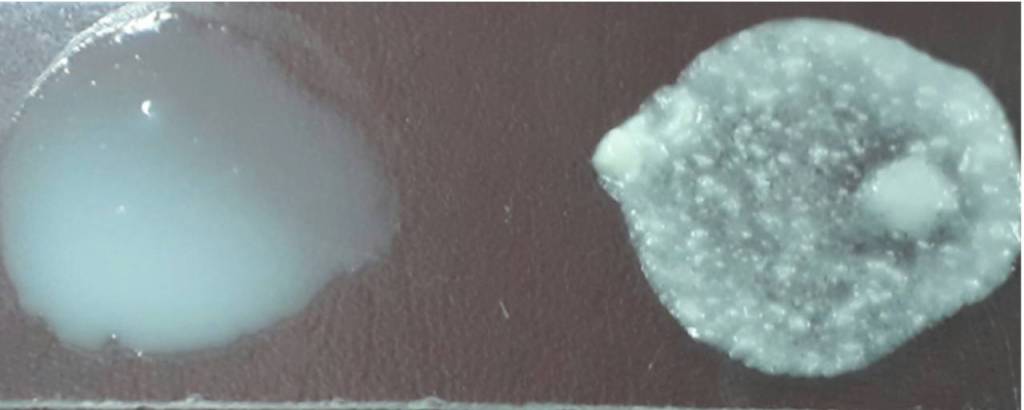
- Smudge test: This method requires a flat transparent surface, like that of a glass slide. Droppers can be used to put a drop of milk on one glass slide and a drop of curd on another slide. Teachers can draw students’ attention to how the two liquids move through the dropper. Does it take more or less time for the curd to move through? If students smudge each of these liquids on its slide and compare the results, can they see any clear observable differences in their consistency? Students are likely to see that a milk smudge is much smoother than that of curd (which appears clumpy), and milk tends to concentrate at the centre of the smudge (see Fig. 1). It may be useful to remind students to use separate droppers and fingers (for smudging) to handle the two samples. This can be shared as a general lab precaution, but students can also be invited to think about and share reasons why this precaution may be necessary in this specific activity.
- pH test: Chapter 2 (‘Exploring Substances: Acidic, Basic, and Neutral) of the Grade VII science textbook (NCERT, 2025) explains that: “… substances that taste sour tend to contain acids and are acidic in nature.”5 Students are then asked to find the name of the most common acid present in curd. Teachers can start this part of the activity by asking students to predict if milk and curd are acidic, basic, or neutral. Also invite them to support their answers with reasoning. Students are likely to predict that curd is acidic. They can then be asked to test their predictions using pH paper. If access to pH paper is limited, a small piece of it can be used to demonstrate the difference in pH between the two liquids. Teachers can do this themselves or invite two students to demonstrate this to the class. Students typically find curd more acidic (~4.5–5.5) than milk (~6.5–6.7). If pH paper is unavailable, students can prepare and use graded natural acid-base indicators like the extract of red cabbage or China rose, if available. These indicators can help students observe that curd is more acidic than milk. This exercise can highlight another application of the natural indicators students read about in Chapter 2 of the Grade VII science textbook (NCERT, 2025).5
This activity can reinforce that scientific observation can involve ‘multiple’ senses and be refined using ‘simple tools’. It can also be used to probe students’ understanding of the change involved in curd formation. Chapter 5 (‘Changes Around Us: Physical and Chemical’) of the Grade VII textbook (NCERT, 2025) draws students’ attention to many common examples of change from everyday life (like boiling water, chopping vegetables, etc.). They are then introduced to two categories of change: “A physical change is one in which a substance or object undergoes a change in its physical properties and no new substance is formed. A chemical change is one in which one or more new substances are formed. It involves a chemical reaction and can be represented by a chemical equation.“6 Students can be asked questions like:
- Is the conversion of milk to curd a physical or chemical change? Or both?
- Is this change permanent or reversible? Can curd be turned back into milk?
Students can be encouraged to justify their responses with observations of the differences between milk and curd.
How is milk changed to curd?
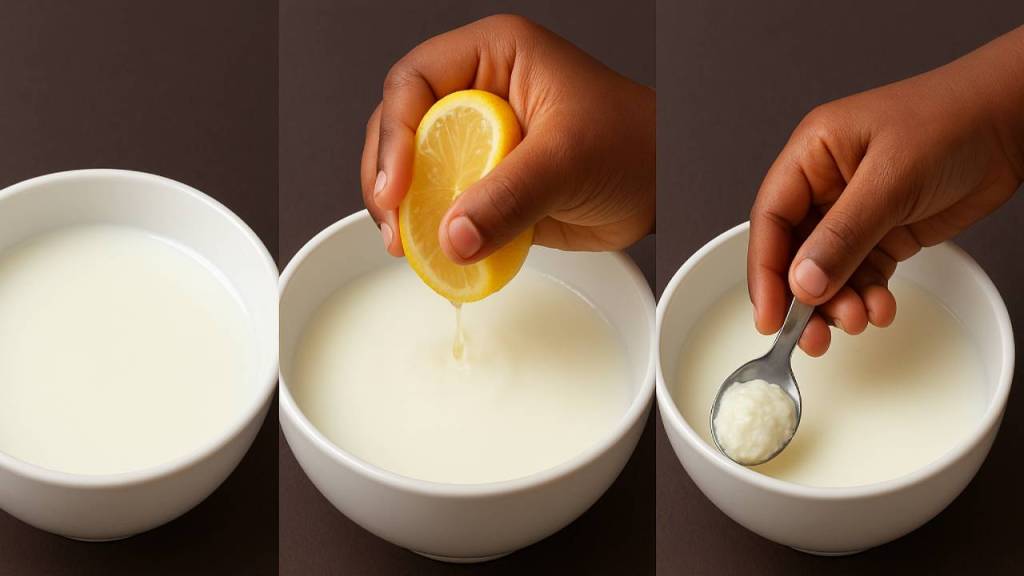
This investigation can begin by asking students how curd is prepared. Many are likely to respond that a fresh batch of curd is made by adding a spoonful of old curd to milk. Popular belief and some online resources suggest that fresh curd can be made without old curd using alternatives such as lemon juice, silver coins, or green/red chillies (see Fig. 2). A short article or video on this theme can be shared with students.
Students can then be divided into groups of 5–6 to explore this question through a hands-on activity (see Activity Sheet II). This activity may take 5–6 hours, so it is best to start at the beginning of the school day, with observations continuing until the last period. Groups can assign different students to record observations at regular intervals. Once students have completed the activity, each group can be invited to share their conclusions with the class. Typical findings include: (a) Milk left alone does not form curd, (b) Fresh curd forms only when old curd is added, (c) A silver coin does not turn milk into curd, and (d) Adding lemon juice to milk produces paneer (cottage cheese), not curd.
Students can now be invited to consider if milk spoilage, paneer formation, and curd formation are physical or chemical changes. They can also be asked: Are there differences in the changes involved in these processes? Students can use pH paper to compare the acidity of fresh milk with spoilt milk, paneer, and curd. This allows them to observe, for themselves, that all three processes increase acidity. Guided discussion can help students understand that while all three processes involve irreversible chemical changes, milk spoilage and curd formation also involve biological changes. Teachers can explain that paneer forms when acid (like from lemon juice) coagulates milk proteins (casein), separating them from whey, whereas curd and spoilt milk become acidic due to bacterial fermentation.
Teachers can ask: What does old curd contain that turns milk into a fresh batch? Does it change the chemistry or biology of milk? Students may relate to this passage from Chapter 2 of the Grade VIII science textbook (NCERT, 2025): “…curd contains several types of bacteria. One of them is Lactobacillus. This bacterium feeds on the sugar in the milk (lactose), multiplies, and ferments the milk to form curd… these bacteria produce lactic acid, which makes curd sour.“2 Teachers can explain that these bacteria are collectively called lactic acid bacteria (or LAB). Here are some other questions that students can be encouraged to think about:
- When we use old curd to set new curd, we are transferring some live LAB from the old curd to fresh milk. Scientists who study microbes (microbiologists) would call the old curd a starter culture. The live LAB then grows in the milk. When we eat curd, are we eating live or dead bacteria?
- Is eating live LAB healthy or unhealthy for us? From everyday experience and what they hear at home, many students are likely to think of curd as healthy food. In Chapter 9 (‘Life Processes in Animals’) of the Grade VII textbook (NCERT, 2025), students read that: “Fibre-rich food, and especially ‘fermented foods’ (like curd, buttermilk, shrikhand, kanji, pickles, gundruk, and poita bhat) are good for a healthy digestive system and overall wellbeing.“7 Teachers can also encourage students to try this exercise from the ‘Discover, design, and debate’ section of Chapter 2 of the Grade VIII textbook (NCERT, 2025): “With the help of your parents and teachers, list some traditional food items from your area that utilise the process of fermentation. Investigate the ingredients used in the preparation of these fermented food items; the method of preparing them; the microorganism responsible for the fermentation of the food, and the cultural and nutritional importance of the fermented food.“2 Having students share their findings in class can help them appreciate the everyday uses of fermentation as a metabolic process where microbes like yeast and bacteria convert sugars into alcohol, gases, or acids.
Similarly, teachers can ask students what causes milk that is left to itself to spoil. Likely that some students may relate this question to this passage in Chapter 2 of the Grade VIII science textbook (NCERT, 2025): “Have you ever seen…any other food item rot after being left outside for some time?… This happens because they have been infected by microbes.“2 Teachers can share that this process is also caused by bacteria and can pose these follow-up questions from the same chapter of the textbook: “But where did these microbes come from? How did they come in contact with the food?“2 Responses to this question can be used to draw students’ attention to the fact that “… microorganisms can be found everywhere, be it in water, soil, air, or even in some food items.“2 Here are some questions that students can be encouraged to think about:
- Can senses other than taste be used to detect milk spoilage? Why is it important to avoid using the sense of taste in detecting spoilage of food or water? Chapter 3 (‘Health: The Ultimate Treasure’) of the Grade VIII science textbook (NCERT, 2025) shares how “…contaminated drinking water or food” can cause disease.8 What about spoiled milk? How would drinking it affect us?
- In Chapter 2 of the Grade VIII science textbook (NCERT, 2025), students learn that pickles and murabbas do not spoil because they have high concentrations of salt or sugar, which prevent microbes from growing on them.2 Chapter 3 of the Grade VIII science textbook (NCERT, 2025) suggests that infections can be prevented by taking simple precautions like “keeping ourselves and our surroundings clean”, “washing hands with soap and water to remove pathogens“, and “boiling” water before drinking it.8 Would similar precautions help prevent milk spoilage?
- Milk spoils quickly, but when converted to curd, it remains edible longer. Does this have anything to do with the Lactobacillus in the old curd? Can fermentation be seen as a process of food preservation?
Teachers can use this discussion to point out that, unlike paneer formation (a chemical change), curd formation and milk spoilage involve both chemical and biological changes. They can also pose the question asked in Chapter 5 of the Grade VII science textbook (NCERT, 2025): Are all changes desirable? In the same chapter, students read: “Many useful changes happen in our daily life. For example, the changing of milk into curd, ripening of fruits, cutting of fruits, and cooking of food. All these are desirable changes… On the other hand, some changes may be undesirable, such as the rusting of iron or the decay of food during its storage.”6
Parting thoughts
The National Curriculum Framework for School Education (NCF-SE) 2023 emphasises the need for school education to help students develop capacities for scientific inquiry. An investigation into the conversion of milk to curd can help teachers introduce students to the scientific process in a simple, inexpensive, and yet practically relevant way. It can also allow students to relate many middle-stage science concepts about acids and bases, physical and chemical changes, and microbes to their everyday lives. Such explorations can enable students to “…understand the world around them with increasing depth, explore scientific questions at different levels through discussion and experimentation, and learn to communicate this understanding in different ways.”1
Key takeaways
- Setting curd from milk is a familiar practice in many Indian homes. Investigating this everyday process in the classroom allows teachers to introduce students to scientific inquiry in a simple, accessible, and inexpensive way.
- Encouraging students to carefully observe and record differences between milk and curd helps them recognise how scientific investigation draws on multiple senses and on simple tools such as glass slides, pH paper, or graded natural indicators.
- Hands-on explorations of whether old curd is required to set new curd enable students to connect ideas about physical and chemical changes, as well as the beneficial and harmful roles of microbes to situations from their everyday lives
Acknowledgements
This article and related classroom resources were first published in i wonder…, August 2019, pp. 43–46. Previous versions are available at: https://publications.azimpremjiuniversity.edu.in/2099/. The original version has been modified by Chitra Ravi to include direct connections to the classroom instruction of chapters and concepts in the middle-stage science curriculum. The resource versions have been modified similarly with questions that encourage students to think critically about textbook concepts. The i wonder… team thanks the author for permission to publish the revised versions.
Notes
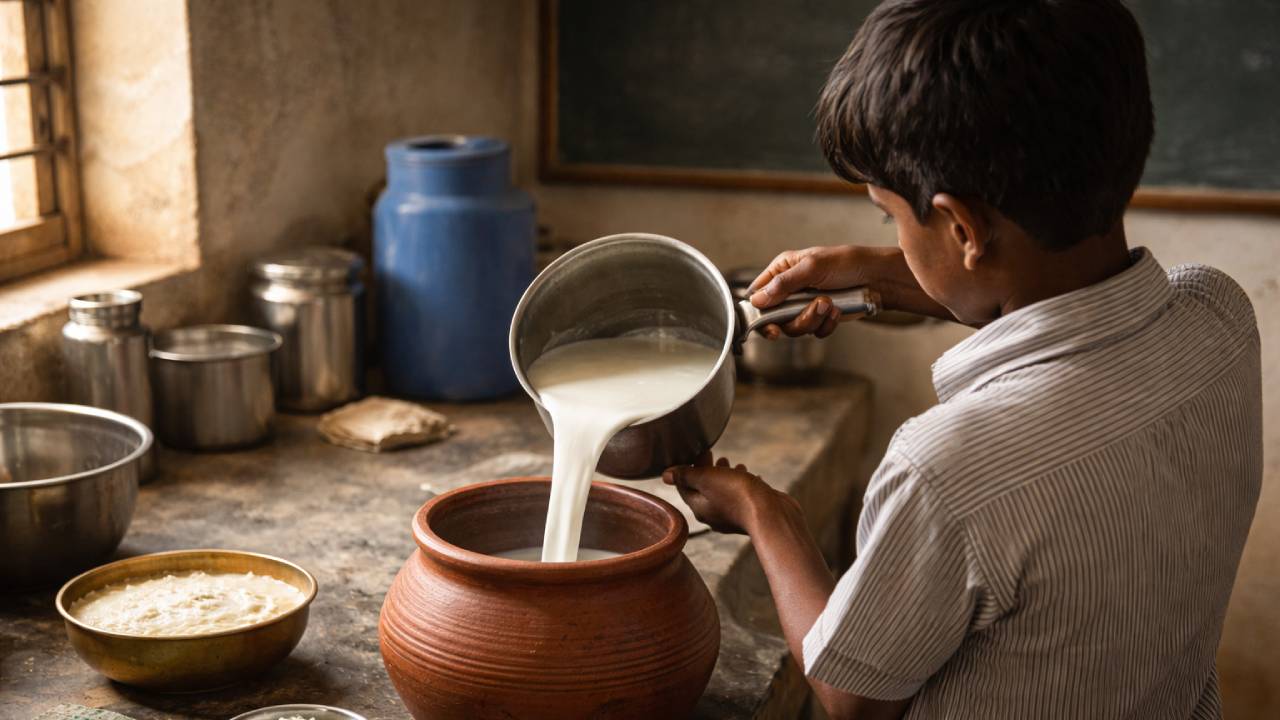
- Credits for the image (Preparing curd) used in the background of the article title: Created for i wonder… using ChatGPT, under prompting by Chitra Ravi (Dec 2025). License: CC BY-NC-ND 4.0.
- This article includes two detachable classroom resources: Activity Sheet I: How is milk different from curd? and Activity Sheet II: What causes milk to change to curd?
- Fresh milk is nearly neutral (pH ~6.5–6.7) and curd is mildly acidic (pH ~4.5–5.0). Litmus paper and some simple natural indicators (like turmeric root extract) cannot reliably show the small difference in acidity between the two liquids. Some graded natural indicators, such as extracts of red cabbage or China rose, may show that curd is more acidic than milk. But the difference can often be subtle and difficult to detect, depending on the concentration and freshness of the indicator as well as lighting conditions. pH paper, with its graded colour scale, is the most reliable classroom tool to show that curd is more acidic than milk.
References
- National Council of Educational Research and Training (2025). ‘Chapter 1: Exploring the Investigative World of Science’. Curiosity, Textbook of Science for Grade VIII: 1-7. URL: https://ncert.nic.in/textbook.php?hecu1=1-13.
- National Council of Educational Research and Training (2025). ‘Chapter 2: The Invisible Living World: Beyond Our Naked Eye’. Curiosity, Textbook of Science for Grade VIII: 8-27. URL: https://ncert.nic.in/textbook.php?hecu1=2-13.
- National Steering Committee for National Curriculum Frameworks (2023). ‘National Curriculum Framework for School Education 2023’. National Council of Educational Research and Training. URL: https://ncert.nic.in/pdf/NCFSE-2023-August_2023.pdf.
- National Council of Educational Research and Training (2017). ‘Learning Outcomes at the Elementary Stage’. National Council of Educational Research and Training. URL: https://ncert.nic.in/pdf/publication/otherpublications/tilops101.pdf.
- National Council of Educational Research and Training (2025). ‘Chapter 2: Exploring Substances: Acidic, Basic, and Neutral’. Curiosity, Textbook of Science for Grade VII: 7-22. URL: https://ncert.nic.in/textbook.php?gecu1=2-12.
- National Council of Educational Research and Training (2025). ‘Chapter 5: Changes Around Us: Physical and Chemical’. Curiosity, Textbook of Science for Grade VII: 57-72. URL: https://ncert.nic.in/textbook.php?gecu1=5-12.
- National Council of Educational Research and Training (2025). ‘Chapter 9: Life Processes in Animals’. Curiosity, Textbook of Science for Grade VII: 121-136. URL: https://ncert.nic.in/textbook.php?gecu1=9-12.
- National Council of Educational Research and Training (2025). ‘Chapter 3: Health: The Ultimate Treasure’. Curiosity, Textbook of Science for Grade VIII: 28-35. URL: https://ncert.nic.in/textbook.php?hecu1=3-13.