
When do ‘floating’ and ‘sinking’ surprise us?
In much of school science, we often rush from ‘seeing’ to ‘explaining,’ and sometimes skip the ‘seeing’ part altogether. For example, Chapter 7 (‘How Things Work’) of the Grade IV EVS textbook (NCERT, 2025-2026) suggests an investigation into floating and sinking.1 Yet, we often let memorised textbook facts and remembered childhood stories settle this investigation for us. Take the well-known fable of the thirsty crow: it finds a pitcher of water, but the level is too low for it to reach. It cleverly drops pebbles into the pitcher until the water rises high enough for it to drink.2 Because we know this story so well, conclusions like “stones sink“, “leaves float“, and “dropping objects that sink into water can raise its level” can seem so obvious that we think of them as rules.3 We assume that these rules tell us how ‘all’ objects will behave, so we see no need to actually test them.
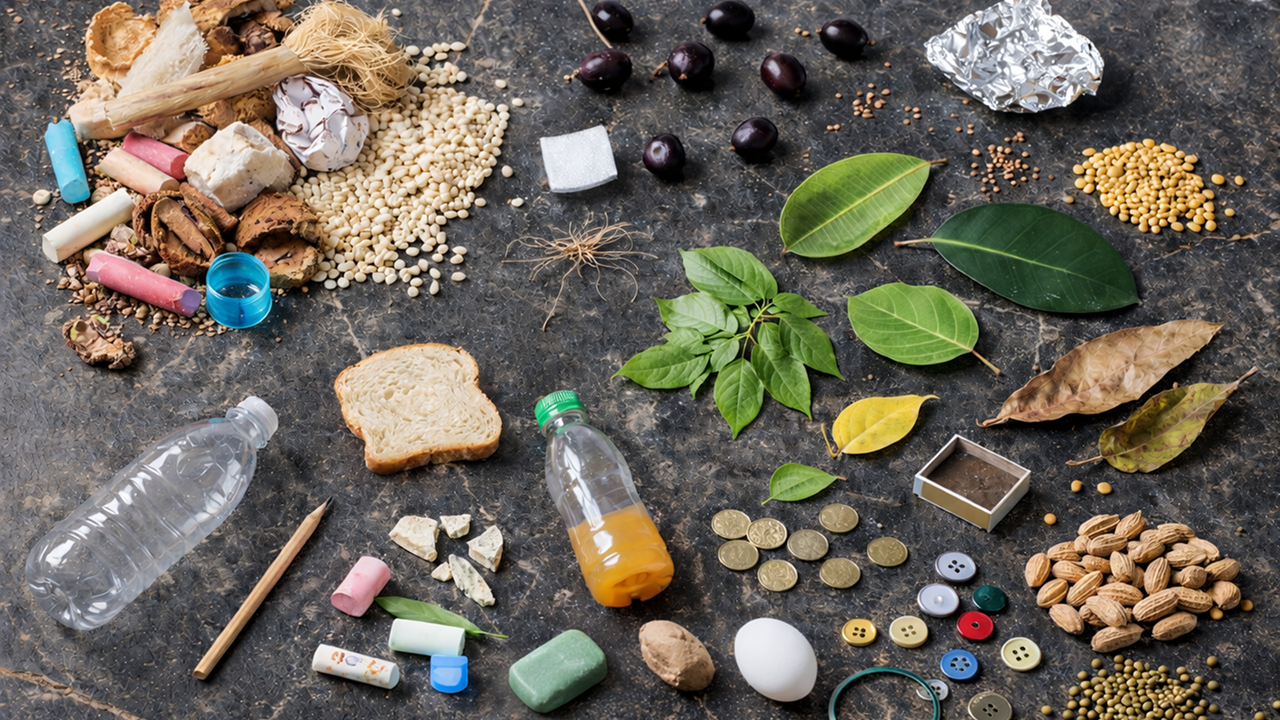
Here is a puzzle that invites you to test your assumptions. Imagine you are the crow, looking for objects that can raise the water level enough for it to be within your reach.4 Around you are many different everyday objects (see Table I). We invite you to start by predicting how these objects will behave, and then test your predictions. Use this to identify surprises and reflect on how—and why your understanding of floating and sinking changes in response. The goal here is not to be right; it is to become aware of what we notice and what we miss when we do not try things out for ourselves.
- Choose the container: The crow did not have a choice. But you do. What kind of container would make it easier for you to observe small changes in the level of water? A tall and narrow container or a short and wide one? Straight sides or sloping ones? Transparent or opaque? Which of these features matter most and why?
- Map ideas to objects: Before you look at the objects, pause and ask yourself: What must be true of an object for the crow’s method to work? List as many conditions as you can think of. Try not to name objects; instead describe properties or behaviours. For example, what shape and size would make it difficult to fit an object into the container? Does the object need to sink to the bottom of the container, or can it stay just a little below the surface? Would it need to actively push water aside or can it rest lightly on top? What if it soaks up water, breaks apart, or dissolves instead of holding its form over time? Keep in mind that labels like ‘heavy,’ ‘sinking,’ or ‘made of stone’ do not automatically answer these questions.
| A wooden stick | A piece of dry sponge | One small piece of thread |
| A piece of bread or roti | A crumpled ball of paper | Some puffed rice |
| The cap of a water bottle | Some pieces of kopra (dried coconut) | One plastic ball |
| One small wooden pencil | A biscuit | 10 metal paper clips |
| Chalk pieces | An assortment of buttons | A matchbox without matches |
| Some fresh and dry leaves | A flat piece of aluminium foil | Some ripe jamuns (the fruit) |
| One small uncapped empty cold drink bottle | A small, tightly capped cold drink bottle with some juice. | A handful of moong dhal seeds |
| A sharpener | A piece of Thermocol (polystyrene foam) | One glass bangle |
| A handful of groundnuts with shells | Some coins | Some flowers |
| A used piece of soap | A raw egg | A small lump of clay |
- Commit to predictions: Once you have listed your conditions, think about which everyday objects might best satisfy these conditions (see Table II). Without testing them yet, answer the following questions:
- Which five objects would you choose first if your aim was to raise the water level as much as possible?
- Which three objects do you feel most unsure about, but are curious to test?
- Which objects look very different from each other, but you think might behave in a similar way in water?
Notice which choices you feel confident about, and which ones are just guesses.
| S. No. | What to think about | Which objects (~2–4) from Table I might fit this? | Make a brief note on why you think so. |
|---|---|---|---|
| 1 | Shape matters: The same amount of material could behave differently if its shape changes (flat, crumpled, hollow, compact). | ||
| 2 | Trapped air: The object may carry air into the water at first, even if it later sinks or changes. | ||
| 3 | Absorption and change over time: The object may soak up water, swell, soften, or break apart. | ||
| 4 | Placement and balance: How the object is placed (gently, tilted, dropped) may affect what happens. | ||
| 5 | Same material, different behaviour: Objects that seem similar in material may not behave similarly in water. | ||
| 6 | “Feels heavy”: Objects that seem heavy enough to sink, but still surprise you in how they affect the water level. |
- Test your predictions: Gently put one object at a time into the water in your chosen container. Watch not only where the object goes in the first few seconds, but also if this changes over the next few minutes. As you test, keep asking yourself: Which predictions were correct, and which ones changed? What did I notice only after I tested my predictions? Which observations were the most surprising?
- Change the liquid: What if you replaced tap water with a different liquid? For example, can you predict what would change if you used: (a) Salt water (how much salt would you add?), (b) Sugar solution (how much sugar would you add?), (c) Fresh lemon juice, (d) Bottled fruit juice, and (e) Milk? Using the same objects, predict which liquid would show the maximum rise? Can you think of another everyday liquid that might show an even greater rise? Do you think any objects in Table I might behave differently in these liquids—if so, why? If you tested these ideas, what observations would surprise you the most?
- A boundary case to notice: Before drawing any conclusions, try this with a fresh container of water. Gently place a dry needle right on top of the water’s surface. Notice what happens. Then, place a second needle (of the same kind) on a small piece of tissue paper and lower it carefully into the water. Watch what happens as the tissue paper gets soaked and sinks. Do the two needles behave the same way? Look closely at the water under the second needle. Is it supporting the needle in the same way that it supports a floating object? What might be holding the needle up? What did the tissue paper allow you to do for the second needle that your fingers could not do for the first one? Notice how this observation does not fit neatly into our usual categories of ‘floating’ and ‘sinking’. You do not need to fully explain this ‘difference’ yet. This is just a reminder that some observations can strain our categories.
- Reflect: We often remember puzzles like this because of what surprised us. But their real value comes from what they make us think about afterward. Look back at your predictions, observations, and surprises. Then, think about:
- What mattered most in your observations: the material of the object, its size and shape, or what it did once it entered the liquid?
- Did an object always need to sink to be ‘useful’ for raising the water level? Did floating always mean it was ‘not useful’?
- If your prediction was different from what you observed, did you revise your explanation to fit what you observed? Or did you check whether your observation was affected by an error or limitation? Explain your thinking.
It is in reflecting on these questions that our observations turn into understanding.3 When we pause to examine our own predictions, hesitations, and revisions, we practice the kind of thinking we ask students to do—but rarely give ourselves time for. With your classroom in mind, consider these:
- If a student made the same predictions you did, what would they need help noticing?
- How often do we expect students to make predictions based on careful reasoning without first giving them time to try things out, observe, wait, and adjust their ideas?
Parting thoughts
This puzzle mirrors the thinking we want students to practice: predicting, observing, and revising ideas rather than relying on assumptions. By trying it ourselves, we uncover hidden details, identify surprises, and refine our reasoning—just as students need to. It helps us anticipate misconceptions, scaffold observations, and ask students questions that deepen their understanding. Rather than being separate from classroom practice, this puzzle is a rehearsal for noticing, guiding, and supporting inquiry in real student investigations.
Key takeaways
- Testing how different everyday objects behave in water for ourselves can challenge our prior assumptions about rules that determine floating and sinking. Careful observation can help us more accurately identify the underlying patterns and physical properties that shape this dynamic process.
- Changing other features, such as the shape of the container or the liquid, of such an investigation can open up new opportunities to invite students to make predictions. Testing these variations can help us recognise how the conditions of an investigation shape what we observe and the questions we ask.
- Exploring boundary cases—like balancing a needle on water—can strain our understanding of categories like floating and sinking. Such unexpected observations can become opportunities to refine our thinking.
- Pausing to examine our own observations before explaining a phenomenon can reveal details we might otherwise overlook. This can help us anticipate what students may notice, where they may struggle, and how we might support their inquiry.
Notes
- Credits for the image (Everyday objects for investigation, scattered on floor) used in the background of the article title: Created for i wonder… using ChatGPT, under prompting by Chitra Ravi (Dec 2025). License: CC BY-NC-ND 4.0.
- The order in which the authors’ names and bios appear reflects the sequence in which contributions were made to this article. The author who made the first substantial contribution is listed first, and the author who made the final contribution is listed last. Unlike in academic articles, this order does not indicate the relative amount, importance, or value of each author’s contribution.
- This digital version was last updated on Aug 17, 2026.
References
- National Council of Educational Research and Training (2025). ‘Unit 4: Things Around Us.’ Our Wondrous World, Textbook of EVS (The World Around Us) for Grade IV: 102-103. URL: https://ncert.nic.in/textbook.php?deev1=7-10.
- Yadav, Manish (2021). ‘Fun with Archimedes’ principle’. i wonder…, 6: 20-23. ISSN 2582-1636. URL: https://publications.azimpremjiuniversity. edu.in/2844/.
- Sharma, Anshika (2025). ‘Experiencing how things work’. i wonder…, 13: 39-47. ISSN 2582-1636. URL: https://publications. azimpremjiuniversity.edu.in/6328/.
- Classic Aesopica. (n.d.). ‘The crow and the pitcher’. URL: https://www.classicaesopica.com/crow-and-pitcher. Accessed on: Dec 30, 2025.