
Doing science without labs


Often, our students learn science by memorizing textbook terms and definitions for exams. They may score well in these examinations, but not connect with these concepts outside the classroom. This is because science is not a bundle of information to be memorized. It is a living and dynamic process. Unless students do science, they may not understand this process or experience the fun of working like a scientist. According to the National Curriculum Framework for School Education (NCF-SE) 2023: “The most important part of learning science is actually ‘doing science’ through hands-on experiential learning. ‘Doing science’ can range from trial and error, using materials around them, or using basic scientific instruments (measuring instruments), and laboratory apparatus. In this process, students gain conceptual understanding and develop capacities through manipulating, designing, and building experiments and demonstrations”. But how can students do science in schools with no labs? I share three ways in which teachers can address this challenge. These ideas are based on my experience of working for four years with students in upper primary government schools in Champawat, Uttarakhand.
- Creative corner
This is ideal for students of Grade III and upwards. At this stage, the main aim of teaching is to nurture curiosity in children about the world around them. Put together a variety of easily available and inexpensive materials in a box and place the box on a table in the middle of the classroom (see Table I).
| S. No. | Material | Use | Quantity |
|---|---|---|---|
| 1 | Big empty box | To store all the materials | 1 |
| 2 | Table | To place the box of materials on. If unavailable, you can keep the box of materials in any corner of the class. | 1 |
| 3 | Mats | For children to sit on. | 1 |
| 4 | Small cardboard boxes | Place these in class. Invite students to write their questions on slips of paper and drop them into these boxes. Shake the box before asking students to take out a slip and read it aloud in class. Encourage students to respond to the question. | 5 |
| 5 | Nails | To display student work on the walls of the classroom. This should be done with the help of the teacher. | 13 |
| 6 | Fevicol/Glue stick | As adhesives in construction. | 1–2 |
| 7 | Ice cream sticks | To construct many things, like a whistle. | 50 |
| 8 | Old newspapers | To make paper mache figures and shapes. | 1 kg |
| 9 | Drinking straws | To make sound and rotating toys. | 1 pack |
| 10 | Balloons | To make toys and for simple experiments. | 1 pack |
| 11 | Spool of thread | To make string telephones. | 1 per student |
| 12 | Coffee cups | To make string telephones. | 2 per student |
| 13 | Old bulbs | To make convex lenses. | 4 |
| 14 | Old CDs | To make CD hovercrafts. | 5 |
| 15 | Light emitting diodes | To light bulbs with potato batteries. | 10 |
| 16 | Copper wires | To light bulbs with potato batteries. | 1 foot |
| 17 | Zinc strips | To light bulbs with potato batteries. | 5 |
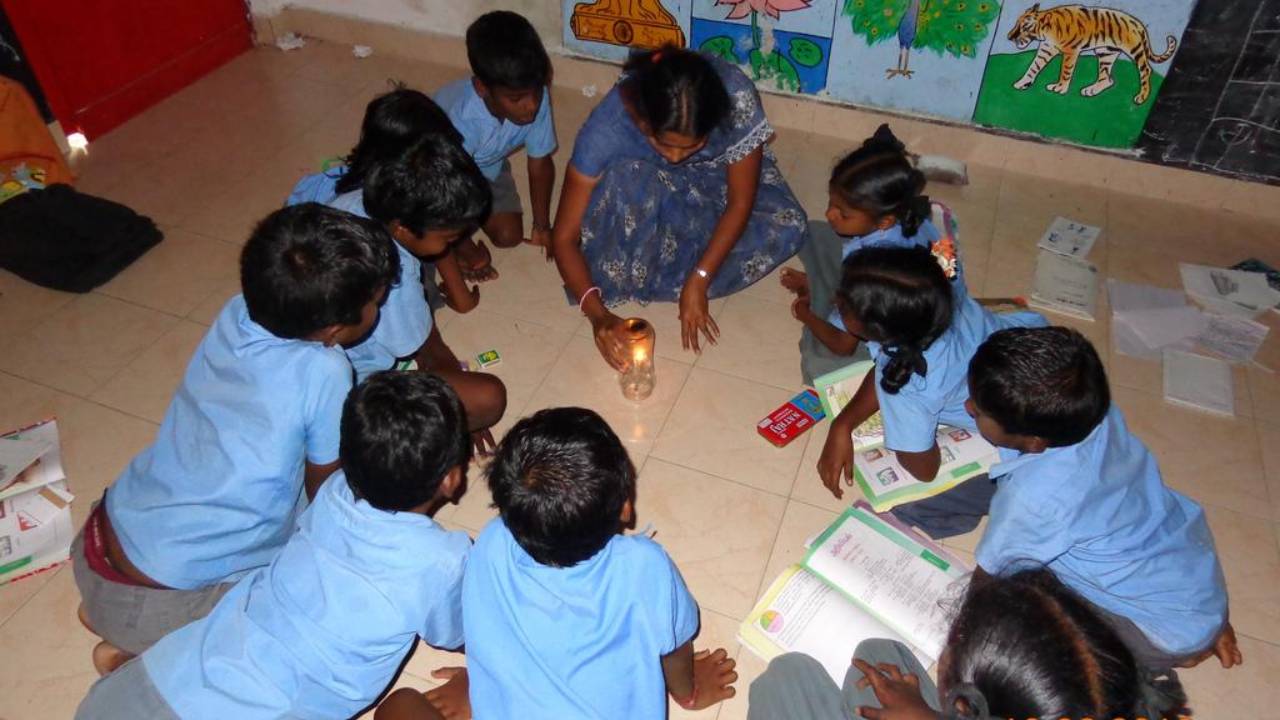
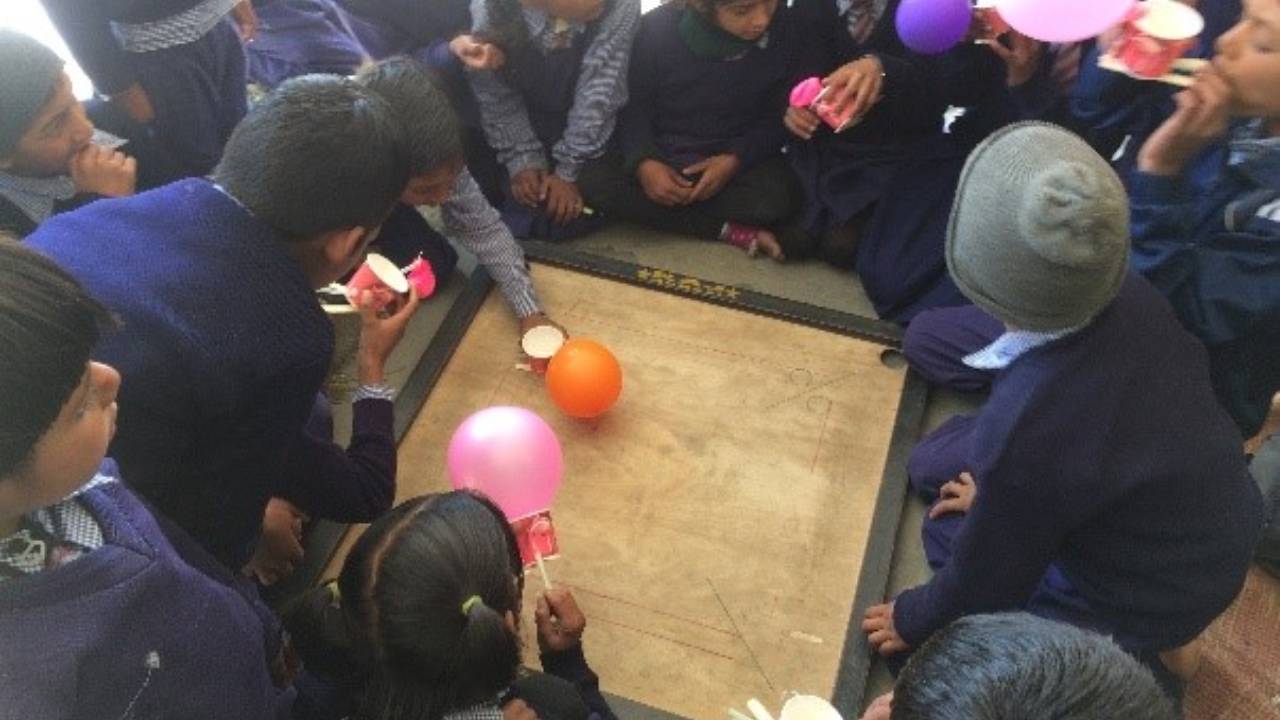
Share copies of books with ideas for simple experiments, preferably presented as pictures (see Box 1). Demonstrate some of these experiments in class. Invite your students to use the materials in the box and try out new things for themselves (see Fig. 1). Encourage group work and peer discussion.
Box 1. Recommended books for the creative corner:
- Arvind Gupta. ‘Apane Haath Ganit’. URL: https://www. arvindguptatoys.com/arvindgupta/ h-apne-hath-ganit.pdf
- Arvind Gupta. ‘Little Science: Kabaad se Jugaad’. Published by Eklavya. URL: https://www. arvindguptatoys.com/arvindgupta/ kabad-jugad-ag.pdf.
- Arvind Gupta. ‘Vigyan ka Maza’. Published by Pratham. URL: https://www.arvindguptatoys. com/arvindgupta/vigyan-maza- pratham.pdf.
- Arvind Gupta. ‘Kachre se Kamaal’. Published by Pratham. URL: https://www.arvindguptatoys. com/arvindgupta/kachre-kamal- pratham.pdf.
- Arvind Gupta. ‘The Toy Bag’. Published by Eklavya. URL: https:// www.arvindguptatoys.com/ arvindgupta/Toy_bag.pdf.
- Arvind Gupta. ‘Best of Arvind Gupta: Science Skills and Thrills’. Published by Rubin DCruz, Director, Kerala State Institute of Children’s Literature. URL: https:// www.arvindguptatoys.com/ arvindgupta/skillsthrills.pdf.

- Science corner
This is ideal for students in the middle stage (Grades VI-VIII). Make a list of materials required for the experiments listed in the textbooks for these grades. Collect as many of these materials as possible. Divide them into separate piles, with each pile being specific to experiments for a certain grade level. Put the materials from each pile into a transparent box, like the kind used to sell toffees in bulk. Label the boxes to indicate the appropriate grade level. This will make it easier for students to look for what they need. Rather than looking for a separate room to set up a lab, find a corner in your classroom which allows students the freedom to do these experiments (see Fig. 2). Preferably choose a location that can be used for this purpose for a long time. You can set up your lab by moving a table from the class to this corner.
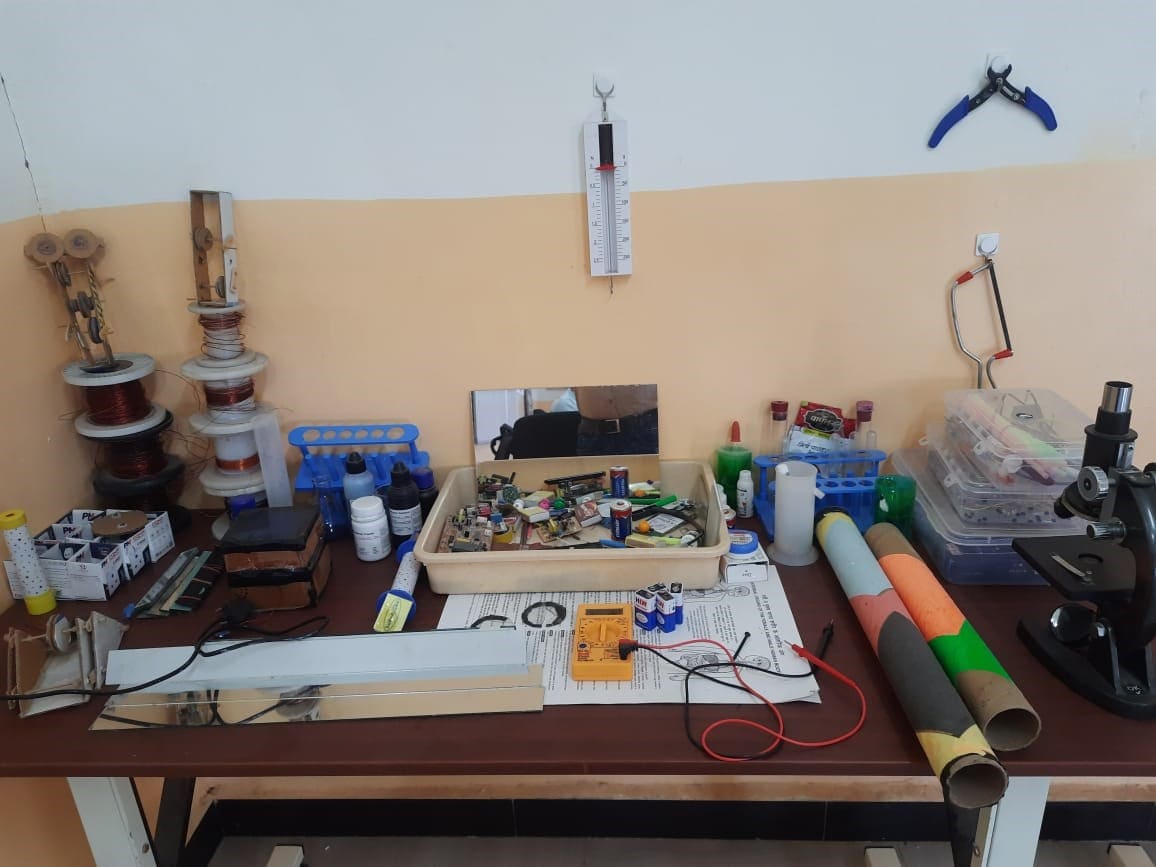
Introduce the corner and its purpose to students. Making the best use of the science corner may need a change in your teaching methods. Rather than insisting that students memorize important principles, offer them the opportunity to reach these conclusions by doing their own experiments and learning through observation, discussion, and reflection. Encourage your students to bring material from the science corner to their tables to set up their experiments. Allow them to choose if they want to work by themselves, in pairs, or in small groups. Ensure that children are given the maximum opportunity to work with these materials, ask questions, discuss with peers, and learn for themselves. Ask questions that help them think more deeply about what they are doing and seeing.
Use the last few minutes of class to help students put back any unused material in the labelled boxes. Ask your students to record and share their experiences of the experiments they do. Encourage them to present some of their work as posters. Display these posters on the walls of the classroom. These can inspire your students, give them more confidence in their ability to think for themselves, and encourage more creativity.
- Jugaad from junk
This is ideal for students in middle school and upwards. I am using the word ‘jugaad‘ to refer to innovation and the word ‘junk’ to refer to the many things that are discarded from our homes and schools. Choose a room in the school that your students can visit without hesitation. In one corner of the room, stock tools and materials like screwdrivers, hammers, springs, pulleys, radio making kits, old mobile phones, discarded radio and television sets, old wires, fused bulbs, old cells, etc. Encourage students to add to this stock any discarded materials from their homes and neighborhoods that are of interest to them.
It is important that this space be seen as an opportunity to nurture students’ natural curiosity and help them take their bookish knowledge forward based on their own experiences. Allow them the freedom to touch and disassemble junk as well as build and experiment with the assembly of their own models. Working with discarded materials will give students the confidence to manipulate materials in different ways, even if some of the models they build do not work. In addition to inspiring the spirit of innovation, such a space can help expand environmental awareness as students begin to discover for themselves the many ways in which ‘waste’ can be reused.
Parting thoughts
Teachers play a vital role in such ‘lab’ spaces:
- Students are drawn to these spaces by their curiosity. Teachers can inspire this by creating a learning environment where students ask a lot of questions about what they see and do in class. Rather than provide answers, encourage students to find these out for themselves.
- Students learn through practical experiences. Teachers can encourage this kind of learning by offering many opportunities for construction and experimentation. Allowing your students to observe and understand the concepts and mechanisms underlying their models and experiments gives them a natural sense of what it means to be a scientist.
- Students learn by communicating what they think and do. Teachers can invite them to present their work to their peers or the other children in school. Morning assemblies can be useful spaces for such presentations. For example, I saw two middle grade students show how they had made a drone from junk. Since it was fitted with a light motor, this model could fly to some height above the ground. In another instance, I saw two Grade V students demonstrate how they had constructed a scooter model with a paper cup. I have often seen younger children being given the chance to perform stories from their textbooks with puppets they had made themselves. Giving your students such opportunities can often increase their confidence in their own creativity.
While the teachers I worked with did not always find it easy to create and maintain such ‘lab’ spaces, the presence of such spaces in their schools have had many advantages. Initially, children would use the materials provided to them, wait to work with their teachers, and would need their teachers to be present for the entire process of experimentation or construction. But this changed over time. Students started bringing broken equipment from their own homes in the hope of investigating them or reusing their parts. They began to express interest in working on their own projects, like building a whistle or kaleidoscope (a tube with coloured glass pieces that displays colorful scenes when rotated). Sometimes, students would come up with ideas for projects that were not possible to do with the materials available to them. If this happened frequently, their teacher and I would plan a meeting with the students. These meetings were arranged after regular school hours. We would start each meeting by discussing what students wanted to make and what they would need for it.
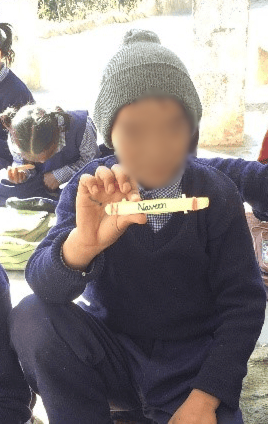
Their teacher and I would list the materials they needed on the black board and highlight materials that were unavailable in school. We would then explore and suggest sources from which these materials could be procured with minimal or no cost. Through these experiences, we discovered that most materials needed to make new things could be found in old things. This exercise encouraged students to think more creatively about materials in their own environment. Making such creative spaces in school led to changes outside science too. For example, young children often wanted to write their names on the models they had constructed. Students who did not know how to write asked their teachers for help. After a few months of observing how their teachers wrote their names, these students started doing so themselves (see Fig. 3).
Many teachers noticed the eagerness with which children sought out these spaces as soon as they arrived at school. Other teachers reported more regular attendance from children who routinely absented themselves from school. Many of these children expressed a sense of anticipation and excitement for what they would get to do in these creative spaces. Some teachers spoke of how the freedom given to children to choose and do things on their own helped them cultivate a sense of responsibility. Overall, such ‘lab’ spaces can open countless opportunities for student learning—what you do with it is a matter of choice.
Key takeaways
- Unless students ‘do’ science, they may not understand its process or experience the fun of thinking and working like a scientist.
- Science teachers from schools with no labs can use inexpensive, locally available, or discarded materials to create and maintain grade-appropriate experiential learning spaces for their students. Rather than use an entire room, such spaces can be built in a corner of the classroom.
- To make the most effective use of such spaces, science teachers may need to try teaching methods that inspire curiosity and encourage practical experience. They may also need to give their students the opportunity to present their work to their peers and other children in school.
Acknowledgements
The editors thank Saurav Shome from Azim Premji University, Bhopal, for sharing this draft and facilitating its review and design.
Notes
- Note: This image is from a real classroom and is published here with permission from the guardians of the children in the photo. Note: Please see Publication Terms here for details on the reuse of this image. Credits for the image used in the background of the article title: Hands-on Learning Spaces, Satish Bhaskar. Credits for the image used in the background of the article title: Hands-on Learning Spaces, Satish Bhaskar. License: CC BY-NC-ND 4.0.