

Exploring the Sun’s path with Stellarium



Systematic observations of patterns in the apparent motion of heavenly bodies across our sky have played an important role in shaping our concept of time, our sense of direction, and how we navigate the globe. The preparatory-stage Environmental Studies (EVS) and middle-stage science curricula encourage students to observe some of these patterns themselves (see Teacher’s Guide I). But making these observations in the real world can be a slow (taking as long as a year) and imprecise process. Observations from one location may not capture differences caused due to the Earth’s tilt and rotation. Also, making such observations may not be practical in all contexts.
For these reasons, virtual planetarium software can be good substitutes to real-world observations. Chapter 12 of the Grade VI science textbook (NCERT, 2024-2025) suggests that: “To find out when and in which portion of the sky a star or a constellation will be visible from your location, you may take the help of sky mapping apps that can be downloaded on a mobile phone or other online resources. Sky Map is a very handy app for identification of stars, constellations, and planets from mobile phones. Stellarium is another such app. The computer version of Stellarium is free for download and has many features”.1 This is one application of Stellarium (see Box 1). Teachers can also use this interactive and visually engaging educational tool in the classroom to help students investigate many patterns in the sky (see Teacher’s Guide II). I share some examples.
Box 1. About Stellarium:
Stellarium can be downloaded for free from www.stellarium. org. Students can use this software in the classroom to see the position of celestial objects (including deep-sky objects like galaxies and star clusters) on any date and at any time. They can zoom into or out of an object, change their location of observation to any place on the Earth, move forward or back in time, see the sky without the Earth’s atmosphere, and switch on or off a feature that provides labels and boundaries for constellations. These features are easy to locate on the software and are also outlined in the user’s guide that comes along with it.
Rising and setting positions of the Sun
Students learn that, when seen from any location on Earth, the Sun appears to rise in the east and set in the west. For example, Chapter 10 (‘Walls Tell Stories’) of the Grade V EVS textbook (NCERT, 2024-2025) asks students: “Where is east-west? At the place where you are, where does the Sun rise? Where does it set? Where you are standing, find out what all is there to your east? What all is there to your west? Also, find out what places are there to your north and south?”.2 But does the Sun always rise exactly due East? Does it always set exactly due West? Do the rising and setting positions of the Sun remain the same throughout the year? Would we see any difference in these positions if we were to view them from a different latitude? Invite students to investigate these questions using Stellarium (see Activity Sheet I).
By the end of this activity, students will observe that the position of the rising Sun, for example, drifts in the following cyclical manner:
- March 21 (± 1 day): The Sun rises exactly due East.
- From March 22-June 20: The rising Sun drifts towards the north of East.
- June 21 (± 1 day): The rising Sun reaches maximum north of East.
- From June 21-September 21: The rising Sun starts drifting towards the South.
- September 22 (± 1 day): Again, the Sun rises exactly due East.
- From September 23-December 21: The rising Sun continues to drift towards south of East.
- December 22 (± 1 day): The rising Sun reaches its maximum south of East.
- From December 23-March 20: The rising Sun starts drifting towards the North.
Discussion around these observations can highlight the following:
- On most days of the year, the Sun rises somewhere along the eastern horizon and sets somewhere in the west. Neither does it always rise due East nor does it always set due West.
- The Sun rises due East and sets due West only twice a year. These two days can be introduced as the ‘Vernal Equinox’ or ‘Vasantha Sampath‘ (March 21 ± 1 day) and ‘Autumnal Equinox‘ or ‘Sharat Sampath‘ (September 22 ± 1 day). ‘Equinox’ loosely translates into ‘equal day and night’.
- The centuries-old calendar system in India divides the year into two halves. The six-month period between December and June, when the rising (and setting) position of the Sun moves from the south to the north, is called ‘Uttarayana‘ (‘uttara‘: north and ‘ayana‘: journey) or its ‘northward’ journey. The other six-month period, between June and December, when the rising (and setting) position of the Sun drifts from the north to the south, is called ‘Dakshinayana‘ or its ‘southward’ journey.
These questions can be shared with students for further exploration:
- How would this pattern change if observed from a location at a different latitude? Students can investigate this by using the ‘Location Window’ on Stellarium to view the position of sunrises and sunsets from 1-2 other locations (chosen from both the Northern and Southern Hemispheres) of their choice. This can be used to highlight the fact that the shift in the Sun’s rising and setting points over a year is the same in both the Northern and Southern Hemispheres.
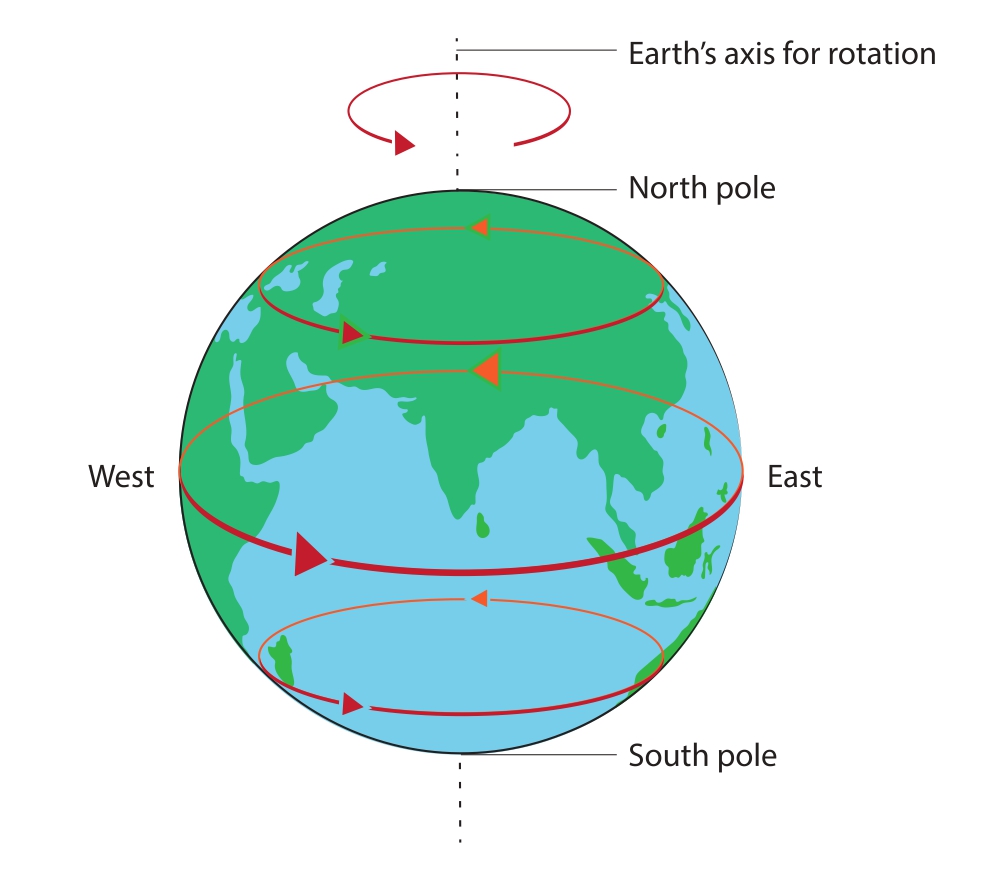
- Do stars other than the Sun also appear to rise from the east and set in the west? Students can observe the apparent movement (fast-forwarded in time) of stars (other than the Sun) in the sky by increasing the time speed from the bottom control panel. Discussions around their observations from this exercise can be used to highlight that all stars (like the Sun) appear to rise in the east and set in the west because the Earth’s spin is oriented from west to east on its axis (see Fig. 1). This means that if the Earth were to be viewed from above the North Pole, it would show counterclockwise rotation (also called prograde rotation).
Length of day and night
Students learn that the rising and setting times of the Sun determine the duration of day and night at any location and at any time of the year. For example, Chapter 9 (‘Motion and Time’) of the Grade VII science textbook (NCERT, 2024-2025) tells students that: “Our ancestors noticed that many events in nature repeat themselves after definite intervals of time. For example, they found that the Sun rises every day in the morning. The time between one sunrise and the next was called a day… A year was fixed as the time taken by the Earth to complete one revolution of the Sun”.3 But is the length of day equal to that of night at any time of the year? Does the duration of day (or night) at their location remain the same throughout the year? Does it change at different latitudes? Invite students to investigate these questions using Stellarium (see Activity Sheet II).
By the end of this activity, students will observe that:
- For locations along the equator, the duration of day and night is roughly equal and does not vary much over the course of a year.
- For locations away from the Equator, day and night are of near equal duration on two days of the year: On March 21 ± 1 day (or Vernal Equinox in the Northern Hemisphere and Autumnal Equinox in the Southern Hemisphere) and on September 22 ± 1 day (or Autumnal Equinox in the Northern Hemisphere and Vernal Equinox in the Southern Hemisphere).
- For locations in the Northern Hemisphere, the duration of day increases from December-June (the Uttarayana phase) and decreases from June-December (the Dakshinayana phase). The longest day of the year in this hemisphere typically occurs on June 21 ± 1 a day (called ‘Summer Solstice’). The duration of night proportionately decreases from December-June and increases from June-December. The longest night of the year in this hemisphere typically occurs on December 22 ± 1 day (called ‘Winter Solstice’).
- For locations in the Southern Hemisphere, the duration of day decreases from December-June and increases from June-December. The longest day of the year in this hemisphere typically occurs on December 22 ± 1 day (or Summer Solstice). The duration of night proportionately increases from December-June and decreases from June-December. The longest night of the year in this hemisphere typically occurs on June 21 ± 1 day (or Winter Solstice).
- The seasons are opposite in the two hemispheres. For example, in December, when the Sun completes its Dakshinayana journey, it is winter in the Northern Hemisphere, but summer in the Southern Hemisphere. In June, when Uttarayana is about to end, it is summer in the Northern Hemisphere and winter in the Southern Hemisphere.
- At both geographic poles, a day (called ‘Polar Day’) lasts for six months (of continuous sunlight) and is followed by a night (called ‘Polar Night’) that lasts for six months (of continuous darkness). When it is day in the North Pole, it is night in the South Pole, and vice versa.
The daily period of the Earth
The length of the Earth’s daily day-night cycle is the time it takes to complete one 360° rotation about its own axis. How do we know when this occurs? By observing the Earth’s spin relative to another celestial object. This object could be the Sun or any other star. The period of the Earth can be calculated by measuring how long it takes for it to return to its original position in relation to this reference point. Chapter 12 (‘Beyond Earth’) of the Grade VI science textbook (NCERT, 2024-2025) tells students that: “While revolving around the Sun, the Earth is also rotating about its own axis. For one full rotation, the Earth takes about 24 hours, which is called a day”.1 This value is based on the apparent daily motion of the Sun in the sky. Viewed from the Earth, the Sun appears to take 24 hours to complete a full circle around it. But is this period exactly or approximately 24 hours? Would it be the same if we chose a different star as our reference? Invite your students to explore these questions using Stellarium (see Activity Sheet III). For this exercise, students will need to measure how long it takes for the Sun to reappear at the same altitude in the sky (see Box 2).
By the end of this activity, students will observe that:
- It takes 24 hours for our point of observation on the Earth to return to the same position in relation to the Sun. This duration is called a ‘Solar Day’. Since our everyday activities are tightly linked to the rising and setting of the Sun, all the clocks we use are based on solar time.
- It takes 23 hours and 56 minutes for our point of observation on the Earth to return to the same position in relation to any star other than the Sun. This duration of time is called a ‘Sidereal Day’ (‘Sidereal’ is derived from a term in Latin that means ‘in relation to stars’). Because of their interest in objects beyond the Sun that become visible during the night, astronomers often use sidereal time.
Discussions around this difference can be explained by sharing the following: The Earth takes 365 days to complete 360° around the Sun. This means that the Earth moves a little less than a degree in the time it takes to complete a rotation around its own axis. To return to its exact position in relation to the Sun, it needs to rotate by an additional amount, equal to 1/365 of a full turn. The Earth takes four minutes to cover this distance. This is why a solar day is longer than a sidereal day.
Box 2. Calculating altitude on Stellarium:
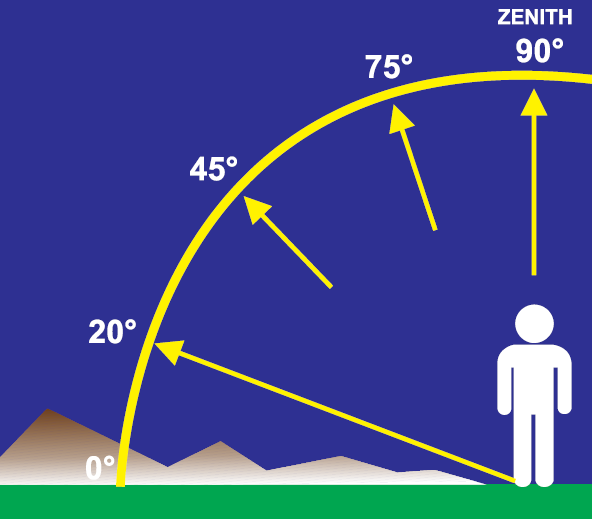
Altitude is a measure of how high or how low an object is with reference to our horizon. A star that is just rising from the eastern horizon has an altitude of 0°. A star that is just setting in the western horizon also has an altitude of 0°. A star that is directly above our head (called the ‘Zenith Point’) is at an altitude of 90°. A star that has crossed the zenith has an altitude less than 90°. (see Fig. 2). Just as an hour is divided into sixty minutes and a minute is divided into sixty seconds, angles that span less than a degree are divided into minutes and seconds. 1 minute is 1/60th of a degree and one second is 1/60th of a minute. Instead of writing angles in decimal notation, it is common to express them in minutes and seconds. Thus, 45.5° is also written as 45 degrees 30 minutes (or 45°30’). Similarly, 60.73° is also written as 60 degrees 43 minutes 48 seconds (or 60°43’48’’).
Box 3. Curricular connections:
These activities and discussions can help meet the following curricular goals outlined in the National Curriculum Framework for School Education (NCF-SE) 2023 for:
- Preparatory-stage EVS:
- CG-1: [The student] explores and engages with the natural and socio-cultural environment in their surroundings. Specifically, it can support students in developing the following competencies: (a) C-1.1: “Observe and identify the natural (… sun and moon, stars, planets…) and social components in their immediate environment”, and (b) C-1.3: “Ask questions and make predictions about simple patterns (season change…phases of the moon, movement of stars and planets…) observed in the immediate environment”.4
- Middle-stage science:
- CG-2: [The student] explores the physical world in scientific and mathematical terms. Specifically, it can support students in developing the following competency: C-2.5: “Observe and identify celestial objects (stars… )… using a simple telescope and images/ photographs, and explain their role in navigation, calendars, and other phenomena (…life on the Earth)”.4
- CG-6: [The student] explores the nature and processes of science through engaging with the evolution of scientific knowledge and conducting scientific inquiry. Specifically, it can support students in developing the following competency: C-6.2: “Formulate questions using scientific terminology (to identify possible causes for an event, patterns, or behaviour of objects) and collect data as evidence (through observation of the natural environment, design of simple experiments…)”.4
Parting thoughts
Stellarium allows students to simulate real-world observations of the movement of the Earth in relation to the Sun over a year from different latitudes, while sitting in their classroom. It can also help students appreciate the role these observations have played in shaping our concepts of time and direction (see Box 3).
The activities shared in this article are only a small handful of the exercises that can be simulated on Stellarium. As your students and you become more familiar with the interactive features that this software offers, you will be able to write your own exercises to explore other patterns and movements in our changing sky.
Key takeaways

- Tracking the apparent movement of the Sun and other stars across our sky can help students appreciate their role in shaping our concept of time and direction.
- Student explorations of the patterns that shape these concepts through real-world observations can be slow, limited, and imprecise.
- Using free virtual planetarium software, like Stellarium, as a teaching tool in the classroom allows students to inquire into and observe how these patterns change during a year and across different latitudes.
Notes
- Credits for the image (Sundial) used in the background of the article title: CarolinaP (pixabay.com). URL: https://www.needpix.com/photo/558618/sun-dial-tarragona-tourist-traditional-solar-ancient-watch-clock-day. License: Public Domain.
- This article was first published in i wonder…, November 2015, pp. 105-109. The original draft can be found here: https://publications.azimpremjiuniversity.edu.in/1246/. The version included in this issue has been reviewed and modified in structure and wording to align with our readership of middle-stage science and preparatory-stage EVS teachers. It includes new material.
- This article includes five detachable classroom resources: Teacher’s Guide I: Tracking the Sun, Teacher’s Guide II: Using Stellarium on a Computer, Activity Sheet I: Track the Sun’s Rising & Setting Positions, Activity Sheet II: Track the Length of Day, and Activity Sheet III: Find the Length of the Day-Night Cycle.
References
- National Council of Educational Research and Training (2024). ‘Chapter 12: Beyond Earth’. Science Textbook for Grade VI: 231-252. URL: https://ncert.nic.in/textbook.php?fecu1=12-12.
- National Council of Educational Research and Training (2024). ‘Chapter 10: Walls Tell Stories’. EVS Textbook for Grade V: 87-98. URL: https://ncert.nic.in/textbook.php?eeap1=10-22.
- National Council of Educational Research and Training (2024). ‘Chapter 9: Motion and Time’. Science Textbook for Grade VII: 92-108. URL: https://ncert.nic.in/textbook.php?gesc1=9-13.
- National Steering Committee for National Curriculum Frameworks (2023). ‘National Curriculum Framework for School Education 2023’. National Council of Educational Research and Training. URL: https://ncert.nic.in/pdf/NCFSE-2023-August_2023.pdf.